If You Invest $10,000 in Palantir Today, Here’s What It Could Be Worth by 2030
Palantir just posted its ninth straight earnings beat and triple-digit revenue growth, but its valuation sits at levels that make even bulls nervous. Here is what five years of holding the stock could realistically do to a $10,000 position.

This post may contain links from our sponsors and affiliates, and Flywheel Publishing may receive compensation for actions taken through them.

Palantir (NASDAQ:PLTR | PLTR Price Prediction) closed at $189.67 in its latest session. If you put $10,000 into the stock today, what could it be worth by 2030?
The company just reported revenue growth of 92.8% year over year and its ninth straight EPS beat, so the long-range numbers are worth a close look.

Your $10,000 Could Reach About $13,583 in the Base Case
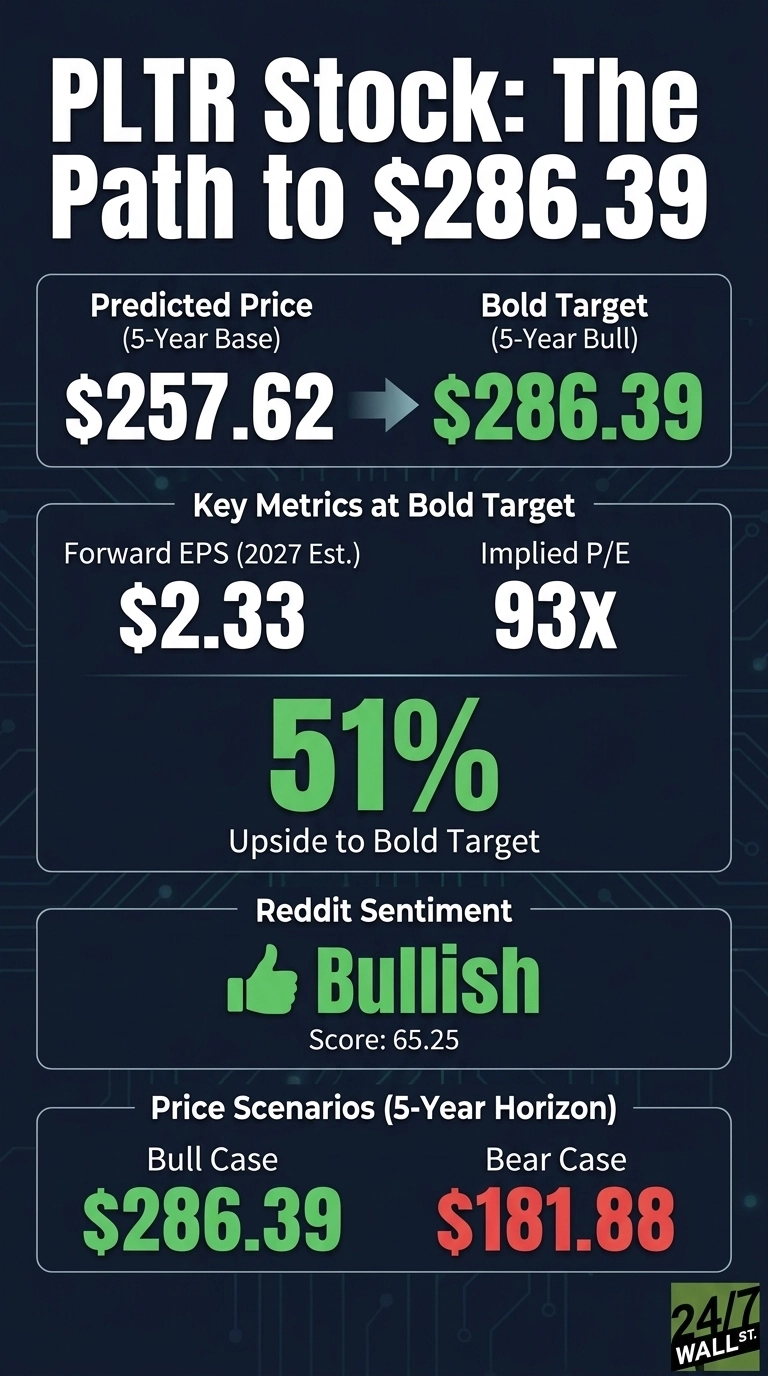
The price model’s five-year horizon ends on September 26, 2031. That is the projected horizon closest to 2030. Measured to that date, a $10,000 investment in Palantir could reach about $13,583, a total return of 35.83%. Its central scenario assumes a per-share target of $257.62, which equals an annualized return of 6.32%.
The model also has a point at the end of 2030, on December 26, 2030. There, the central price estimate is $244.71, which would turn $10,000 into roughly $12,901.88.
That 2030 figure is only illustrative because it sits partway along the projected path. The scenario figures below all use the five-year horizon. Looking just 12 months out, the central target is $204.58, or 7.86% upside.
Bull, Base, and Bear Outcomes for a $10,000 Stake
| Scenario | Five-Year Target Price | Total Return | Ending Value of $10,000 |
|---|---|---|---|
| Bull | $286.39 | 51% | $15,100 |
| Base | $257.62 | 35.83% | $13,583 |
| Bear | $181.88 | -4.11% | $9,589 |
Here is where each scenario stands at the illustrative 2030 year-end point:
- Bull: $268.76 per share, or about $14,169.87 for the position
- Base: $244.71 per share, or about $12,901.88
- Bear: $172.32 per share, or about $9,085.25
The average analyst price target is $195.57. Ratings break down as 1 strong buy, 20 buy, 9 hold, 1 sell, and 1 strong sell, so 66% of analysts are bullish. The model’s confidence is 0.9 on a scale of 0 to 1, and its adjustment factor is rated high confidence.

Three Growth Engines Powering the Upside Case
AI Sovereignty Demand
Second-quarter revenue was $1.935B. GAAP operating income was $912M, a 47% margin, and the Rule of 40 score reached 155%. (The Rule of 40 adds revenue growth to profit margin, and 40% is a strong result.)
CEO Alex Karp said “Demand for AI sovereignty has now been unleashed” and added that “the sovereign AI revolution makes us very optimistic about the future.”
U.S. Commercial Acceleration
U.S. commercial revenue rose to $764M (+149% YoY). Remaining deal value reached $6.238B, up 124% YoY, and the company closed 73 deals worth more than $10M in the quarter. Management expects full-year U.S. commercial revenue above $3.424B.
Government Franchise and Rising Estimates
U.S. government revenue grew to $809M (+90% YoY). Management raised full-year revenue guidance to between $8.150B and $8.158B and expects adjusted free cash flow of $4.5B to $4.7B.
Analysts have been raising their numbers. For fiscal 2027 EPS, there were 26 up revisions and 0 down revisions over the past 30 days, and the consensus now stands at $2.3267.
Risks That Could Shrink Your Stake
The biggest risk is valuation. Palantir trades at roughly 268 times trailing earnings, 93x forward earnings, and about 207 times free cash flow. At those multiples, even a modest slowdown in growth could send the stock lower.
The bear case shows that result: your $10,000 would shrink to $9,589 over five years. The stock has swung hard before. It traded at $187.75 in December and $133.02 in February. Its beta of 1.62 means it tends to move more than the broader market.
The company also flags its own risks. Stock-based compensation was $265M in the second quarter. Sales cycles are long and hard to forecast. Some government contracts can be ended at the customer’s discretion (termination-for-convenience clauses). Revenue is concentrated in the U.S., and results are exposed to macro, geopolitical, and AI platform risks.
What $10,000 Could Mean for Your Portfolio
Over the five-year horizon, the model places a $10,000 Palantir position between $9,589 and $15,100, and a central estimate of $13,583. Each figure is a projected scenario, and none is guaranteed.
Keep an eye on U.S. commercial growth and margins in upcoming earnings reports, since those will show which path the stock is following. Palantir shares many of the traits early winners had before their huge runs, the ones we cataloged in a free playbook here. It is a projection, not investment advice.
Contact [email protected] for any questions or corrections.
Vandita Jadeja is a financial publisher with over a decade of experience writing about financial topics, including investment, savings, retirement, insurance and banking. Vandita is a Chartered Accountant who loves to debunk financial concepts for readers.
Her work has appeared on sites that include The Motley Fool, InvestorPlace, and Benzinga. She covers investing and focuses on stock picks and price prediction for 24/7 Wall St.
When not looking for the next stock investment opportunity, she can be found traveling, reading, chasing sunsets and enjoying her iced latte.