AMD Spikes 4% as Citi Lifts Target to $800 and Stifel Goes to $700; NVIDIA Ticks Up, Intel Slips
Citi and Stifel raised their AMD price targets for completely different reasons, yet the stock jumped while a chipmaker they both named as a beneficiary sold off. That contradiction is the real story behind today's rally.

This post may contain links from our sponsors and affiliates, and Flywheel Publishing may receive compensation for actions taken through them.
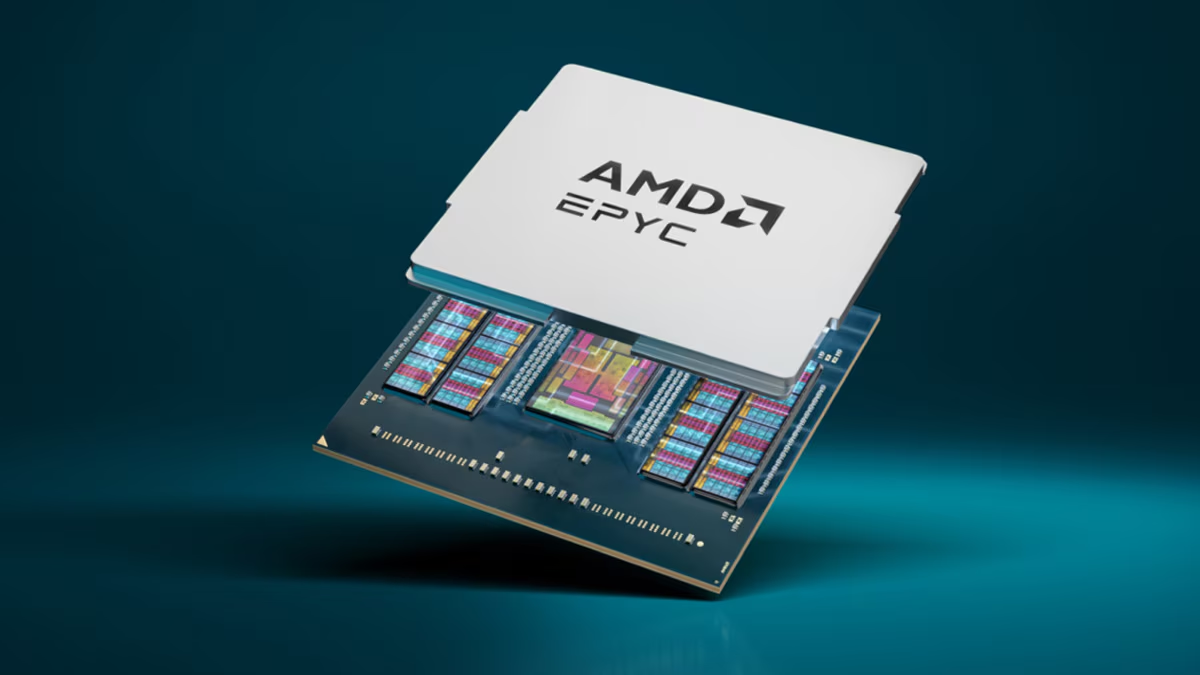
Two Wall Street price target raises built on separate arguments are lifting Advanced Micro Devices (NASDAQ:AMD | AMD Price Prediction) stock, and the market is treating the bullish case as one that belongs to AMD alone. Advanced Micro Devices stock is up 4% to $657.50 in late morning trading, with Citi and Stifel both raising their price targets.
Meanwhile, NVIDIA (NASDAQ:NVDA) stock is up 1% to $241.92, a sign that traders see room for the accelerator leader inside the same demand story. Intel (NASDAQ:INTC) stock is heading the other way, down 2% to $114.35. That split between two of AMD’s closest rivals sets up the most revealing question behind the rally.
Broader gauges for chips and large-cap tech are firmer as well, though by a far smaller margin than AMD stock. Thus, the iShares Semiconductor ETF (NASDAQ:SOXX) is rising 0.9% while the Invesco QQQ Trust (NASDAQ:QQQ) is up 0.85%.
Citi and Stifel Raise AMD Targets for Different Reasons
Citi analyst Atif Malik raised his price target on AMD stock to $800, arguing that the chipmaker will be the primary beneficiary of a renaissance in server processor demand following the release of Meta Platforms‘ (NASDAQ:META) personal artificial intelligence (AI) agent. Malik named Intel a secondary beneficiary and described agentic AI as a potential orders-of-magnitude driver of compute demand compared with traditional chatbots.

Stifel analyst Ruben Roy separately raised his price target on AMD stock to $700 ahead of the company’s third-quarter 2026 results, expecting strength led by server processors. Roy’s view is that AMD’s longer-term commentary may draw more attention than the quarter itself. Whether AMD management puts figures behind its data center framework for next year is the question Roy has flagged as most important.

Why Intel Slips While NVIDIA Edges Higher
AMD sells both server processors and AI accelerators, so a broadening of compute demand reaches two of its product lines at once. NVIDIA dominates the accelerator market AMD is attacking, while Intel competes directly with AMD on server processors. That overlap explains why a thesis built on processor demand lands differently on each of the three chipmakers.
Selling in Intel stock is the detail worth holding onto, since Malik named Intel a secondary beneficiary of that same processor trend. Weakness in Intel shares alongside such bullish processor commentary suggests the market sees the Citi thesis as specific to AMD.
Gains in NVIDIA stock point in a different direction for the accelerator side of the trade. Traders appear to read a larger processor market as compatible with strong accelerator demand, the segment NVIDIA dominates.
What to Watch Next
The next scheduled test for AMD is its third-quarter report, where management can decide whether to attach figures to the company’s longer-term data center framework. Both Malik’s $800 target and Roy’s $700 target for AMD stock lean on that longer-term view of the company’s data center business. Shareholders can watch for whether AMD backs the Citi agentic AI thesis with its own read on server processor demand.
A demand wave reaching both of AMD’s core data center product lines forms the bull case for the stock (we reverse-engineered what the earliest signs of the next monster chip winner look like in a free playbook here). However, AMD stock now carries expectations tied to figures management hasn’t yet supplied, and the slide in Intel shares shows how quickly the market can separate winners from laggards in a single processor story.
Contact [email protected] for any questions or corrections.
David Moadel is financial writer specializing in stocks, ETFs, options, precious metals, and Bitcoin. David has written well over 1,000 articles for leading online publications, helping investors understand markets, income strategies, and risk.His work has appeared in The Motley Fool, InvestorPlace, U.S. News & World Report, TipRanks, ValueWalk, Benzinga, Market Realist, TalkMarkets, Finmasters, 24/7 Wall St., and others.With a master’s degree in education, David has taught at the elementary, high school, and college levels. That teaching background shapes his writing style: clear, educational, and practical. David has also built a loyal social-media audience by providing trustworthy financial content on YouTube, X/Twitter, and StockTwits.