Western Digital Fell Nearly 20% Over The Last 3 Months: A Respected Wall Street Analyst Says 140% To Come
Western Digital shares sit nearly 45% below their peak while analyst estimates keep climbing, leaving investors to decide whether a supply scare just created a rare buying opportunity or a warning sign the bull story is cracking.

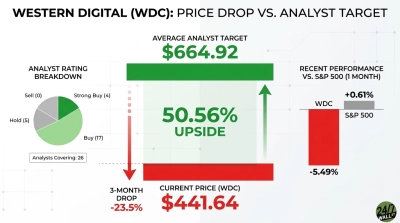
Western Digital (NASDAQ:WDC | WDC Price Prediction) currently trades at $441.64, while Wall Street’s average price target stands at $664.92. That gap implies 50.56% upside.
Western Digital became a pure-play hard disk drive maker after spinning off its flash business into Sandisk (NASDAQ:SNDK). CEO Irving Tan notes “roughly 80% of data stored in a hyperscale data center resides on hard disk drives.”
The gap stands out because the business keeps getting better. One analyst sees even more room than the consensus does. Ben Reitzes at Melius Research holds a Street-high $1,050.00 target, which implies 137.75% upside.
Toshiba Supply Scare Deepens a 44% Slide From the Peak
A Nikkei Asia report that Toshiba aims to boost hard disk drive supply triggered sharp selling. Western Digital and Seagate Technology (NASDAQ:STX) each dropped 10% in one session. HDD pricing power depends on tight supply, so a rival adding capacity threatens the “high teens” per-terabyte price increases Western Digital reported last quarter.
Shares fell 23.5% over three months and now sit 44.77% below the 52-week high of $799.62. The stock traded at $553.20 when the company beat fiscal fourth-quarter estimates, so most of the decline came after strong results.
This weakness goes mostly to Western Digital. Over the same three months, Seagate rose 2.17% and Micron Technology (NASDAQ:MU) gained 8.04%. With a beta of 2.182, Western Digital moves harder than the market in both directions.
Analysts Keep Raising Estimates While the Shares Slide
Execution supports the bullish argument. Fiscal fourth-quarter revenue rose 43.8% to $3.75B. EPS of $3.56 beat the $3.29 consensus, the 5th consecutive EPS beat. Gross margin reached 54.4%, and guidance calls for 55%-56% next quarter on EPS of $4.00.
Fiscal 2027 consensus EPS rose to $20.0914 from $17.2540 90 days ago, with 16 upward revisions and zero downward revisions over 30 days. Shares trade at a forward P/E of about 23x. After the Toshiba report, Bernstein, Citi, and Morgan Stanley argued the expansion cannot close the HDD supply gap. Goldman Sachs rates Western Digital Neutral and prefers Seagate. The ratings mix is 4 Strong Buy, 17 Buy, and 5 Hold, with no Sell ratings.
Melius builds its target on three pillars: a multi-year supply-demand imbalance in enterprise SSDs and HDDs, a sum-of-the-parts value unlock from the separation, and memory makers moving capital toward HBM, which leaves traditional NAND short of supply. Investors should be skeptical of the last two. Most of that flash upside now goes to Sandisk, and Western Digital reaches it mainly through its retained Sandisk stake. The storage half of the story is the cleaner read, and it is the same AI data-center expansion thesis we laid out across seven non-chipmaker suppliers in a free report here.
The timeline runs into 2027 and beyond. Western Digital expects to ship its 44TB HAMR drive in the first half of calendar 2027. It also projects exabyte demand growth of 25% plus and has one long-term agreement extending to calendar year 2029.
Seagate and Micron Held Up While Western Digital Fell Alone
Seagate took the same Toshiba hit but is still up 2.17% over three months. With shares at $887.09 and a target of $1,125, it implies 26.82% upside. Analysts rate it 4 Strong Buy, 18 Buy, 2 Hold, and 1 Strong Sell. Analysts see less upside here than in Western Digital.
Micron sells memory instead of disk drives, but the same AI data demand drives its business. Shares are up 8.04% over three months. With shares at $1,063.96 and a target of $1,520.02, the implied upside is 42.86%. Ratings stand at 9 Strong Buy, 36 Buy, 3 Hold, and 1 Strong Sell. That upside is large but still trails Western Digital’s.
Western Digital carries the biggest consensus upside of the three and is the only one whose shares fell over three months.
Down 23.5% in Three Months, Still Up 156.64% This Year
At $441.64, the stock offers 50.56% upside to the $664.92 average target set by 26 analysts. Shares fell 5.49% over the past month, while the S&P 500 rose 0.61%.
Western Digital is up 156.64% year to date, compared with 13.63% for the S&P 500. Shares also rose 6.34% in the latest session as analysts pressed investors to buy the dip.
Supply Discipline Decides Whether Western Digital Retakes $600
The bullish argument strengthens if Toshiba’s added capacity shows too small to slow pricing and next quarter delivers $4.00 in EPS with gross margins of 55%-56%. Rising estimates would make the consensus target reasonable. The thesis weakens if per-terabyte price increases stall, as margin expansion is the entire bull story.
The data leans bullish. Estimates keep moving up, and long-term agreements give the company visibility. The $664.92 consensus looks more realistic than Melius’s $1,050.00. The next earnings report will show whether the Toshiba scare was justified.
Contact [email protected] for any questions or corrections.
Alex Sirois is a financial writer with experience spanning both retail and institutional investing. He has written for InvestorPlace and held roles at BNY Mellon and Bernstein, giving him a perspective that bridges Main Street portfolios and Wall Street analysis.
Alex holds an MBA from George Washington University and has built his career across multiple industries, including e-commerce, education, and translation — a breadth of experience that informs how he breaks down complex financial topics for everyday investors. His writing is conversational, actionable, and grounded in long-term, buy-and-hold investing principles.
At 247 Wall St., Alex focuses on delivering analysis that is both accessible and useful, with a clear emphasis on helping readers make more informed decisions with their money.