Seagate Tumbles 10%, Western Digital Drops 7% as Toshiba Moves to Double Hard Disk Output
A single capacity announcement from Toshiba sent two of this year's hottest storage stocks into freefall while the rest of the memory sector shrugged it off, and the reason behind that split tells you everything about where the HDD trade…


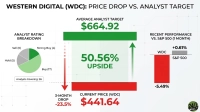
One capacity announcement from Toshiba is splitting the storage trade in two, hitting the hard disk drive (HDD) makers heavily while the broader memory group barely moves. Seagate Technology Holdings (NASDAQ:STX | STX Price Prediction) stock is down 10% to $849.79 in morning trading, the sharpest decline among the storage names. Meanwhile, Western Digital (NASDAQ:WDC) shares are slipping 7% to $429.45 as the pure-play HDD company takes a similar hit.
The Roundhill Memory ETF (CBOE:DRAM) is up 0.82% to $62.54, even though Seagate and Western Digital sit among its holdings. Meanwhile, the Invesco QQQ Trust (NASDAQ:QQQ) is up 1.17% to $750.73, so large-cap technology stocks are trading stronger overall. The Roundhill fund would have dropped alongside the two drive makers in a broad memory selloff, so the damage looks confined to one product line.
Demand from artificial intelligence (AI) data centers turned Seagate and Western Digital into two of the year’s standout technology stocks, and Toshiba wants a bigger share of it. Both Seagate and Western Digital beat earnings estimates in every quarter of fiscal 2026, which puts the focus of the selloff directly on future supply.


Toshiba Plans to Double Its Hard Drive Output
Toshiba plans to double its HDD production capacity, with the expansion centered on its manufacturing facility in the Philippines. The Japanese company is aiming the added output at storage demand from AI data centers, the same customers that have fueled surging results at Seagate and Western Digital.
Toshiba, the smallest of the three companies that control HDD manufacturing, has set a medium-term target of 30% of the market measured by storage capacity. Reaching that goal would mean taking market share from Seagate and Western Digital in an industry where tight supply has supported rising prices.
Hard Drive Makers Slide While Memory Stocks Hold Firm
What Seagate and Western Digital share, and what separates both from the rest of the storage group, is concentrated exposure to the exact product Toshiba plans to build more of. Micron Technology (NASDAQ:MU), SanDisk (NASDAQ:SNDK) and SK Hynix (NASDAQ:SKHY) benefit from the same AI infrastructure boom through memory chips and flash storage without that HDD concentration. That likely explains why the Roundhill fund is holding steady.
Both stocks’ big runs this year leave them sensitive to news suggesting the industry’s supply and demand balance could loosen. Before the drop, Seagate shares were up 210% year to date (YTD), and Western Digital stock was up 150% YTD.
Western Digital CEO Irving Tan linked pricing directly to scarcity on the company’s August 5 earnings call, stating, “In the very tight supply environment that we’re in, that provides us an opportunity for increased pricing leverage as well.” Seagate has leaned on the same discipline, with chief executive Dave Mosley asserting on the company’s April 28 call, “The total number of units is not really increasing.” Toshiba’s plan to double its output works directly against that approach.
What to Watch Next
Long-term contracts give Seagate and Western Digital some protection against Toshiba’s added supply. Nearline capacity at Seagate (the high-capacity drives sold to data centers) was almost fully allocated through calendar 2027, the company stated in April. Guidance from Western Digital calls for the company’s fiscal Q1 2027 revenue to reach $4.1 billion, plus or minus $100 million.
What remains unknown is how quickly Toshiba’s new capacity reaches cloud buyers. Any slide in the Roundhill Memory ETF to match the two stocks would suggest the worry is spreading beyond HDDs.
Contact [email protected] for any questions or corrections.
David Moadel is financial writer specializing in stocks, ETFs, options, precious metals, and Bitcoin. David has written well over 1,000 articles for leading online publications, helping investors understand markets, income strategies, and risk.His work has appeared in The Motley Fool, InvestorPlace, U.S. News & World Report, TipRanks, ValueWalk, Benzinga, Market Realist, TalkMarkets, Finmasters, 24/7 Wall St., and others.With a master’s degree in education, David has taught at the elementary, high school, and college levels. That teaching background shapes his writing style: clear, educational, and practical. David has also built a loyal social-media audience by providing trustworthy financial content on YouTube, X/Twitter, and StockTwits.