Better Dividend Bet: DRI or SBUX? The Cash Flow Numbers Reveal a Clear Winner
Both Darden and Starbucks just got cheaper after steep selloffs, but one of them is quietly struggling to fund its own dividend from free cash flow while the other keeps raising payouts and buying back stock.


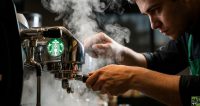
Between Darden Restaurants (NYSE:DRI | DRI Price Prediction) and Starbucks (NASDAQ:SBUX), which one should a retirement-focused investor own right now for dividend income? Both stocks slid over the past month, with Darden down 8.71% and Starbucks down 12.56%. That decline puts the payout question front and center, and on dividend quality the two differ sharply.
Yield and Payout Safety: Darden Pays More and Covers It
Starbucks yields 2.56% on an annualized dividend of $2.48. Darden’s forward annualized dividend is $6.48 against a share price of $199.77, which means shareholders get more cash for their money than Starbucks delivers at $94.86.
Free cash flow is where the gap broadens. Starbucks’ free cash flow yield of 2.26% sits below its dividend yield, meaning trailing free cash flow fell short of funding the payout. Trailing EPS of $1.73 also trails the dividend, and even raised fiscal 2026 guidance of $2.55 to $2.65 barely clears it.
Darden generated $1.853B in fiscal 2026 operating cash flow against $734M of capex. In its latest quarter it paid $184.2M in dividends and still bought back $222.3M of stock, while Starbucks has made no share buybacks in recent quarters. Fiscal 2027 EPS guidance of $11.10 to $11.35 leaves wide room above the dividend. Winner: Darden.


Dividend Growth and Track Record: Darden Has the Momentum Now
Starbucks owns the cleaner streak: 65 consecutive quarters of payouts with a 17% CAGR, starting from $0.10 in April 2010. The recent pace tells a different story. The latest raise moved the quarterly payout from $0.61 to $0.62, a single penny, and the company’s quoted CAGR slipped from 18% to 17%.
Darden’s quarterly records stretch back to April 7, 1999. Its quarterly payout climbed from $1.21 in early 2023 to $1.62 in 2026, with the latest step an 8.0% raise. Shareholders also kept more wealth: Darden rose 48.47% over five years while Starbucks fell 6.39%. Winner: Darden.
Business Durability: Darden’s Cash Flow Defends Its Payout Better
Starbucks has the stronger operating story. Global comparable sales rose 7.9% last quarter and non-GAAP operating margin expanded 430 bps to 14.4%. Its international exposure is now lower, with about 90% of that portfolio licensed, and it paid back roughly $1.8 billion of debt. Still, shareholders’ equity stands at -$7.67B, net debt to EBITDA is 4.44, and the chain said it is closing 250 stores across North America.


Darden’s risk is discretionary sit-down dining, the spending consumers cut first in a downturn. Its stock fell as Olive Garden reported slower growth, and quarterly net income dropped 9.46%. Yet blended same-restaurant sales rose 3.1% with every segment positive, and its beta of 0.59 undercuts Starbucks’ 0.965. A multi-brand portfolio with positive equity and room in its payout handles a soft patch more easily. Winner: Darden.
Verdict: Darden Is the Retirement Income Pick
For those seeking steady income, Darden wins outright. It pays more, covers the check with cash flow, raises substantially, and trades at a forward P/E of 19 versus 31 for Starbucks.
The Starbucks case belongs to a younger investor with a longer runway. Its chief financial officer said the stronger balance sheet lets it “maintain our competitive dividend and create longer term value for shareholders,” and a $2 billion cost-savings plan runs through fiscal 2028.
What could change the picture is specific: if Starbucks’ free cash flow yield climbs back above its dividend yield and raises reaccelerate past a penny, the verdict strengthens. For Darden, watch same-restaurant sales against its 2.5% to 3.5% guidance. A slide below that range would be the first crack in the stronger dividend.
Contact [email protected] for any questions or corrections.
Chris Lange is a financial and geopolitical writer with more than a decade of experience covering a myriad of topics. He has published thousands of articles for 24/7 Wall St., with past coverage focused heavily on stocks, IPOs, healthcare, defense, global affairs, and technology.
His work has been quoted, or referenced by a number of outlets including Business Insider, USA Today, Yahoo Finance, MSN, The Motley Fool, and many other publications. A graduate of Southwestern University, he studied business with a focus on investments and has previous experience in banking and startups.
When not reading or writing the news, he is following his passion for Lacrosse, playing chess, or building solar projects with his dad.