Microsoft’s Most Powerful Laptop Ever Runs on Nvidia, Not Intel
Microsoft just built its most powerful laptop ever and left Intel out of it entirely, raising a question every PC investor should be asking about who controls the market going forward.

This post may contain links from our sponsors and affiliates, and Flywheel Publishing may receive compensation for actions taken through them.
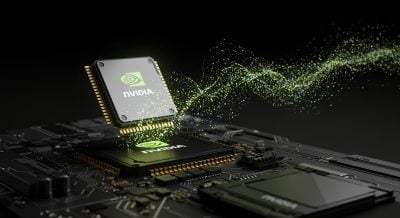
For $2,599, Microsoft (NASDAQ:MSFT | MSFT Price Prediction) will now sell you a 15-inch laptop with up to a 20-core NVIDIA (NASDAQ:NVDA) Grace CPU and up to 128 GB of unified memory. On Oct 7, 2026, Microsoft opened preorders for the Surface Laptop Ultra. Its flagship model runs on an NVIDIA processor.
The Ultra adds a new top level. It replaces no Intel (NASDAQ:INTC) model, and Microsoft still sells Intel-based business Surface machines. Even so, Intel has no option inside Microsoft’s most powerful laptop. Qualcomm (NASDAQ:QCOM) also lost the top slot, even though Arm-based Windows laptops were supposed to be its territory.
What Microsoft Actually Shipped
On Microsoft’s own site, prices start at $2,599.99. The top configuration costs $5,899.99, and shipments begin Oct 16, 2026.
The chip is RTX Spark, an Arm-based part that NVIDIA co-designed with MediaTek. It is NVIDIA’s first CPU for mainstream Windows PCs. NVIDIA unveiled it on May 31 to June 1, 2026, so the Oct 7 announcement covered pricing and preorders only.
NVIDIA chief Jensen Huang said the company “reinvented the personal computer completely.” Microsoft chief Satya Nadella said, “We needed to make the desktop the most secure place for agents to execute.”
Nadella’s comment points to the product’s purpose, because AI agents execute multi-step tasks autonomously. Running them locally requires a processor and graphics cores sharing one large memory pool, which unified memory provides.
Three Surface Generations Point Away From Intel
Microsoft’s previous performance laptop paired an Intel processor with an NVIDIA graphics chip. Microsoft discontinued it in May 2025. Its mainstream consumer Surface Laptops moved to Qualcomm Snapdragon chips in 2024, while Intel versions stayed on sale for business buyers.
The most expensive Surface now excludes Intel entirely. Acer, ASUS, Lenovo, MSI, Gigabyte and major US PC brands are all building RTX Spark machines, so the design extends well beyond one Surface model.
What This Costs Intel If It Spreads
Intel’s PC chip business brought in $32.23 billion in 2025. Intel supplied about 70% of PC processors in the second quarter of 2026, so it still controls the volume. It no longer controls the top of the market, though.
Analyst Richard Windsor said Intel’s older chip design was effectively called out as obsolete in data centers and PCs.
The competition is complicated because NVIDIA holds a minority stake in Intel, and the two companies are co-developing PC chips built on Intel’s own design.
Why the Stocks Barely Moved
Qualcomm fell more than 6% at the announcement, and Intel and AMD (NASDAQ:AMD) fell too. Preorder day brought no repeat: Qualcomm slid 2.16% to $177.12, Intel rose 0.55% to $113.12, and AMD fell 0.55% to $645.86. Even partners Microsoft, up 0.09% to $529.76, and NVIDIA, down 0.74% to $237.47, barely moved.
Most of the selling came when the chip was announced. One premium laptop won’t move revenue much at NVIDIA, which reported $96.22 billion in its fiscal second quarter, mostly from data centers.
Price is the main barrier, according to Anshel Sag of Moor Insights, who said, “Now the software is ready and the hardware is too expensive to actually run it locally.” AI that runs on the laptop only wins if the device is cheap enough to replace a cloud subscription, and at $5,899.99 it isn’t.
Intel Faces a Harder Road in Premium PCs
Intel still supplies about 70% of PC processors, keeps its place in business with Surface models, and has NVIDIA as both a rival and a shareholder, working on chips together.
The bear case is stronger because Intel lost the top level, and most major PC makers are building competing machines. The stock is up 206.56% year to date. Management expects PC chip revenue to be roughly flat in the third quarter even as the overall PC market contracts.


NVIDIA comes out of this launch in a stronger position because it gets the PC design win and controls part of Intel, and it trades at 48 times earnings while Intel’s earnings are negative. The signs that showed up early in past tech giants are the same ones we cataloged in a free playbook on spotting the next NVIDIA.
Keep an eye on Intel’s third-quarter report, where guidance calls for $15.8 billion to $16.8 billion in revenue. RTX Spark laptops start shipping Oct. 16. If Intel’s PC chip revenue comes in below flat after that, the share loss has begun.
Contact [email protected] for any questions or corrections.
Omor Ibne Ehsan is a writer at 24/7 Wall St. He is a self-taught investor with a focus on growth, cyclical, and dividend equities that have strong fundamentals, value, and long-term potential. He also has an interest in high-risk, high-reward investments such as penny stocks.