What Wall Street’s Biggest Bank Is Quietly Saying About The Biggest AI Capex Spenders
Bank of America just revised its Big Tech capex forecast into trillion-dollar territory, and now investors want to know which AI spender actually earns that money back. Microsoft and Amazon are placing very different bets, and only one of them…

This post may contain links from our sponsors and affiliates, and Flywheel Publishing may receive compensation for actions taken through them.

Bank of America (NYSE:BAC | BAC Price Prediction) raised its Big Tech capex forecast to $860 billion in 2026 and nearly $1.2 trillion in 2027. Investors are considering the returns on that spending. The best test comes from Microsoft (NASDAQ:MSFT) and Amazon (NASDAQ:AMZN), each building AI with different partners and chips.
Copilot Seats Lift Microsoft. Trainium Chips Lift Amazon.
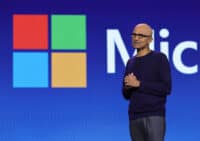
Microsoft’s fiscal Q4 revenue rose 17.8% to $90.01 billion. Azure grew 43% and passed $100 billion in annual revenue. Nearly 90% of Microsoft Cloud revenue came from customers outside frontier model companies. Microsoft 365 Copilot exceeded 30 million paid seats. CFO Amy Hood said: “Demand continues to exceed available supply.”
AWS revenue rose 37% to $42.23 billion, its fastest growth in 18 quarters. CEO Andy Jassy said the AI and chips businesses “each eclipsed run rates of more than $25 billion.” Anthropic and OpenAI have both made multi-year, multi-gigawatt commitments to Trainium, Amazon’s own AI chip. I would discount the $5.75 GAAP EPS, though. A $53.4 billion one-time gain on the Anthropic stake inflated it.
| Business Driver | Microsoft | Amazon |
|---|---|---|
| AI Growth Engine | Azure plus Copilot software | AWS compute plus Trainium chips |
| Anchor AI Lab | OpenAI (~27% stake) | Anthropic (Project Rainier) |
| Latest Quarterly Capex | $35.8 billion | $54.2 billion |
| Contracted Backlog | $678 billion commercial RPO | $496 billion AWS backlog |
Microsoft Stays Flexible While Amazon Builds for Decades
Satya Nadella treats AI models as interchangeable parts: “The models are an input, not some extraction of the knowledge of the enterprise.” Copilot moves to per-seat-plus-consumption pricing. CPUs and GPUs are short-lived assets, so Microsoft can slow purchases if demand cools.
Amazon plans its expansion over decades. Servers break even in a little less than three years, most AI capacity is contracted for at least five-year terms, and data centers earn revenue for 30-plus years. Its trailing free cash flow is -$7.6 billion, while Microsoft generated $19.6 billion in a single quarter.
Azure’s 45% Target and Amazon’s Cash Gap Come Next
Microsoft expects Azure to grow about 45% in constant currency in fiscal Q1. Watch whether new capacity gets “quickly monetized.” For Amazon, monitor Q3 operating income guidance of $22.5 billion to $26.5 billion and any move to sell Trainium chips outside AWS. Microsoft’s fiscal 2027 EPS estimate drew 21 upward revisions against 8 downward over 30 days. Amazon’s 2027 estimate saw 4 up and 0 down.
Why I Lean Toward Microsoft for Capex Discipline
Amazon shares rose 17.2% over the past year against Microsoft’s 1.94%. Microsoft looks better balanced: it funds capex from operating cash flow, earns software revenue on top of hardware, and can slow spending if demand fades. Amazon offers more upside potential alongside bigger swings. Trainium sales to outside customers could improve margins. Review once Amazon’s new data centers generate revenue and free cash flow turns positive.
Contact [email protected] for any questions or corrections.
Alex Sirois is a financial writer with experience spanning both retail and institutional investing. He has written for InvestorPlace and held roles at BNY Mellon and Bernstein, giving him a perspective that bridges Main Street portfolios and Wall Street analysis.
Alex holds an MBA from George Washington University and has built his career across multiple industries, including e-commerce, education, and translation — a breadth of experience that informs how he breaks down complex financial topics for everyday investors. His writing is conversational, actionable, and grounded in long-term, buy-and-hold investing principles.
At 247 Wall St., Alex focuses on delivering analysis that is both accessible and useful, with a clear emphasis on helping readers make more informed decisions with their money.