1 of These Stocks Raised Its Dividend 50%. The Other Pays Nearly 4 Times the Yield.
One cruise giant rebuilt its dividend from nothing and is raising it fast, while a casino landlord quietly pays nearly four times the yield. Before you chase either payout, there are risks hiding in both balance sheets worth knowing.

This post may contain links from our sponsors and affiliates, and Flywheel Publishing may receive compensation for actions taken through them.

Royal Caribbean (NYSE:RCL | RCL Price Prediction) and VICI Properties (NYSE:VICI) both paid quarterly dividends on October 8, 2026. Royal Caribbean raised its payout 50% from a year ago, while VICI raised its payout 2.2%. VICI still yields about 3.8 times as much, and it delivers the larger income stream per dollar invested.
Both companies make money from the same leisure dollar, just at opposite ends. Royal Caribbean operates the ships and sells the vacations. VICI owns casino and entertainment real estate, and it takes in rent from the companies that run them.
Royal Caribbean: A Dividend Rebuilt From Zero
Royal Caribbean runs cruise brands, ships, and private destinations. It served 2.4 million guests in the second quarter of 2026. On October 8, it paid $1.50 per share, or $150 on a 100-share position. The same quarter a year earlier paid $1.00, so the increase is 50%. The annualized rate is now $6.00 per share.
In Friday premarket trading, the stock was at $284.94, up 1.3% from Thursday’s close. That works out to a yield of about 2.1%. The stock is down fractionally this year and 8.3% over the past 12 months.
This dividend went away entirely and came back. Royal Caribbean made no payments between its March 2020 ex-dividend date and the restart in September 2024, when it paid $0.40. Since then, it has raised the quarterly check repeatedly. Along the way, the board approved a 33% increase to $1.00 in September 2025, then another jump to $1.50.
The low yield comes from how far the stock has run. Shares have gained 220.8% over five years, so each fresh increase lands on a much higher price. Management treats the dividend as one piece of a larger capital return plan. In the second quarter alone, Royal Caribbean paid $404 million in dividends and bought back 0.8 million shares. Another $805 million remains under its buyback authorization.


VICI Properties: Small Raises, Every Single Year
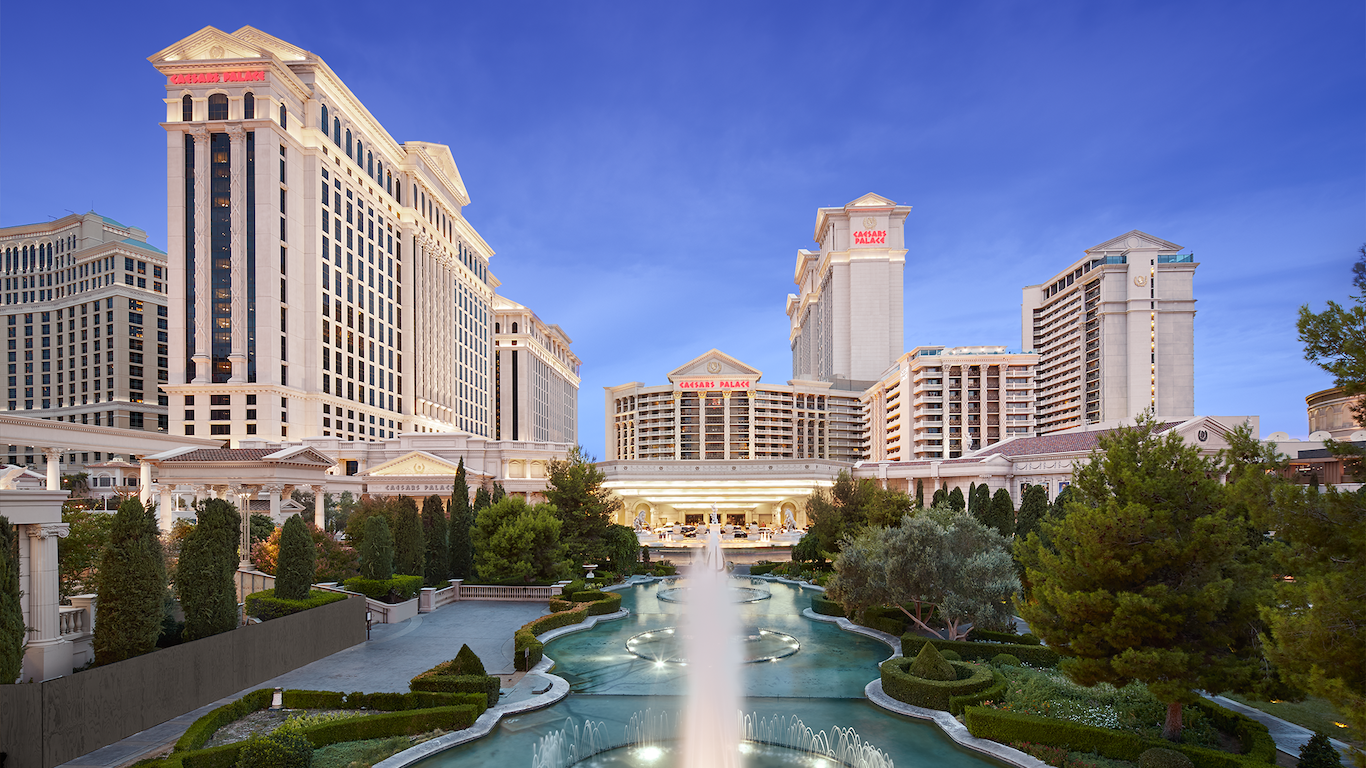
VICI is a real estate investment trust. A REIT owns property and must pay out most of its taxable income as dividends, which is why REITs tend to have high yields. VICI owns 93 casino, hotel, and entertainment properties, including Caesars Palace. It rents them out under triple-net leases, which means the tenant pays the property taxes, insurance, and maintenance. VICI takes in the rent. Its properties are 100% occupied, the average lease has 39.6 years left, and most leases raise rent 2.0% a year.
VICI paid $0.46 per share on October 8, or $46 on 100 shares. A year earlier, the quarterly payment was $0.45, so the increase is 2.2%. The annualized rate is $1.84. At $22.89 in Friday premarket trading, up 0.44%, the stock yields about 8.0%.
VICI’s dividend history is the opposite of Royal Caribbean’s. It started with an initial dividend of $0.16 and has raised the payout every year since, with no cuts or breaks. The raises are small and steady, in line with rent increases that move a few percent a year.
| Metric | Royal Caribbean | VICI Properties |
|---|---|---|
| Paid Oct. 8, 2026 | $1.50 | $0.46 |
| Year-earlier quarter | $1.00 | $0.45 |
| Year-over-year increase | 50% | 2.2% |
| Annualized rate | $6.00 | $1.84 |
| Live yield | 2.1% | 8.0% |
| One-year share move | −0.7% | −26.1% |
Dividend Safety: Where the 8% Yield Comes From
A dividend yield can rise for two reasons: the company increases its payout, or the stock price falls. Most of VICI’s rise comes from the falling stock. The stock is down 26.1% over the past year and 18.6% in 2026. A year ago, shares traded at $29.38, and the $1.80 annual rate yielded about 6.1%. At that price, today’s higher $1.84 annual dividend would yield only about 6.3%. The rest of the jump to 8% comes from the falling stock. A falling price can mean investors see more risk, so an 8% yield needs a closer look. (We wrote up the seven warning signs that a big yield is about to be cut in a free report.)
For a REIT, the right way to test the payout is adjusted funds from operations. AFFO adds back large non-cash charges that skew reported earnings, so it shows the cash actually available for dividends. In the second quarter, a $271.1 million non-cash credit-loss charge pulled GAAP EPS down to $0.48. AFFO was $0.62 per diluted share, up 4.6% from a year earlier. The new $0.46 quarterly dividend equals about 74% of that figure. Full-year 2026 AFFO guidance is $2.45 to $2.47 per share. The $1.84 annual rate uses roughly 74% to 75% of that, which leaves room in the budget.
The bigger risks are on the balance sheet and in the tenant list. VICI has about $17.22 billion of debt. Caesars Entertainment (NASDAQ:CZR) pays 38% of its rent, and MGM Resorts International (NYSE:MGM) pays 32%. Adding three new tenants in the second quarter, bringing the total to 16, spreads that risk only modestly. The dividend is covered by AFFO, and the stock price reflects investor concern about the financial health of those two casino operators.
For Royal Caribbean, the test is free cash flow, meaning operating cash flow minus spending on ships and other capital projects. In 2025, operating cash flow was $6.465 billion and capital spending was $5.229 billion. That left about $1.236 billion in free cash flow, roughly 4.7 times the $264 million paid in dividends.
The first half of 2026 was tighter because new ships were delivered. Free cash flow came to about $457 million, while dividends amounted to $674 million and buybacks amounted to about $1.035 billion. Shipbuilding spending arrives in large increments, and Royal Caribbean used debt to fill the gap. Total debt was $23.518 billion against $875 million in cash at the end of June. Management reported $6.9 billion of liquidity and leverage below three times.
Measured against earnings, the $6.00 annual rate is about 34% of the $17.80 midpoint of 2026 adjusted EPS guidance ($17.73 to $17.87). On the July 28 call, CEO Jason Liberty said, “We expect another year of strong earnings growth and cash flow generation.” Royal Caribbean’s dividend depends on strong cruise demand. As a cyclical business, it already suspended the payout once.
Why Some Shareholders Got Nothing on October 8
Some people who owned these stocks on October 8 received no dividend. The timing comes from a four-step calendar:
- On the declaration date, the board announces the amount and dates. Royal Caribbean declared on September 1, 2026, and VICI declared on September 3, 2026.
- On the record date, the company checks its books to see who owns shares. Under today’s one-day settlement cycle, this usually falls on the same day as the ex-dividend date.
- The ex-dividend date determines who gets paid. You must own the shares before this day starts. Both companies set the same ex-dividend date: September 17, 2026.
- The payment date is when cash lands in eligible accounts. Both paid on October 8, 2026.
Shares bought on or after September 17 came without the right to this payment. The first dividend for those investors will be the next one.
Income per Dollar Decides This Matchup
A 50% increase on a 2.1% yield and a 2.2% raise on an 8.0% yield are very different deals for an income investor. What matters is how much cash each dollar invested brings in, and VICI brings in close to four times as much. Royal Caribbean’s raise reflects a cyclical business that is recovering fast and returning cash mainly through buybacks. VICI’s yield delivers the larger income stream, covered by AFFO at about three-quarters of the cash it generates, and the risk to watch is its two biggest casino tenants.
Contact [email protected] for any questions or corrections.
Trey has been an editor and author at 24/7 Wall St. for more than a decade, where he has published thousands of articles analyzing corporate earnings, dividend stocks, short interest, insider buying, private equity, and market trends. His comprehensive coverage spans the full spectrum of financial markets, from blue-chip stalwarts to emerging growth companies.
Beyond 24/7 Wall St., Trey has created and edited financial content for Benzinga and AOL's BloggingStocks, contributing additional hundreds of articles to the investment community.
Trey's editorial expertise extends across multiple publishing environments. He served as production editor at Dearborn Financial Publishing and development editor at Kaplan, where he helped shape financial education materials. Earlier in his career, he worked as a writer-producer at SVE. His freelance editing portfolio includes work for prestigious clients such as Sage Publications, Rand McNally, the Institute for Supply Management, the American Library Association, Eggplant Literary Productions, and Spiegel.
Outside of financial journalism, Trey writes fiction and has been an active member of the writing community for years, moderating workshop sessions at regional conventions.