Taiwan Semiconductor Vs. ASML: If I Had to Choose One For the Next 5 Years, It’s This One
TSMC prints the chips and ASML prints the machines that make them possible, but five years from now only one of these AI supply chain giants looks positioned to justify its valuation and absorb its biggest risk.

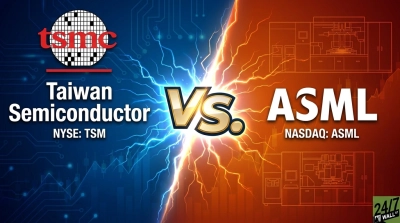
Taiwan Semiconductor Manufacturing (NYSE:TSM | TSM Price Prediction) and ASML (NASDAQ:ASML) sit at opposite ends of the same AI supply chain. TSMC makes the chips, and ASML builds the EUV machines that print them. Both beat their guidance in July. TSMC just reported September revenue up 54.6% year over year, ahead of its October 15 earnings report.
AI Wafers Carry TSMC While Upgrades Lift ASML
TSMC’s Q2 revenue reached $40.20 billion, with gross margin at 67.7%. High-performance computing revenue rose 20% quarter over quarter to 66% of revenue, while smartphone revenue slipped 4%. The 2nm process delivered 3% of wafer revenue in its first quarter of sales, with output set to rise quickly.
ASML’s sales of €9.3 billion beat guidance because installed base management came in almost €300 million above plan. Management raised full-year guidance to €43B to €45B from €36B-€40B, indicating real order momentum.
TSMC Pays for Capacity While ASML Gets Paid for It
TSMC set its 2026 capital spending budget between $60 billion and $64 billion. It expects the 2nm ramp to cut gross margin by about 3 to 4 percentage points in Q3. Management sounds restrained on pricing: “The higher the better, of course. But we are a partner.”
ASML sounds more aggressive. Management said “The current environment provides more flexibility for pricing than what you would have had in different days.” Its low NA EUV output for 2027 is “close to being fully covered with orders.” China should make up around 20% of total net sales this year, so export controls remain a live risk.
| Lens | TSMC | ASML |
|---|---|---|
| Growth Engine | AI and HPC wafers | EUV systems and upgrades |
| Pricing Stance | Partner pricing | Value-based pricing |
| Key Vulnerability | Taiwan Strait, 2nm margin dilution | China exposure, uneven orders |
| Forward P/E | 21 | 29 |
| Five-Year Stock Return | 350.77% | 155.24% |
October 15 Shows Whether 2nm Costs Bite
TSMC forecast Q3 revenue to $44.6B to $45.8B, with gross margin of 65% to 67%. Watch whether margin stays in the upper half as 2nm volume grows. For ASML, keep an eye on High NA EUV, which just reached high-volume qualification on select Intel (NASDAQ:INTC) 18A product layers.
Why TSMC Holds the Growth and Valuation Edge for the Next Five Years
ASML’s EUV monopoly is real, but the low end of its 2030 revenue opportunity of €44B to €60B overlaps this year’s guidance, lowering long-run expectations. TSMC targets a 2024-2029 revenue growth rate approaching 25% a year and trades at a lower forward multiple. That mix of growth, valuation, and reach gives TSMC a stronger long-run profile despite the Taiwan Strait risk.
Contact [email protected] for any questions or corrections.
Alex Sirois is a financial writer with experience spanning both retail and institutional investing. He has written for InvestorPlace and held roles at BNY Mellon and Bernstein, giving him a perspective that bridges Main Street portfolios and Wall Street analysis.
Alex holds an MBA from George Washington University and has built his career across multiple industries, including e-commerce, education, and translation — a breadth of experience that informs how he breaks down complex financial topics for everyday investors. His writing is conversational, actionable, and grounded in long-term, buy-and-hold investing principles.
At 247 Wall St., Alex focuses on delivering analysis that is both accessible and useful, with a clear emphasis on helping readers make more informed decisions with their money.