Dave Ramsey Says Online Sportsbooks Are Ruining Gen Z Finances Faster Than Anything in 30 Years
Dave Ramsey called two of America's biggest sportsbook companies out by name, and the financial case he made against them goes beyond morality into something every young investor should see in the earnings data.


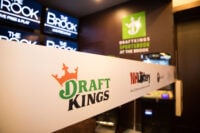
Dave Ramsey has picked a new target, and he named the companies. He was talking about a father whose college-age son used sportsbook apps while also investing for the long term. The personal finance host aimed his criticism at the two largest U.S. online sportsbook operators: Flutter Entertainment (NYSE:FLUT | FLUT Price Prediction), which owns FanDuel, and DraftKings (NASDAQ:DKNG).
“The fastest growing addiction that is destroying young men in their 20s in America, faster than anything I’ve ever seen in 30 years of doing this, is online sports gambling,” Ramsey said. He added: “FanDuel is a portal to hell. DraftKings ain’t king of nothing except their own pocketbook.”
The father suggested steering his son’s appetite for risk toward short-term trading. Ramsey rejected that too: “It’s not conducive to building wealth. It’s not conducive to building a high-quality life.”
The heated language is Ramsey’s. Behind it lies a simple financial point: money lost again and again never gets the chance to compound, pay dividends or grow in a portfolio.
Young Adults Dominate Online Sportsbook Activity
Research from the Bank of America Institute, the think tank of Bank of America (NYSE:BAC), found that Gen Z and millennials made up 88% of online betting activity in July. The Bank of America Institute also found that first-time online bettors in June and July were more than three times January’s level. And according to the Bank of America Institute, the median deposit balance of households that bet online was 59% of the balance held by households that did not.
Epic Research looked at health records covering more than 197 million U.S. adults. Epic Research found that diagnosed gambling disorder in states with legal sports betting rose from three cases per 100,000 adult patients in early 2018 to 4.8 per 100,000 in the first quarter of 2026, an increase Epic Research put at about 61%. Epic Research also says the trend cannot be attributed to a single legalization event, and it notes that prediction markets expanded over that span. The data shows diagnoses rising alongside legalization. It does not prove that legalization caused the rise.
When Customers Won, the Operators’ Earnings Fell
Ramsey’s explanation for the advertising campaign: “Because you don’t win. That’s why they can afford to buy ads.” The latest quarterly results show what happens to the operators when customers do win.
DraftKings’ second-quarter revenue fell 4.6% to $1.44 billion, and the company swung to a $67.6 million net loss, according to its Q2 2026 filing with the SEC. Its sports net revenue margin contracted to 6.8% from 8.7%, and management blamed part of the drop on customer-friendly results. Sales and marketing spending rose to $322.5 million from $233.2 million.

At Flutter, U.S. sportsbook revenue fell 15%, and U.S. adjusted EBITDA dropped 70% to $119 million. Management said “the Knicks’ legendary win in June put some cash back in our customers’ wallets in time for the World Cup.” FanDuel’s response is to spend more: it plans $270 million of extra investment in the second half. In a FanDuel survey, more than half of customers said its Rewards Club made them place more bets.

Prediction Markets Are Expanding Into New States
Mobile sportsbooks are live in 27 states, D.C., and Puerto Rico. Both companies launched prediction market products in December 2025. These are contracts on the outcome of events, supervise by federal regulators at the CFTC, and both companies are using them to reach states where sportsbooks remain illegal. DraftKings says more than 600,000 customers have used its offering so far this year, and CEO Jason Robins pointed to California and Texas as focus markets.
Shareholders have had a rough year as well. DraftKings trades at $19.85, down 42.4% year to date. Flutter is at $77.80, down 63.82%, after it lowered its full-year revenue midpoint to $17.91 billion.


Owning an Asset Versus Paying for an Outcome
For parents and grandparents, Ramsey’s comments point to a distinction worth sharing with the young men in their lives. A share of stock or an index fund is a stake in businesses that earn profits, and over long periods those profits can compound and pay dividends. A sportsbook ticket is a one-time payment for a chance at an outcome, priced so the operator keeps a margin over time. The first can grow over decades. The second ends when the game does, and the operators’ own filings show that, over time, their revenue depends on customers coming out behind.
Contact [email protected] for any questions or corrections.
Chris Lange is a financial and geopolitical writer with more than a decade of experience covering a myriad of topics. He has published thousands of articles for 24/7 Wall St., with past coverage focused heavily on stocks, IPOs, healthcare, defense, global affairs, and technology.
His work has been quoted, or referenced by a number of outlets including Business Insider, USA Today, Yahoo Finance, MSN, The Motley Fool, and many other publications. A graduate of Southwestern University, he studied business with a focus on investments and has previous experience in banking and startups.
When not reading or writing the news, he is following his passion for Lacrosse, playing chess, or building solar projects with his dad.