Taiwan Semiconductor’s Top Line Growth is Starting to Raise Eyebrows
Taiwan Semiconductor keeps raising its own growth targets while its share price moves in the opposite direction, and third-quarter results will determine whether that gap closes in investors' favor or widens into something more troubling.


Taiwan Semiconductor Manufacturing (NYSE:TSM | TSM Price Prediction) trades at $445.16. September revenue rose 54.6% year over year, and in the same stretch the stock pulled back on AI spending fears. That leaves a gap between the business and the share price just before third-quarter results.
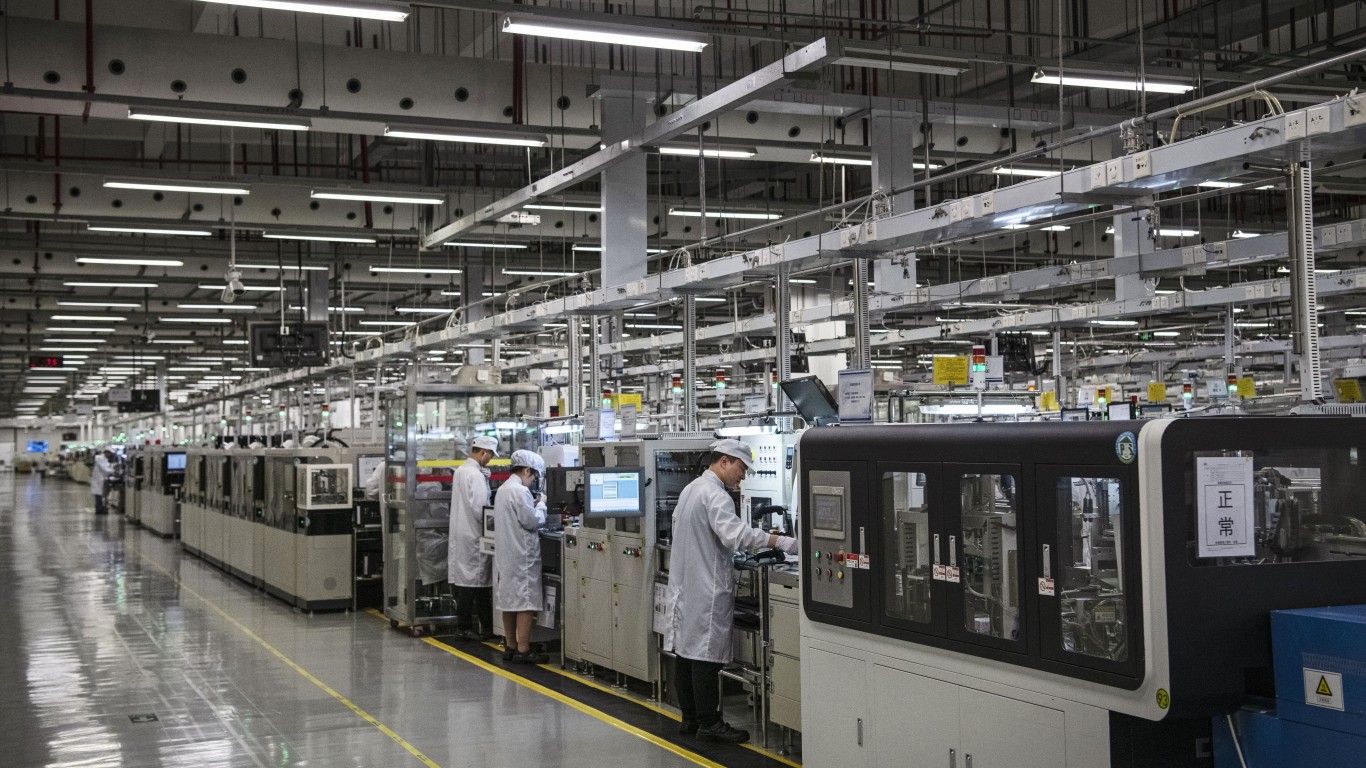
Taiwan Semiconductor is the world’s largest dedicated foundry. It makes chips for Apple (NASDAQ:AAPL), NVIDIA (NASDAQ:NVDA), AMD (NASDAQ:AMD) and Qualcomm (NASDAQ:QCOM) and sells no branded chips of its own. High-performance computing made up 66% of second-quarter revenue. The stock is up 47.62% year to date, but it fell 7.7% in the past week as chip stocks tumbled on AI spending fears and rising Chinese competition.
AI Demand Is Pushing Revenue Growth Past 40%
Revenue for the first nine months of the year reached $122.12 billion, up 41.1%. Management now guides full-year growth to slightly above 40%, up from close to 30% at the start of the year. Second-quarter EPS came in at $4.31, ahead of the $3.89 consensus. Gross margin hit 67.7%, and net income rose 77.4%.
The stock trades at about 21x forward earnings, compared with 33x trailing, and its PEG ratio is 0.858. Management expects strong demand “all the way to probably 2029, 2030”. A14 pilot production is set to begin in 2027.
Margin Dilution and Heavy Capex Could Cap Upside
The 2nm ramp will cut gross margin by about 3 to 4 percentage points in the second half, and third-quarter margin guidance stands at 65% to 67%. Overseas fabs add more dilution, which management says could increase to 3% to 4% in later stages. The 2026 capital budget has been raised to $60 billion to $64 billion, and the company has committed another $100 billion to Arizona.
September revenue slipped 0.6% from August. Management also admitted it is unsure whether demand will see “a dip” along the way. On top of that come customer concentration, Chinese competition and Taiwan geopolitical risk.
Q3 Results Will Show Whether Margins Survive the 2nm Ramp
The stock still trades above its 200-day moving average of $391.77. Consensus calls for third-quarter EPS of $4.46 on guided revenue of $44.6 billion to $45.8 billion. If gross margin lands near the 66% midpoint and fourth-quarter guidance holds firm, the case for upside gets stronger. A margin miss or a softer guide would point the other way.
Analysts See 24.7% Upside After a Year of Beating the Market
The average analyst target of $555.01 means 24.7% upside from $445.16. Targets are one data point and come with no guarantee. Of the 21 analysts covering the stock:
- Strong Buy: 6
- Buy: 14
- Hold: 1
- Sell: 0
Over the past year Taiwan Semiconductor gained 48.49%, while the S&P 500 rose 17.35%. Year to date the stock is up 47.62% against 14.1% for the index. The past week went the other way: the stock fell 7.7% while the S&P 500 slipped just 0.13%. Shares now sit below their 52-week high of $487.47.
Revenue Accelerates as the Stock Pulls Back Before Q3 Results
At $445.16, Taiwan Semiconductor trades below its 52-week high of $487.47.
Revenue is accelerating, and the stock is moving the opposite way. September’s 54.6% growth ran well ahead of the 37% year-over-year midpoint in third-quarter guidance. That points to another quarter of upside on the top line. The fastest path higher is the coming report: a revenue beat plus fourth-quarter guidance that keeps full-year growth above 40%.
Beyond the foundries themselves, the broader AI expansion runs on power, cooling, and networking suppliers that rarely get the headlines (we covered seven of them in a report you can download here).
The stock trades at about 21x forward earnings. The main thing that would break this thesis is gross margin falling below the guided range. A sharp cut in hyperscaler capex plans would also break it. Track both each quarter.
The recent decline has brought down the share price of a company that keeps raising its own growth targets.
Contact [email protected] for any questions or corrections.
Alex Sirois is a financial writer with experience spanning both retail and institutional investing. He has written for InvestorPlace and held roles at BNY Mellon and Bernstein, giving him a perspective that bridges Main Street portfolios and Wall Street analysis.
Alex holds an MBA from George Washington University and has built his career across multiple industries, including e-commerce, education, and translation — a breadth of experience that informs how he breaks down complex financial topics for everyday investors. His writing is conversational, actionable, and grounded in long-term, buy-and-hold investing principles.
At 247 Wall St., Alex focuses on delivering analysis that is both accessible and useful, with a clear emphasis on helping readers make more informed decisions with their money.