Barclays Says a Tesla-SpaceX Merger Could Be Announced Before December
A single Barclays research note sent two trillion-dollar stocks sliding and put a ticking clock on one of the biggest potential deals in corporate history, but neither Tesla nor SpaceX has signed anything, and the deadline is closing fast.

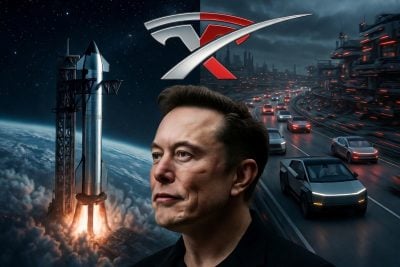
A merger of Tesla (NASDAQ:TSLA | TSLA Price Prediction) and SpaceX (NASDAQ:SPCX) would combine two companies worth about $3.5 trillion, yet the only concrete event behind the idea is a research note. On October 14, 2026, Barclays (NYSE:BCS) analyst Dan Levy wrote that a combination could be announced before Tesla’s annual meeting, which has to be held by December 6.
Neither Tesla nor SpaceX has announced, confirmed, or filed anything about a merger. Tesla’s most recent 8-K is dated July 22, 2026.
Both stocks fell anyway: Tesla closed at $367.16, down 2.15%, and SpaceX closed at $152.16, down 2.80%, before it slipped 1.21% after hours.


What Barclays Actually Wrote
Levy is reading public management commentary. He wrote: “While the industrial logic of a combination had been in question, we believe recent management comments indicate they see key benefits of a combination.”
He suspects “there would be some financial synergies,”. Yet he reasoned “the true value would be in vertical integration.” He described neither hired bankers nor any board committee or active talks.
Levy called the joint Terafab chip plant. He called it a “key driver.” Tesla had already disclosed a $2 billion investment in SpaceX equity and a semiconductor fab partnership with SpaceX at Gigafactory Texas.
Vertical integration means one company owns its own supply chain (such as chips, launch capacity, factories and energy systems), and a single owner would remove the related-party negotiation over who funds a shared plant and who gets its output.
That benefit is real in theory but hard to model, because it shows up as faster decisions instead of a line item. Levy also noted the joint structure creates a “complex dynamic” requiring approval from both boards.
Exchange Ratio Points to SpaceX as the Buyer
Dan Levy estimated each Tesla share would receive ~0.7 shares of SpaceX, with any premium already factored in. That is his estimate, and no company has proposed it.
Tesla holders would receive SpaceX stock, which makes SpaceX the acquirer in substance, consistent with its $2.07 trillion market value against Tesla’s $1.45 trillion.
Tesla owners would end up holding a minority piece of a company built on Starlink, launch, and AI. SpaceX’s AI segment brought in $2.561 billion last quarter, up 247%.
A real deal needs board special committees, a signed agreement, an 8-K, a proxy, and shareholder votes, but none has appeared, and the December 6 deadline leaves little time for that sequence.
Prediction-market traders put the probability of an official announcement by December 31 at 0.24. Each stock’s decline also had its own cause: SpaceX fell on problems at CoreWeave (NASDAQ:CRWV), and Tesla dipped on a competitive question raised by Uber (NYSE:UBER).
What Tesla’s Own Numbers Show Without a Merger
A merger nobody has announced offers little support for the valuation. On its own numbers, Tesla looks extended at $367.16.
Second-quarter non-GAAP EPS of $0.33 missed the $0.5367 estimate, operating margin contracted to 1.4%, and free cash flow was-$1.09 billion. A P/E of 382 leaves no room for that.

SpaceX has the firmer fundamental case, because its shares would be the deal currency and its business is growing faster: $7.814 billion in revenue beat estimates, with $93.52 billion in cash. Its shares are likely to be volatile, since it went public only this year.
If December 6 passes without an 8-K announcing a signed merger agreement, Levy’s call will have failed, and Tesla will go back to being judged on its earnings and margins alone.

Contact [email protected] for any questions or corrections.
Omor Ibne Ehsan is a writer at 24/7 Wall St. He is a self-taught investor with a focus on growth, cyclical, and dividend equities that have strong fundamentals, value, and long-term potential. He also has an interest in high-risk, high-reward investments such as penny stocks.