The Pentagon Offers Rocket Lab a $150 Million Loan to Speed Up Its Neutron Rocket

This post may contain links from our sponsors and affiliates, and Flywheel Publishing may receive compensation for actions taken through them.
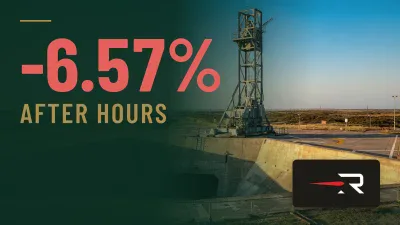
On Monday, November 9, 2026, the Department of War announced a loan. The Department of War’s Office of Strategic Capital announced a $150 million conditional loan commitment with Rocket Lab USA, the main operating subsidiary of Rocket Lab (NASDAQ:RKLB | RKLB Price Prediction). The money is meant to raise how often the Neutron rocket can fly once it launches. That debut is set for no earlier than 2027.
The announcement came after Rocket Lab’s 4:05 p.m. ET earnings release, so the November 9 regular-session move preceded both pieces of news. Shares rose 10.91% to $58.86, a market value of $35.23 billion. They then traded at $54.99 after hours, down 6.57%, and no source ties that drop to the loan.
In the quarter, revenue reached a record $267.8 million, up 73% from $155.1 million and above the $257.17 million consensus. However, the net loss widened to $79.7 million, or $0.12 per share, from $18.3 million, or $0.03. That compared with a consensus loss of $0.07.

What the Pentagon Actually Committed To
The commitment is conditional. Before financial close, Rocket Lab still has to meet financial, legal, technical, investment, and due diligence requirements, and it has not given a closing date.
If the loan closes, it would fund several upgrades. These include faster vehicle delivery and processing, more recovery ships and equipment, more capacity to build composite structures and engines, and infrastructure that cuts the time between launches. Neutron is designed to carry about 13,000 kg to low Earth orbit.
The office’s Peter F. Anderson said the loan would create more launch opportunities for commercial and government customers, and Under Secretary Emil Michael tied it to President Trump’s push for space superiority.
The interest rate was not published. Chief financial officer Adam Spice said on the earnings call, “I think it’s on very attractive terms. I believe it’s like SOFR plus 100 basis points.” SOFR, the Secured Overnight Financing Rate, is a benchmark for short-term borrowing, and the figure reflected his recall of the terms.
Why the Purpose Matters More Than the Size
Rocket Lab held $4.45 billion in cash. The loan’s main value is that it’s non-dilutive, meaning it raises money without issuing new shares, and that it shows Washington wants more domestic medium-lift launch capacity.
The spending targets the cost of each launch, because a reusable rocket makes money when it is recovered and flown again quickly. Spice said Neutron can reach 50% plus non-GAAP gross margins mainly by spreading fixed factory, launch-site and barge costs across more flights.
Demand is already visible in the order book, as Rocket Lab signed more than $515 million in Neutron contracts, bringing the rocket to 16 booked missions before its first flight. It also raised the base price on several of them to $70 million.
Where the Loan Falls Short
The loan pays for flight rate after a debut that has already slipped, and Peter Beck, Rocket Lab’s chief executive, said the delay followed voids in a propellant tank’s forward dome. That dome has since been replaced, but he gave no launch date because the Stage 1 tank still has to clear testing.
Profitability depends on that flight, because adjusted EBITDA (earnings before interest, taxes, depreciation, amortization and certain non-cash items) showed a loss of $18.0 million. Fourth-quarter guidance calls for a loss of $14 million to $20 million, and Spice said the figure should turn positive within six months of Neutron’s first successful flight.
SpaceX, which is privately held, already flies reusable medium-lift missions at high volume. Closer ties to the Pentagon also leave Rocket Lab more dependent on a single government customer.
What Could Move RKLB Stock Next
My view is conservative. The loan helps the company’s finances slightly, but the shares still depend on a rocket that has not flown.
The stock sits well below its one-year high of $151.00 and the 21-analyst average target of $102.15. Getting back toward those levels requires a clean tank campaign, a firm launch date and a successful first flight, and the loan helps with none of them.


By comparison, Lockheed Martin (NYSE:LMT) offers space and missile-defense exposure. Its results rest on a broad set of established programs rather than one unproven vehicle.
My view would change if the Office of Strategic Capital announces financial close and Rocket Lab sets a Neutron launch date after Stage 1 tank testing. Another sign would be a regular-session close above $58.86 on that news.
Contact [email protected] for any questions or corrections.
Omor Ibne Ehsan is a writer at 24/7 Wall St. He is a self-taught investor with a focus on growth, cyclical, and dividend equities that have strong fundamentals, value, and long-term potential. He also has an interest in high-risk, high-reward investments such as penny stocks.