SoFi Technologies Imploded in 2026: A Wall Street Pro Predicts It Will Double in 2027
SoFi just posted record loan originations, deposits, and member growth, yet the stock cratered nearly 46% this year while the broader market surged. One Wall Street analyst sees a setup that could double the shares, but the path there runs…


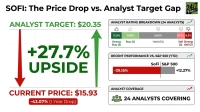
SoFi Technologies (NASDAQ:SOFI | SOFI Price Prediction) currently trades at $14.22. Wall Street’s average price target is $20.36, which works out to 43.18% upside.
SoFi is a digital bank built on three segments. Lending is the engine, Financial Services covers SoFi Money, SoFi Invest and credit cards, and the Technology Platform is anchored by Galileo. The business keeps setting records, and that is exactly why the stock’s drop stands out.
The most bullish call goes much further than the average. Citi’s Peter Christiansen rates SoFi a Buy with a Street-high $30.00 target, which means 110.97% upside. That is a double from here, and on a typical 12-month horizon it lands in 2027.
Profits Fell Behind Revenue and Investors Bailed
Earnings failed to keep pace with revenue, and the market punished it. StoneX analyst Mark Palmer said the shares “lagged because its earnings didn’t keep up with its revenue growth in the first half of 2026, although heavy marketing investment was a significant factor.” The stock is down 45.68% year to date. A drop that size marks a sharp rerating.
Second-quarter results pointed in two directions. Revenue of $1.22 billion beat estimates by 8.24%, and management raised full-year adjusted net revenue guidance to $4.75 to $4.85 billion. Adjusted EPS guidance stayed at about 60 cents, though. Management chose to reinvest, and it now assumes a 22% tax rate, roughly 700 basis points above its original plan. Technology Platform revenue also fell 23% after a large client left.
The selling has picked up recently. Shares lost 19.43% over the past month, including 6.69% in the latest session. Other fintech names fell that day too, so sector pressure is adding to doubts specific to SoFi.
Bulls Argue Wall Street Is Pricing Records as Retreats
Palmer opened coverage at Buy with a $25 target. He said that SoFi “added more members, more deposits, more products and more profit than in any prior quarter, but the market has marked the stock down as if all four were in retreat.”
The operating data supports him. Loan originations hit a record $14.80 billion, up 69%. Deposits rose to $45.5 billion, net interest margin reached 5.98%, and personal loan charge-offs improved to 2.62% from 2.83%. Existing members opened 51% of new products.
Citi’s case rests on three pillars: cross-selling that grows products faster than acquisition costs, scale in the Galileo platform, and steady margins backed by fee diversification. The platform pillar is the weakest given that 23% decline. For a timeline, bulls point to management’s medium-term targets of at least 30% annual revenue growth and a 38%-42% adjusted EPS CAGR through 2028. CEO Anthony Noto called those returns “just a matter of when, not if.”
Coverage is still split:
- Strong Buy: 4
- Buy: 5
- Hold: 12
- Sell: 2
- Strong Sell: 2
Upstart Shares SoFi’s Pain While Affirm Holds Firm
Several stocks in the group sold off with SoFi, but one big name held up. Upstart Holdings (NASDAQ:UPST) is down 48% year to date at $22.74, against a $39.31 target that means 72.87% upside. Its ratings break down into 2 Strong Buys, 6 Buys, 7 Holds and 1 Strong Sell.
Affirm Holdings (NASDAQ:AFRM) has fallen only 5.27% this year. At $70.51, its $98.28 target means 39.38% upside. Analysts are firmly bullish on Affirm, with 27 combined Buy and Strong Buy ratings and zero Sells.
Upstart offers the largest potential gain among these stocks. SoFi sits in the middle, with larger losses than Affirm and weaker analyst conviction. Price targets are estimates for every stock in the group, and none of them is guaranteed.
SoFi Badly Trails a Rising Market
At $14.22, SoFi trades well below the $20.36 consensus from 25 analysts, which points to 43.18% upside. Shares are down 45.68% year to date, while the S&P 500 is up 12.86%. Over one year, SoFi has lost 48.98% as the index gained 16.21%.
The stock trades at about 21 times forward earnings. With a beta of 2.332, it tends to move more than twice as hard as the market in either direction.
Execution Risk Is the Price of a Potential Double
The bull case strengthens if heavy marketing spend starts turning into earnings growth that keeps pace with revenue, and if credit holds up while originations keep growing. The case weakens if the Technology Platform keeps shrinking, charge-offs rise as the loan book expands, or management keeps delaying profits for more reinvestment.
The bull path is simple: profit catches up with revenue, SoFi Plus and fee income keep growing, and the market rewards those results. The bear risk is that SoFi is a high-beta lender carrying a consumer credit cycle that analysts may be underweighting.
A business posting record originations and member growth while trading at about 21 times forward earnings leaves room for a rerating if profits catch up. Citi’s $30 call needs everything to go right. The $20.36 consensus looks like the more realistic test for 2027.
Contact [email protected] for any questions or corrections.
Alex Sirois is a financial writer with experience spanning both retail and institutional investing. He has written for InvestorPlace and held roles at BNY Mellon and Bernstein, giving him a perspective that bridges Main Street portfolios and Wall Street analysis.
Alex holds an MBA from George Washington University and has built his career across multiple industries, including e-commerce, education, and translation — a breadth of experience that informs how he breaks down complex financial topics for everyday investors. His writing is conversational, actionable, and grounded in long-term, buy-and-hold investing principles.
At 247 Wall St., Alex focuses on delivering analysis that is both accessible and useful, with a clear emphasis on helping readers make more informed decisions with their money.