SoFi Stock Is Down More Than 40%. Here’s Why I’m Not Selling.
SoFi just posted record loan originations and its fifth straight earnings beat, yet the stock sits near a 52-week low. Before you cut losses, consider what the bears keep getting wrong about this fintech.


SoFi Technologies (NASDAQ:SOFI | SOFI Price Prediction) has been through a rough 2026, but the fundamentals keep getting better. Shares closed at $17.33, down roughly 47% from the 52-week high of $32.73.
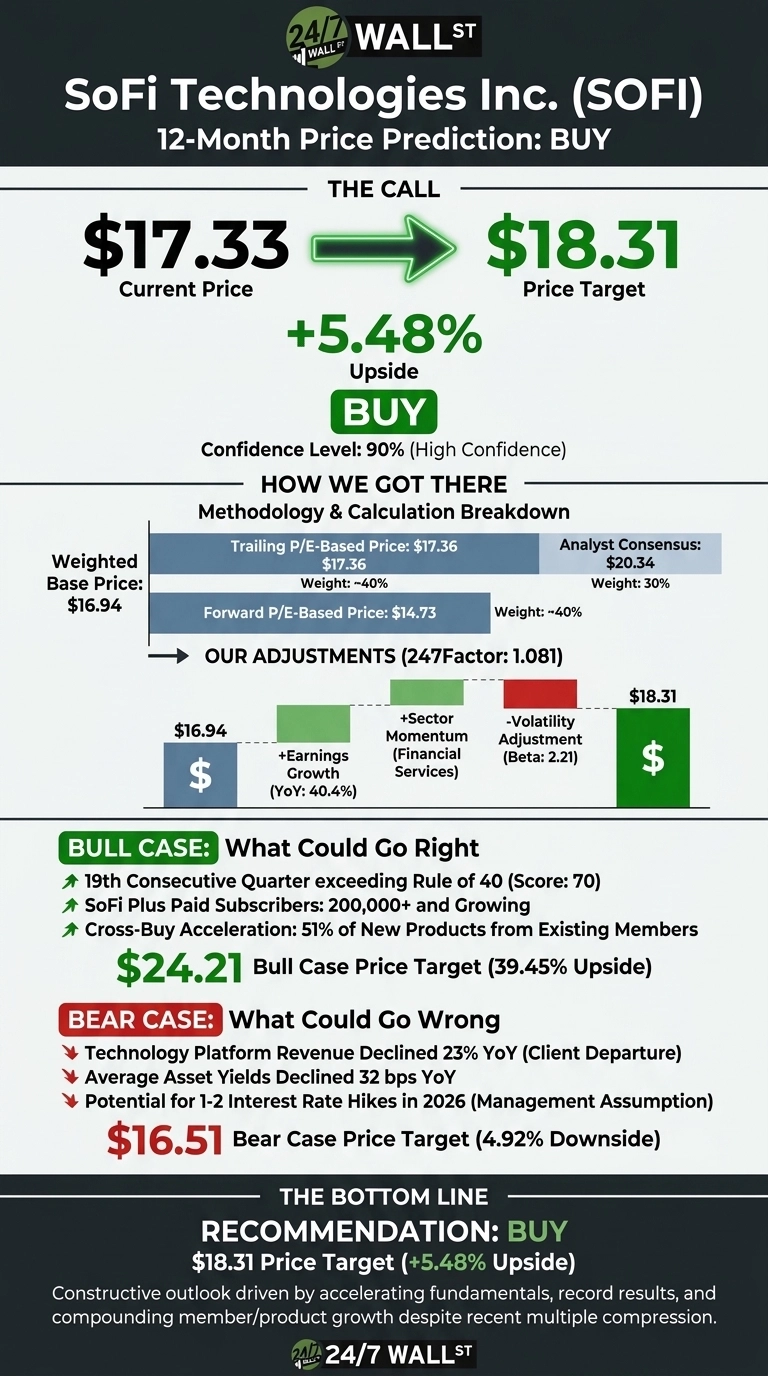
Our 24/7 Wall St. price target for SoFi is $18.31, implying 5.48% upside over the next 12 months. We rate it a buy with high confidence.
| Metric | Value |
|---|---|
| Current Price | $17.33 |
| 24/7 Wall St. Price Target | $18.31 |
| Upside | 5.48% |
| Recommendation | BUY |
| Confidence Level | 90% |

The case for staying constructive rests on operating performance accelerating even as the multiple compresses. SoFi keeps compounding members, products, and profits at rates that argue for patience.
Record Results Meet a Compressed Multiple
SoFi is down 33.8% year to date and 33.27% over the past year, with the 200-day moving average at $19.97.
Yet the Q2 2026 report on July 29, 2026 was excellent: revenue of $1.22 billion beat by 8.24%, EPS of $0.12 marked a fifth straight beat, and GAAP net income jumped 61% YoY to $156.59M.
Loan originations set a record at $14.80 billion, up 69%. Management raised full-year 2026 adjusted revenue guidance to $4.75B-$4.85B. This is a multiple compression story on top of accelerating fundamentals.
Why Bulls See a Path to $24
Our bull scenario puts SoFi at $24.21 in 12 months, a 39.45% return. On the Q2 call, CEO Anthony Noto said SoFi hit its “19th consecutive quarter exceeding the Rule of 40” with a score of 70.
Members reached 15.8 million, up 35%, and cross-buy hit 51% of new products versus 35% a year ago. SoFi Plus already has 200,000 paid subscribers, and Noto said he would be disappointed not to hit 1 million members generating $120 million in annual revenue within a year.
Medium-term guidance calls for ≥30% CAGR adjusted net revenue and 38-42% CAGR adjusted EPS through 2028. Against that, a forward P/E of 23 looks reasonable.

What Could Send SoFi Back to $16
Our bear case puts SoFi at $16.51. Technology Platform revenue fell 23% YoY after a large client departure, and average asset yields declined 32 bps YoY. Management now assumes one to two rate hikes in 2026 rather than cuts, a headwind for loan fair-value marks.
Analyst sentiment is mixed: 12 Hold versus 8 Buy/Strong Buy and 4 Sell/Strong Sell. Bulls would counter that the Tech Platform weakness is isolated to one client, while lending remains healthy: net interest margin at 5.98% with personal loan charge-offs improving to 2.62% from 2.83%.

How SoFi Compares to Robinhood and Affirm
Robinhood (NASDAQ:HOOD) is the premium fintech comp. HOOD carries a $91.1 billion market cap, roughly 4x SoFi’s $22.38 billion, on Q2 2026 revenue of $1.31 billion that grew 32%.
Robinhood earned $0.62 per share, but SoFi’s growth rate is comparable and its bank charter and NIM story are unique. The valuation gap makes SoFi look like the cheaper fintech vehicle.
Affirm (NASDAQ:AFRM) is a closer size match at $20.2 billion. Affirm’s latest quarter delivered revenue of $1.04 billion, up 32.64%, with net income of $102.9 million.
SoFi’s $156.59M in GAAP net income beats that on similar revenue, and SoFi’s product breadth goes well beyond BNPL. That peer set makes our 24/7 Wall St. price target look reasonable.
SoFi Price Prediction 2026-2030
The 24/7 Wall St. price target of $18.31 at 90% confidence reflects a company executing well into a compressed multiple. The bullish setup would strengthen if SoFi Plus scales to Noto’s 1 million subscriber target and Tech Platform revenue reaccelerates. Caution would be warranted if the Fed’s hiking bias worsens credit or if cross-buy plateaus. For now, the setup favors patience.
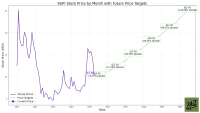
Extending our model on the Rule of 40 cadence and management’s medium-term growth framework, here is where the 24/7 Wall St. price target could trend using our five-year base case as anchor.
| Year | 24/7 Wall St. Price Target |
|---|---|
| 2026 | $18.31 |
| 2027 | $18.57 |
| 2028 | $19.29 |
| 2029 | $20.85 |
| 2030 | $21.57 |
These projections assume SoFi executes on its ROTCE framework. Meaningful upside could come from SoFi Plus scale and Big Business Banking adoption; downside would follow from credit deterioration or a Tech Platform stall.
Contact [email protected] for any questions or corrections.
Vandita Jadeja is a financial publisher with over a decade of experience writing about financial topics, including investment, savings, retirement, insurance and banking. Vandita is a Chartered Accountant who loves to debunk financial concepts for readers.
Her work has appeared on sites that include The Motley Fool, InvestorPlace, and Benzinga. She covers investing and focuses on stock picks and price prediction for 24/7 Wall St.
When not looking for the next stock investment opportunity, she can be found traveling, reading, chasing sunsets and enjoying her iced latte.