3 Dividend Stocks With Economic Moats That Are Almost Impossible to Cross
Building a second freight network across the United States would take over a century and cost more than any rival could justify, and that physical impossibility quietly funds the dividends three railroad giants pay their shareholders. Here is what separates…

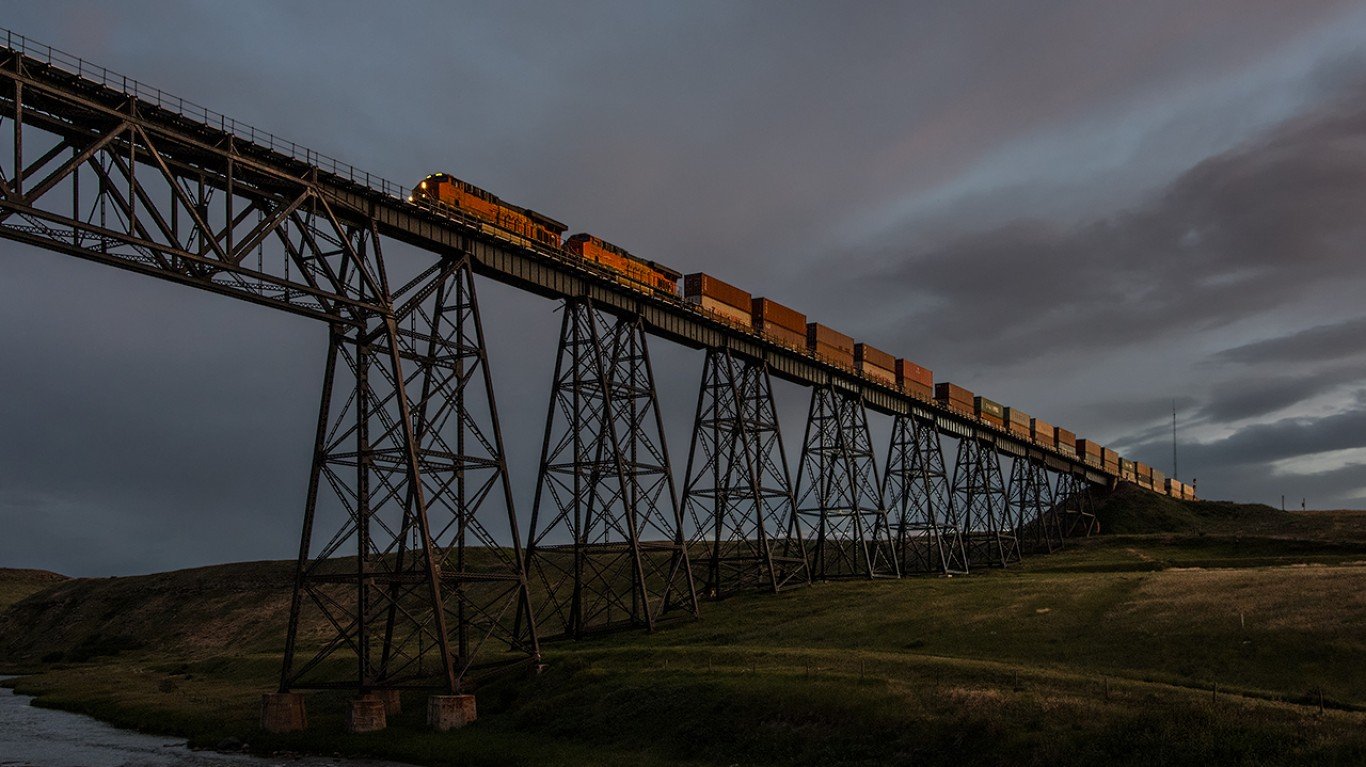
Nobody is going to lay a second freight network across the US. The rights of way, bridges, tunnels and yards behind Union Pacific (NYSE:UNP | UNP Price Prediction), CSX (NASDAQ:CSX) and Norfolk Southern (NYSE:NSC) took more than a century to put together. That gives all three the pricing power that funds steady shareholder payouts. Union Pacific shows what that looks like over decades: its quarterly dividend has grown from $0.20 in the earliest listed records, which start in 1999, to $1.42 in the latest declaration. The yields are low. The case for owning these railroads is strength, coverage and growth on assets no rival can duplicate.
Union Pacific: The Western Network With the Strongest Cash Engine
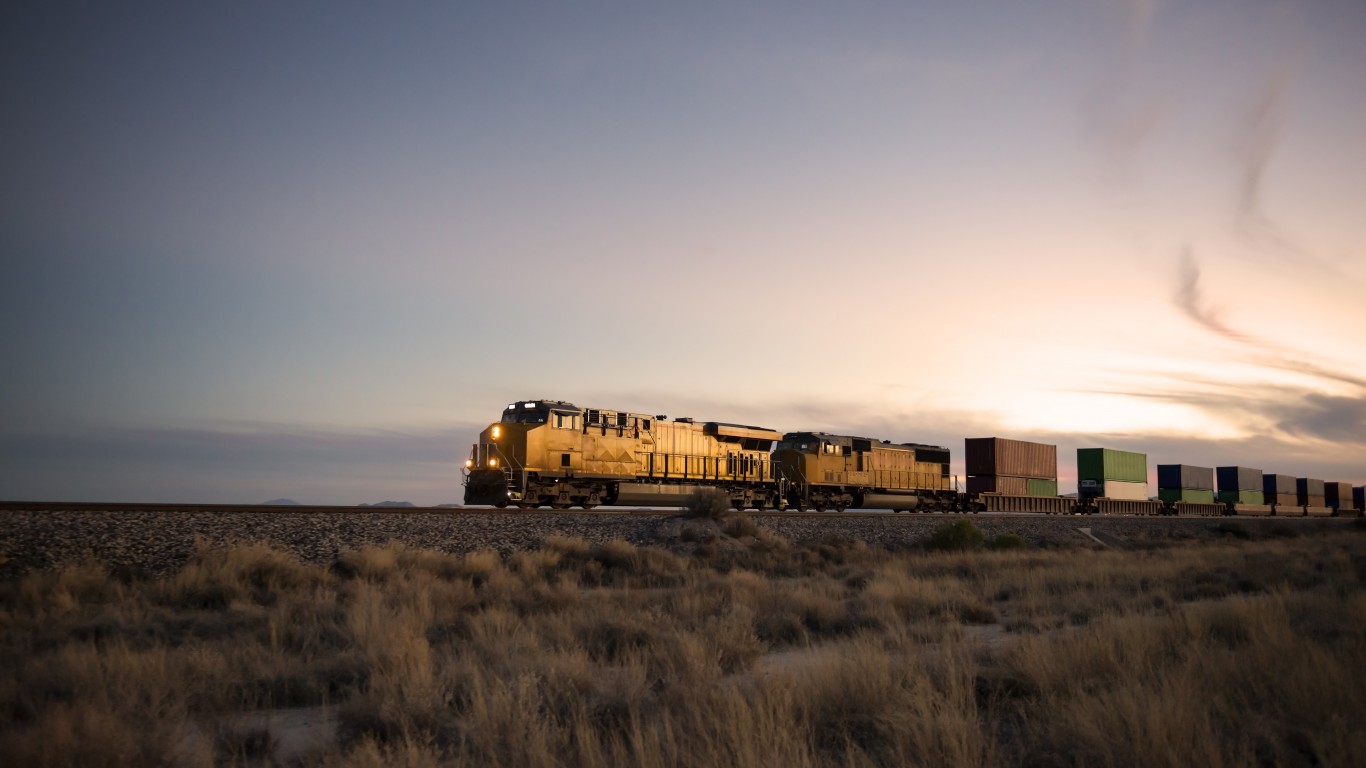
Union Pacific runs the largest US Class I railroad, covering the territory west of the Mississippi. It hauls domestic intermodal containers, grain, petrochemicals, renewable fuels, metals and cars. Management is putting capital into the Houston Complex and double-tracking the Sunset Route from Yuma to Tucson and toward El Paso. Intermodal revenue rose 26% to $1.386B in the second quarter as a tighter trucking market pushed freight onto rail.
At $288.41, the stock yields 1.96% on a trailing dividend of $5.52. The forward annualized rate is now $5.68, because the board raised the quarterly payout to $1.42 from $1.38.
Dividend safety: Union Pacific pays out about 45% of trailing EPS of $12.34. Cash from operations reached $5.5 billion, up 21%, and the CFO, Jennifer Hamann, said “free cash flow totaled $1.8 billion after we reinvested in our network and returned an industry-leading dividend to our shareholders.” The company also paid down $1.5 billion of long-term debt in the first half, bringing adjusted debt to EBITDA to 2.5 times. The quarterly rate has climbed in steps: $1.30, then $1.34, $1.38 and now $1.42.
Bull case: Union Pacific is the most efficient railroad in the group. Its adjusted operating ratio of 59.2% improved 110 bps, and management committed to “consistent annual dividend increases” while raising 2026 guidance to high-single-digit reported EPS growth. The stock trades at 19 times forward earnings, compared with 23 times trailing.
Risk: The pending Norfolk Southern acquisition. Regulators accepted the revised application on May 28, 2026, and comments on the merits are due November 18, 2026, with responses due February 16, 2027. A combination this large brings integration costs and possible regulatory conditions. Those costs would compete with dividend growth for cash.
CSX: Lowest Payout Ratio and a Raise Every Year
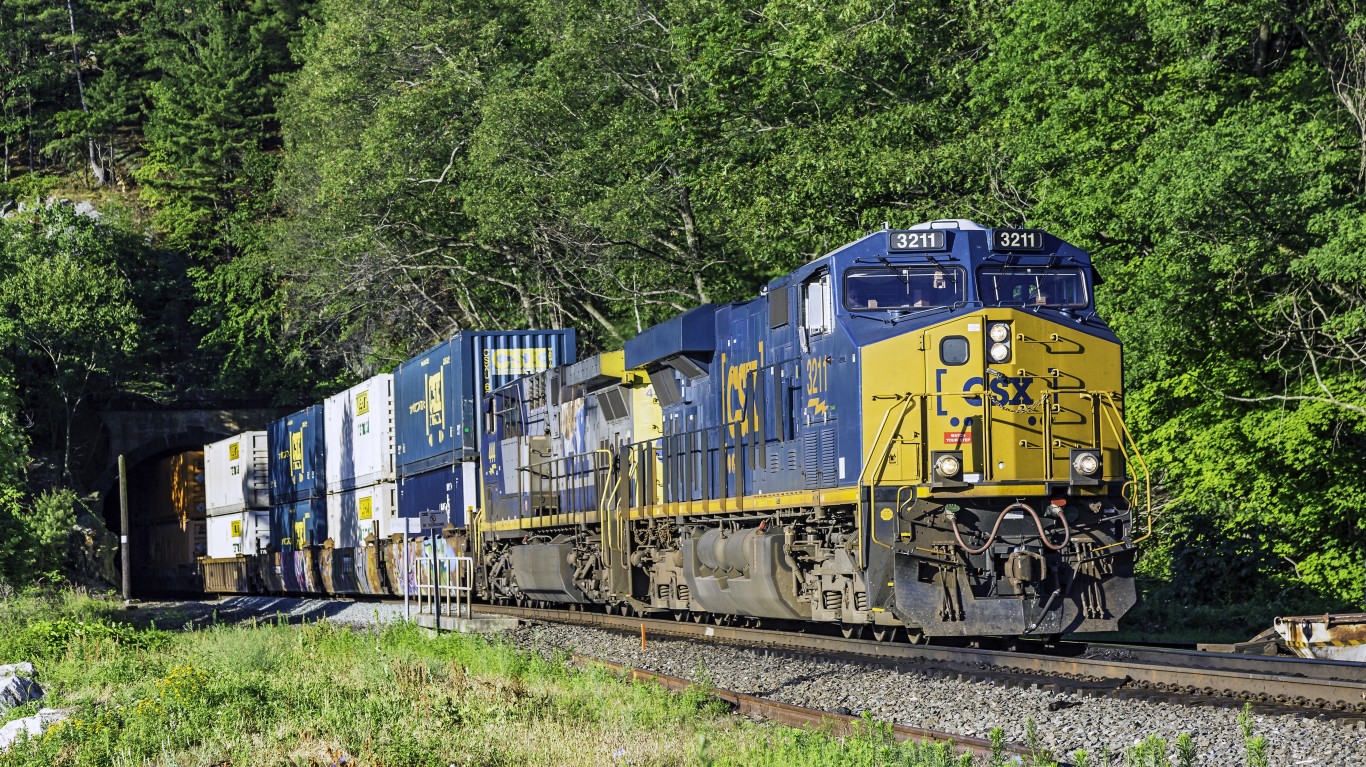
CSX is the independent Eastern railroad, headquartered in Jacksonville, Florida. Its traffic mix covers merchandise, intermodal, coal, metals and heavy equipment, and the Howard Street Tunnel has opened new double-stack capacity. Second-quarter revenue hit a record $3.935B, up 10.1%. Intermodal revenue rose 26% on 9% higher volume, and operating margin expanded 240 bps to 38.3%.
At $48.58, CSX yields 1.13% on a trailing dividend of $0.54, and the forward annualized rate is $0.56. The yield is thin partly because shares are up 35.24% year to date.
Dividend safety: This is the best-covered payout of the three, at about 31% of trailing EPS of $1.72. First-quarter free cash flow was $793M, up 47.95%, and management now expects “free cash flow growth of greater than 80%” for the year, with capital spending held at less than $2.4 billion. That cash also funded $506M of buybacks in the first half. The quarterly dividend went from $0.10 in 2022 to $0.11 in 2023, $0.12 in 2024, $0.13 in 2025 and $0.14 in 2026, with the next $0.14 payment due December 15.
Bull case: A low payout ratio and fast-rising free cash flow give CSX more room to raise its dividend than either peer. The chief executive put the discipline simply: “What’s most important is that the business we add increases operating income, expands margins, and delivers good returns on invested capital.” Q2 EPS of $0.54 beat the $0.52 consensus.
Risk: Coal. CSX coal revenue rose 9% on 4% higher volume, but coal demand swings with utility burn and steel markets more sharply than any other major commodity on the network. The stock’s beta of 1.203 reflects that sensitivity. A coal downturn would hit CSX’s margins faster than its peers’.
Norfolk Southern: 22 States of Track and a Dividend on Pause
Norfolk Southern operates 19,420 route miles in 22 eastern states and the District of Columbia. Second-quarter revenue rose 11.4% to $3.465B, led by Merchandise at $2.133B, Intermodal at $908M (+22.2%) and Coal at $424M. Adjusted EPS of $3.52 beat the $3.32 consensus.
At $324.70, the stock yields 1.69% on an annualized dividend of $5.40.
Dividend safety: The payout takes up about 46% of trailing EPS of $11.72, which is manageable. Cash flow is the weak spot: first-quarter operating cash flow fell 63.79% to $344M, below capex of $382M, and full-year capex guidance is about $1.9 billion. The dividend has stayed at $1.35 per quarter for every payment since the February 2023 ex-date, after stepping up from $0.94 in 2020 to $1.24 in 2022. The record shows no gap. It also shows no recent raise.
Bull case: Operating leverage is turning. Management committed to at least $150 million in cost takeout during 2026 and at least $650 million in cumulative savings over three years. The commercial chief described “a very optimistic freight market out there.” Better cash generation would give the board room to resume raises.
Risk: The Eastern Ohio derailment still weighs on results. First-quarter net income swung partly because of $185M net recoveries in Q1 2025 vs $10M net expense in Q1 2026, and the litigation is ongoing. Unpredictable legal costs make it harder for the board to commit cash to a higher dividend.
Why Freight Cycles Hit Share Prices Before Dividends
Railroads are cyclical. Carloads follow industrial output, coal burn, housing and consumer spending, so this year’s volume gains of 2% at Union Pacific, 6% at CSX and 4% at Norfolk Southern can reverse. CSX’s CFO said the business “has a lot of fixed costs”, so operating leverage works in both directions. Falling volume cuts EPS faster than it cuts revenue, and the share price usually reprices on the first signs of a slowdown. Fuel adds pressure too: Norfolk Southern raised its 2026 expense outlook to $8.8 to $8.9 billion.
Dividends take that hit later. With payout ratios between roughly 31% and 46%, earnings have a wide buffer before the payout comes under strain. A management response to a downturn is more likely to show up as smaller raises or a freeze, which is what Norfolk Southern’s flat payout looks like.
Three Railroads, Three Different Income Profiles
Union Pacific offers the most balanced income profile: the highest yield of the three, a rising payout and the strongest cash engine. CSX has the most room to grow its dividend, with the lowest payout ratio and free cash flow that is compounding quickly. Norfolk Southern pays a reliable but flat dividend, so its income story depends on cost savings and the regulatory review that resumes when comments come due in November. All three own track that no competitor can rebuild, and that advantage is ultimately what funds the dividends.
Contact [email protected] for any questions or corrections.
Chris Lange is a financial and geopolitical writer with more than a decade of experience covering a myriad of topics. He has published thousands of articles for 24/7 Wall St., with past coverage focused heavily on stocks, IPOs, healthcare, defense, global affairs, and technology.
His work has been quoted, or referenced by a number of outlets including Business Insider, USA Today, Yahoo Finance, MSN, The Motley Fool, and many other publications. A graduate of Southwestern University, he studied business with a focus on investments and has previous experience in banking and startups.
When not reading or writing the news, he is following his passion for Lacrosse, playing chess, or building solar projects with his dad.