This Magnificent Seven Stock Could Make Investors Richer by 2027
NVIDIA's stock has pulled back over the past week, but analysts keep raising their estimates and the company keeps beating them. Whether an 80% gain is achievable by 2027 depends on a few catalysts falling into place at exactly the…


NVIDIA (NASDAQ:NVDA | NVDA Price Prediction) sells complete AI factories. That means GPUs, Vera CPUs, NVLink, InfiniBand and Spectrum-X networking, all tied together by CUDA software.
CEO Jensen Huang described where things stand on the August earnings call: “AI has reached its inflection point. It’s doing useful work. Its tokens are productive and profitable. Now, compute is revenue.”
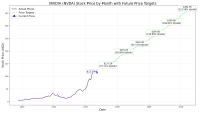
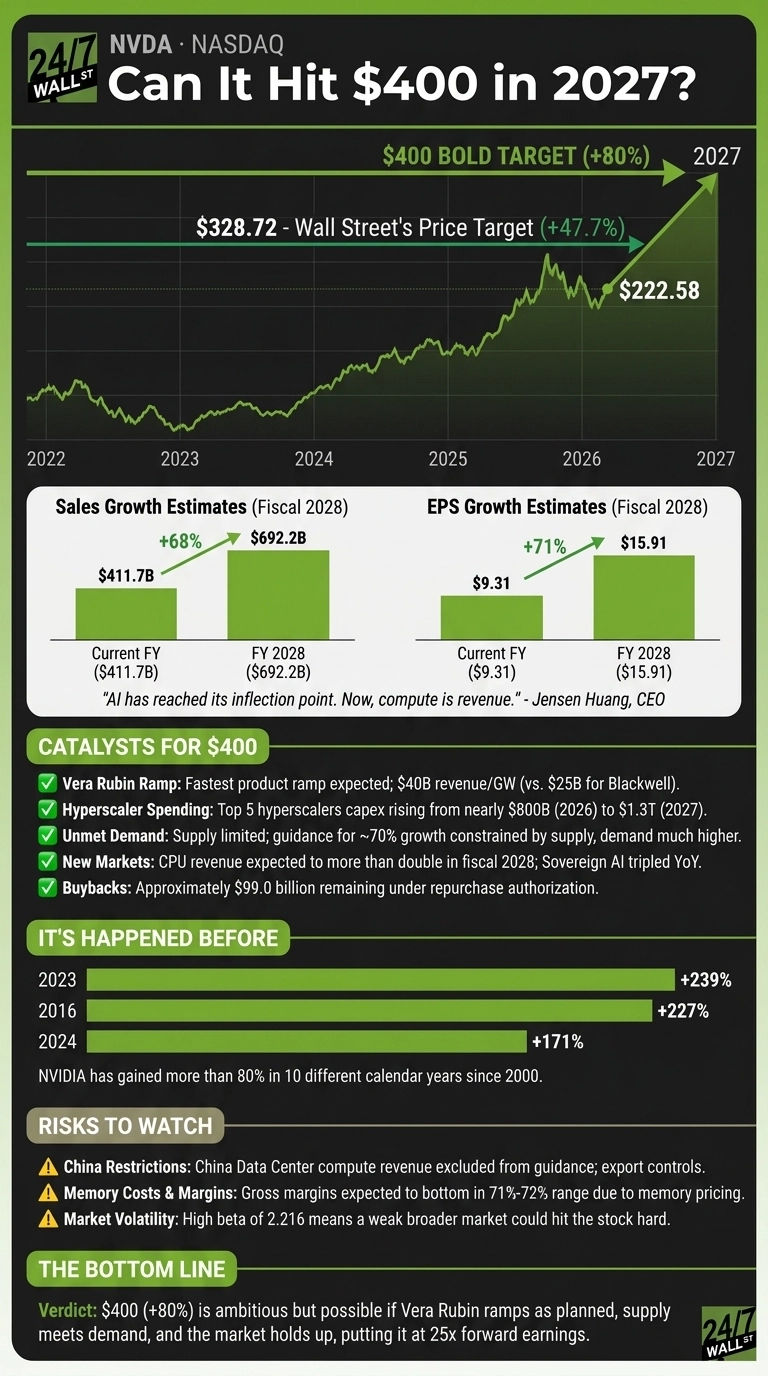
Shares trade at $222.58. That’s up 19.63% year to date and 928.03% over five years. A 6.96% drop over the past week gives the stock a lower starting point. Here’s what NVIDIA needs to reach $400 by the end of 2027.
Wall Street Already Sees Nearly 48% Upside
The consensus price target is $328.72, which means 47.7% upside. Analysts are close to unanimous, with 10 Strong Buy and 49 Buy ratings against a single Sell.

Analysts expect fiscal 2028 revenue of $692.2 billion, up from $411.7 billion this year, which would be 68% growth. The EPS estimate of $15.9146 means 71% growth. Ninety days ago, the same estimate was $12.7102. Over the past 30 days, analysts made 46 upward revisions and zero downward.
NVIDIA has also beat EPS estimates for five consecutive quarters, most recently posting $2.22 against a $2.0887 estimate. Actual results have a habit of exceeding forecasts.

Path to $400 Per Share: Let’s Do the Math
NVIDIA trades at 14x fiscal 2028 earnings. That fiscal year runs through January 2028. At $400, the multiple would rise to 25x, only slightly above the S&P 500’s 21-23x forward range, for a company expected to grow earnings 71%. Getting there requires a gain of about 80%.
What Could Push NVIDIA to $400?
- Vera Rubin ramp: Management expects “the fastest product ramp in NVIDIA’s history.” Revenue per gigawatt rises to $40 billion with Rubin, up from $25 billion for Blackwell.
- Hyperscaler spending: Capital spending by the top five hyperscalers is expected to rise from nearly $800 billion in 2026 to $1.3 trillion in 2027.

- Unmet demand: Guidance calls for approximately 70% fiscal 2028 growth, and that guidance is limited by supply. Huang said, “We have supply for 70%. Our demand is much higher than that.”
- New markets: CPU revenue is expected to more than double in fiscal 2028. Sovereign AI revenue more than tripled year over year.
- Buybacks: Roughly $99 billion remains under the repurchase authorization.
That hyperscaler capex has to be spent on more than GPUs. We rounded up seven suppliers powering, cooling, and networking the AI expansion in a free report here.
These challenges are real. China data center revenue is left out from guidance. Memory costs should push gross margins down to 71% to 72% in Q4. A beta of 2.216 means a weak market would hit the stock hard.

NVIDIA’s History Says an 80% Gain Is Possible
Since 2000, NVIDIA has gained more than 80% in 10 different calendar years. Shares rose 239% in 2023, 171% in 2024, 125% in 2021 and 227% in 2016.
With a market cap of about $5.37 trillion, repeating those returns gets harder. Still, the stock has made moves this large many times before.
Is $400 Realistic? Here’s My Take
Reaching $400 means an 80% gain. Analysts project nearly 48% upside, estimates keep rising, and NVIDIA keeps beating them.
If Vera Rubin ramps as planned, supply matches up with demand and the market holds up, $400 would put NVIDIA at just 25x forward earnings. Keep an eye on gross margins and China policy. Annual gains like this won’t happen every year, but NVIDIA could follow this path to outsized returns in 2027.
Contact [email protected] for any questions or corrections.
Vandita Jadeja is a financial publisher with over a decade of experience writing about financial topics, including investment, savings, retirement, insurance and banking. Vandita is a Chartered Accountant who loves to debunk financial concepts for readers.
Her work has appeared on sites that include The Motley Fool, InvestorPlace, and Benzinga. She covers investing and focuses on stock picks and price prediction for 24/7 Wall St.
When not looking for the next stock investment opportunity, she can be found traveling, reading, chasing sunsets and enjoying her iced latte.