Warren Buffett Has Held Coca-Cola for Decades. Here’s What $1,000 in the Stock Since 1999 Is Worth Today
Berkshire Hathaway has held Coca-Cola since the late 1980s, but what happened to an ordinary investor who bought in at the turn of the millennium tells a more complicated story about patience, timing, and whether the stock still has room…

Berkshire Hathaway (NYSE:BRK-B | BRK-B Price Prediction) started buying Coca-Cola (NYSE:KO) in the late 1980s, and the position became the classic example of buy-and-hold investing. Berkshire’s 13F for the quarter ended June 30, 2026 showed 400 million shares worth $32.5 billion, with no change in share count that quarter. That entry came decades ago. Here’s what a buyer on November 1, 1999 got instead.

From Bottler to Asset-Light Brand Machine
Over this stretch, Coca-Cola moved away from capital-heavy bottling. Today it mainly sells concentrates and syrups to bottling partners, and the refranchising continues. India operations are going to Jubilant Bhartia Group, and the sale of Coca-Cola Beverages Africa is expected to close in Q3 or Q4 2026.
The portfolio also grew well beyond soda to include BODYARMOR, fairlife, Costa and Topo Chico. Some deals fell through. BODYARMOR took a $960M trademark impairment in 2025. Coca-Cola Zero Sugar became the growth engine, with volume up 16% in the latest quarter. Leadership also changed hands when Henrique Braun replaced James Quincey as CEO.
Your 1999 $1,000 Grew to $6,680, and Dividends Come on Top
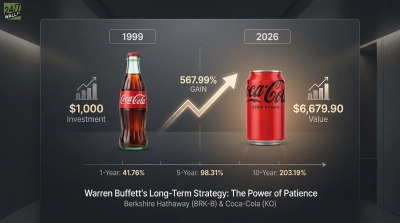
The split-adjusted share price rose from $14.06 to $93.90, a 567.99% gain. That makes $1,000 worth $6,679.90, about 7.3% a year. These figures count share price growth only. Dividends paid along the way would push the total higher.
1-Year Return
- Initial Investment: $1,000
- Current Value: $1,417.60
- Total Return: 41.76%
- S&P 500 (same period): $1,162.10 (16.21%)
5-Year Return
- Initial Investment: $1,000
- Current Value: $1,983.10
- Total Return: 98.31%
- Annualized Return: 14.7%
- S&P 500 (same period): $1,721.90 (72.19%)
10-Year Return
- Initial Investment: $1,000
- Current Value: $3,031.90
- Total Return: 203.19%
- Annualized Return: 11.7%
- S&P 500 (same period): $3,592.50 (259.25%)
Coca-Cola beat the benchmark over one and five years but trailed it over ten. A lot of the recent strength came in 2026. Shares are up 36.09% year to date as organic revenue grew 10% in Q1 and Q2 EPS came in at $0.97, ahead of estimates. Timing counted a lot. A buyer a year ago paid $65.83. Today the stock trades near its 52-week high of $94.10.
What Could Drive Coca-Cola Higher, and What Could Hold It Back
The optimistic thesis rests on zero-sugar and international volume keeping earnings compounding at a high single-digit pace. Management raised guidance to comparable EPS growth of 9-10% and free cash flow of about $12.4B. The company has also raised its dividend for 63 straight years.
The worry is that repeating 2026 would be hard to match. At a trailing P/E of 28 and a forward multiple of 25, investors are paying a lot for a company whose guidance includes about a 3% currency boost. The stock already sits close to the $94.74 average analyst target, and Q4 2026 has six fewer days than Q4 2025.

For now, the valuation leaves little room for error. The bigger lesson is patience. An ordinary investor who held from 1999 grew their money more than six times before counting a single dividend. Buffett researched KO decades ago, and we sorted Berkshire’s current holdings to find the seven cheapest dividend payers he still owns, in a free report here.
Contact [email protected] for any questions or corrections.
Chris Lange is a financial and geopolitical writer with more than a decade of experience covering a myriad of topics. He has published thousands of articles for 24/7 Wall St., with past coverage focused heavily on stocks, IPOs, healthcare, defense, global affairs, and technology.
His work has been quoted, or referenced by a number of outlets including Business Insider, USA Today, Yahoo Finance, MSN, The Motley Fool, and many other publications. A graduate of Southwestern University, he studied business with a focus on investments and has previous experience in banking and startups.
When not reading or writing the news, he is following his passion for Lacrosse, playing chess, or building solar projects with his dad.