Will Interest Rates or Chips Decide the AI Trade?
Jim Cramer drew a line in the bond market that could upend every major AI trade, and the number he named sits uncomfortably close to where long-term yields already stand. Here is what the rate trigger means for the companies…


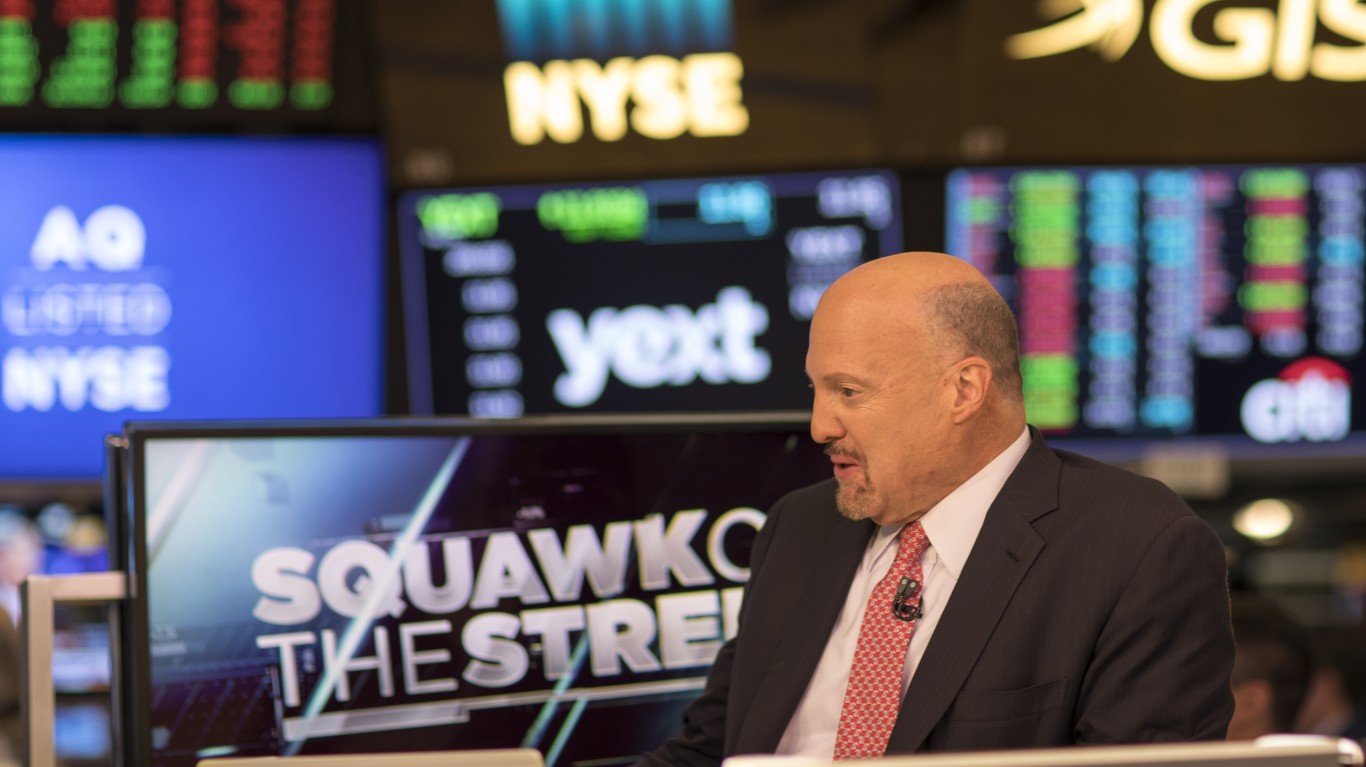
Jim Cramer closed his October 19 Mad Money broadcast by moving AI investors’ attention away from chips and toward bonds. “Let’s spend less time on whether Nvidia’s GPUs hold their value, more time on whether the Fed is satisfied with its progress in the fight against inflation,” he said. “In other words, we kid ourselves if we don’t think the rates matter.” Long-term investors who hold artificial intelligence through index funds own big stakes in Microsoft (NASDAQ:MSFT | MSFT Price Prediction), Amazon (NASDAQ:AMZN) and Nvidia (NASDAQ:NVDA), so his warning hits their largest positions.
Cramer’s 6% Treasury Line Every AI Shareholder Should Know
Cramer set a clear trigger: “If the yield of the 30-year Treasury goes north of 6%, look out.” He described one debt-heavy AI cloud provider as “a little boat in the sea of interest rates.” The 30-year par yield closed at 5.48% on October 19, after reaching 5.67% on October 7. The Fed’s target upper bound held at 4.00%.
Cost of capital is the blended return a company must pay lenders and shareholders to fund projects. Cramer said that “if 15% is your cost of capital, it’s going to cost you an arm and a leg to build a data center.” Oracle (NYSE:ORCL) shows the pressure: interest expense climbed in fiscal Q1 2027 (up 55% to $1.4 billion), with capex of $28.5 billion and free cash flow of −$5.4 billion. Its shares are down 33.8% year to date. Microsoft said its interest expense now includes “the interest payments related to datacenter finance leases.”
Borrowing Long Against Contracts Customers Can Exit
A panelist on CNBC’s Fast Money pointed to “this mismatch in duration”: “They’re borrowing long and their contracts are such, it’s not actually that hard to walk away from them.” In plain terms, a duration mismatch means debt runs for many years while the revenue backing it can disappear sooner. The show also asked whether Microsoft’s ability to walk away from a lease “would throw into question a lot of other leasing agreements.” According to a Bloomberg report cited on air, Anthropic took over a UK lease that Microsoft vacated.
Data center landlords carry this exposure directly. Digital Realty (NYSE:DLR) raised roughly $1.3 billion through share sales and increased planned long-term debt issuance to between $1.5 billion and $2.0 billion. Equinix (NASDAQ:EQIX) expects its blended cost of capital to rise about 150 basis points while annual capex climbs to $5 billion to $7 billion. Over the past week, Equinix fell 6.0% and Digital Realty fell 4.3%. (The landlords are only one slice of the expansion: we examined seven suppliers across power, cooling, and networking in a free report on the AI boom beyond the chipmakers.)
Slower Growth Can Sting at Record Spending Levels
A CNBC Fast Money panelist warned that if capex next year totals $1 trillion instead of $1.2 trillion, “it’s the rate of change that becomes really problematic for stock prices.” Nvidia’s finance chief said top-five hyperscaler capex should reach nearly $800 billion in 2026 and $1.3 trillion in 2027. Nvidia’s data center revenue jumped 117% to $89.02 billion, and Amazon’s trailing free cash flow turned negative at −$7.6 billion. Any slowdown affects both suppliers and buyers.
Big Names Get No Pass on Leverage
A guest on Bloomberg Businessweek extended the worry beyond niche players: “SpaceX is incredibly levered as well. So if the market is not liking the high leverage for these neoclouds, I don’t think SpaceX gets a pass either.” Leverage means funding operations with borrowed money, which amplifies both gains and losses.
A Missing Hedge for GPU Owners
A guest on Bloomberg’s Odd Lots podcast argued that leadership in AI requires a futures market: “We want to be the leader of data centers. We need to have a risk offset for these GPUs and other components.” For now, owners of GPU fleets and their lenders are exposed to hardware price swings with no way to hedge them.
Three Signals That Decide the Trade
- The 30-year yield: Cramer’s 6% threshold is the level to watch against today’s 5.48%.
- Capex guidance: Microsoft guided fiscal Q1 capex to over $50 billion. Any 2027 outlook that shows slowing growth will reprice the entire sector.
- Lease cancellations: Each hyperscaler exit tests whether long-dated debt still has paying tenants behind it.
Contact [email protected] for any questions or corrections.
Trey has been an editor and author at 24/7 Wall St. for more than a decade, where he has published thousands of articles analyzing corporate earnings, dividend stocks, short interest, insider buying, private equity, and market trends. His comprehensive coverage spans the full spectrum of financial markets, from blue-chip stalwarts to emerging growth companies.
Beyond 24/7 Wall St., Trey has created and edited financial content for Benzinga and AOL's BloggingStocks, contributing additional hundreds of articles to the investment community.
Trey's editorial expertise extends across multiple publishing environments. He served as production editor at Dearborn Financial Publishing and development editor at Kaplan, where he helped shape financial education materials. Earlier in his career, he worked as a writer-producer at SVE. His freelance editing portfolio includes work for prestigious clients such as Sage Publications, Rand McNally, the Institute for Supply Management, the American Library Association, Eggplant Literary Productions, and Spiegel.
Outside of financial journalism, Trey writes fiction and has been an active member of the writing community for years, moderating workshop sessions at regional conventions.