AI Cloud Stocks Rise as Musk Calls Overcapacity Talk ‘Ridiculous’: Nebius and CoreWeave Gain 3%, Oracle Edges Higher
Elon Musk spent last week spooking AI cloud investors with a single word, then reversed course entirely on a SpaceX earnings call, and now Nebius and CoreWeave shares are racing to recover ground while one critical market signal holds the…


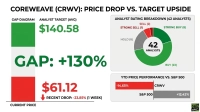
Relief is flowing back into the specialized AI cloud providers that absorbed the biggest damage in last week’s selloff. Nebius Group (NASDAQ:NBIS | NBIS Price Prediction) stock is at $176.60, up 3%, a rebound that recovers part of last week’s damage. Likewise, CoreWeave (NASDAQ:CRWV) stock is at $63.77, up 3%, matching the gain in Nebius shares.
Oracle (NYSE:ORCL) stock trades at $132.92, up 1%, a smaller gain than Nebius and CoreWeave shares are posting. Cloud stocks as a group are lagging as well, a sign that the buying is narrow. The First Trust Cloud Computing ETF is at $164.95, up by only 0.9%.
Large-cap tech is trailing Nebius and CoreWeave shares by an even wider margin. As a tech-sector check, the Invesco QQQ Trust (NASDAQ:QQQ) is at $721.68, up 0.6%.
Musk Calls AI Overcapacity Talk ‘Ridiculous’
After the prior session’s close, SpaceX (NASDAQ:SPCX) held its Q3 2026 earnings call. On that call, SpaceX founder Elon Musk called talk of excess capacity in AI infrastructure “ridiculous,” adding, “I don’t think we’re going to have a demand issue here.” He also stated that SpaceX is “hounded relentlessly by every hyperscaler and by dozens of smaller companies to rent more of our compute.”
The comment on the SpaceX call reverses the tone Musk struck last week, when he posted “Yikes” on X in response to rising yields on CoreWeave’s bonds. That post helped fuel a selloff in shares of CoreWeave, Nebius and other AI cloud names. Musk’s new remarks arrived alongside a SpaceX report showing Super Intelligence segment revenue up 830% year over year to $7.6 billion.
Nebius and CoreWeave Lead a Narrow Rebound
Specialized cloud providers Nebius and CoreWeave rent graphics processor capacity to AI developers, while Oracle sells that compute as one part of a much larger software and database business. Oracle stock entered the rally down 32% year to date (YTD), and its diversified base cushions the downside while damping the upside in sentiment swings like this one.
Nebius chief revenue officer Marc Boroditsky said Nebius funds its growth through equity raises, convertible offerings and upfront customer payments, a mix that steers clear of the kind of debt behind last week’s concerns. Boroditsky added that Nebius could sell all of next year’s planned capacity immediately at current prices. Remaining performance obligations at Nebius total $37.5 billion, giving that claim contractual backing.
Even after the recent drawdown, Nebius stock carried a 105% YTD gain into the rally, giving holders a large cushion. Biggest spending at Nebius cut the other way, since the company spent $8.13 billion on graphics processor and data center infrastructure in the first half of 2026. Three customers also each accounted for more than 10% of Nebius revenue in its latest quarter, a concentration that raises its risk profile.
Demand at CoreWeave looks similar, with a revenue backlog of $104 billion at the end of Q2 2026 and more than $25 billion of net new customer commitments added in early Q3. CoreWeave CEO Michael Intrator declared in the Q2 report, “CoreWeave reached an important inflection point this quarter as our scale began to translate into expanding operating leverage.” One uncertainty for CoreWeave is its reliance on debt to fund that expansion.
Financing Questions Decide the Next Leg for Neoclouds
A key question for Nebius is whether financing worries fade as demand commentary stays strong. Rising yields on CoreWeave’s bonds started last week’s slide, making the debt market the clearest gauge of sentiment toward neocloud stocks.
Musk stated he was “fairly confident” SpaceX could bring an incremental 10 gigawatts of compute online in 2027. SpaceX also guided for Q4 2026 capital expenditures of $35 billion to $40 billion, a spending pace that supports the demand case for AI capacity providers.
That scale of spending has to land somewhere, and the power, cooling, and networking suppliers behind the data centers tend to be the quieter beneficiaries. We pulled seven of them into a free report you can grab here.
Payback on SpaceX’s existing compute deployments runs less than a year at current pricing, according to management, a sign that rental demand still outpaces supply. Nebius and CoreWeave shares remain volatile, so investors weighing their exposure should adjust their holdings carefully given that a fresh shock from the bond market could reverse the bounce.
Contact [email protected] for any questions or corrections.
David Moadel is financial writer specializing in stocks, ETFs, options, precious metals, and Bitcoin. David has written well over 1,000 articles for leading online publications, helping investors understand markets, income strategies, and risk.His work has appeared in The Motley Fool, InvestorPlace, U.S. News & World Report, TipRanks, ValueWalk, Benzinga, Market Realist, TalkMarkets, Finmasters, 24/7 Wall St., and others.With a master’s degree in education, David has taught at the elementary, high school, and college levels. That teaching background shapes his writing style: clear, educational, and practical. David has also built a loyal social-media audience by providing trustworthy financial content on YouTube, X/Twitter, and StockTwits.