Prediction: Nvidia’s Road to $1 Trillion in Annual Revenue Could Transform Its Stock
Nvidia just posted triple-digit revenue growth and guided even higher, yet the stock sits barely above where it started the year. The question of whether shares can surge another 63% by 2027 comes down to three things that all have…

NVIDIA (NASDAQ:NVDA | NVDA Price Prediction | NVDA Price Prediction) just reported $96.22B in quarterly revenue, up 105.8% year over year. It guided to $108B for the current quarter. Annualize that guide and you get a $432B run rate.
A path to far larger annual revenue is starting to show. Even so, the stock is up only 15.08% year to date. So can NVIDIA hit $350 in 2027?

What’s Holding NVIDIA Back Right Now
Investors are worried about funding. Shares fell 6.61% last week and are up just 0.11% over the past month. CNBC reported that Nvidia, AMD and Dell sank in a global tech rout on AI funding worries. Supply commitments have climbed to $279B, and guidance includes no China Data Center compute revenue.
Management also expects gross margins to bottom in the 71% to 72% range in Q4. With a beta of 2.216, the stock tends to swing harder than the market whenever confidence in AI spending slips.
Analysts Are Bullish, and I Think They Are Still Too Cautious
Wall Street’s consensus target is $328.72. Analyst ratings break down to 10 Strong Buys, 49 Buys, 2 Holds and 1 Sell. Our model’s central estimate is $258.42, which is 20.68% upside, and its full range runs from $225.15 to $269.13. The model’s confidence level is high at 0.9.
I think the model understates the upside. It applies a 50% mega-cap penalty, so 95% bullish analyst sentiment and 127.8% earnings growth add only slightly to the target. Earnings growth contributes just 0.03 to the factor.

Here’s What It Takes for NVIDIA to Reach $350
A climb to $350 from the current price of $214.13 would require a gain of 63.5%.
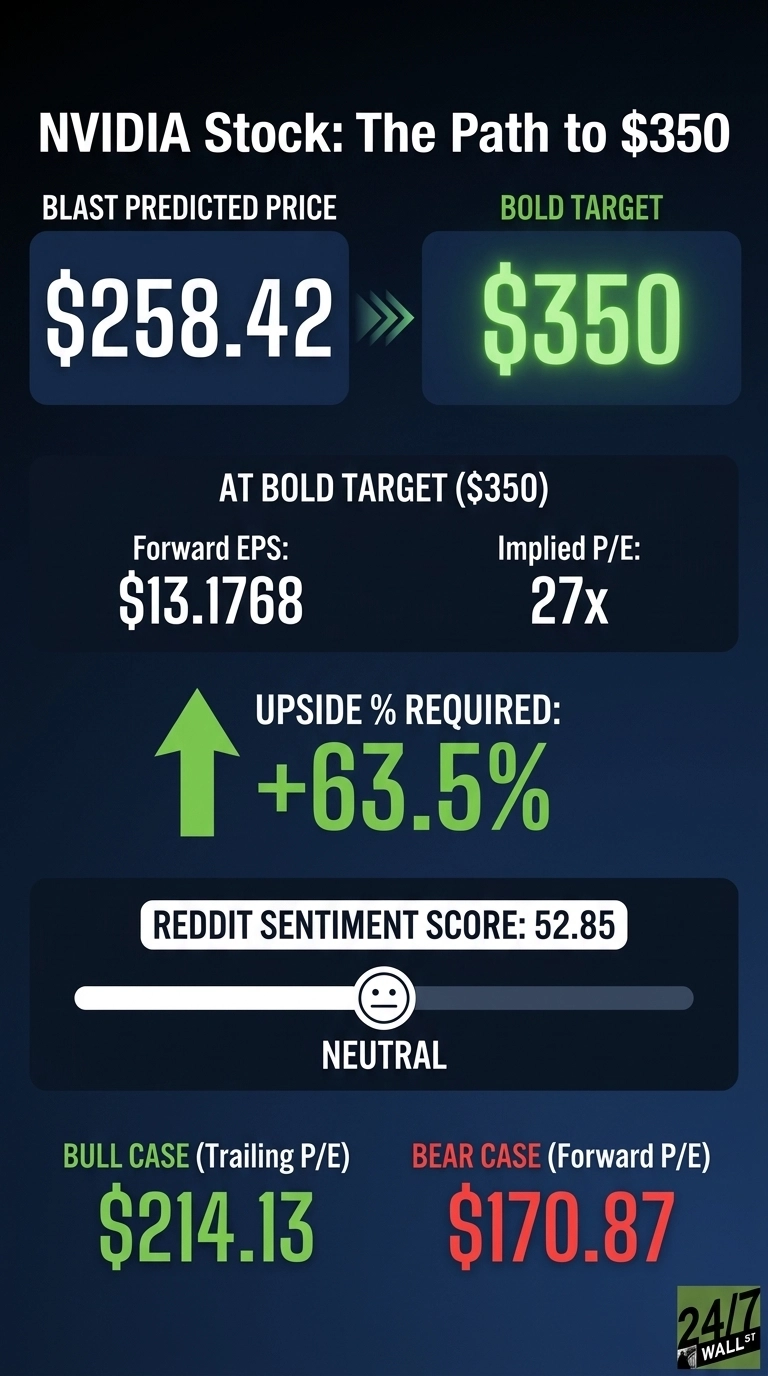
With forward EPS of $13.1768, a price of $350 implies a forward P/E of 27x. Our central forecast already implies 20x, so the bold target requires about 7x of additional multiple expansion.
I think that is possible. Earnings are growing fast enough to shrink the multiple: the trailing P/E of 43 drops to 16 on forward numbers. Revenue per gigawatt rises from $25 billion with Blackwell to $40 billion with Vera Rubin. Top hyperscaler capex is expected to reach $1.3 trillion in 2027. Jensen Huang also said CoreWeave is improving and no backstop is needed.
On the earnings call, he put it simply: “AI has reached its inflection point. It’s doing useful work. Its tokens are productive and profitable. Now, compute is revenue.” He added that “the unconstrained would be a lot higher” than the roughly 70% growth outlook for fiscal 2028.

A key risk is that AI financing dries up before Vera Rubin capacity reaches customers.
That financing question is also why the picks-and-shovels names around NVIDIA matter so much right now; we rounded up seven suppliers driving the data-center expansion, from electricity to cooling, which you can read here: 7 Stocks Powering the AI Boom (That Aren’t Chipmakers).
Where NVIDIA Trades Today vs Its Earnings Power
At 16x forward earnings, NVIDIA looks cheap for a company growing revenue at triple-digit rates. Shares trade between a 52-week bottom of $163.90 and a peak of $243.37.
Over 10 years, the stock has returned 13,002.9%. At today’s multiple, investors pay little for the growth the bull case depends on.
$350 Is a Stretch, but Here’s Why It’s Possible
Hitting $350 requires a 63.5% gain. My verdict: it’s a stretch, but a credible one. Three things need to go right. Vera Rubin has to ramp as the fastest launch in NVIDIA’s history.
Supply has to ease enough to let revenue follow demand. And the market has to stop pricing in a funding scare. A prolonged freeze in AI capital markets would halt it. Returns at this level shouldn’t be expected every year, but we’ve outlined the plan for how NVIDIA could reach $350 in 2027.
Contact [email protected] for any questions or corrections.
Vandita Jadeja is a financial publisher with over a decade of experience writing about financial topics, including investment, savings, retirement, insurance and banking. Vandita is a Chartered Accountant who loves to debunk financial concepts for readers.
Her work has appeared on sites that include The Motley Fool, InvestorPlace, and Benzinga. She covers investing and focuses on stock picks and price prediction for 24/7 Wall St.
When not looking for the next stock investment opportunity, she can be found traveling, reading, chasing sunsets and enjoying her iced latte.