Nvidia Has a $5.5 Trillion Valuation. Can the AI Giant Still Go Higher?
NVIDIA just doubled its revenue per gigawatt of AI capacity and posted triple-digit earnings growth, yet its stock has struggled to keep pace with the profits. A $350 price target sounds ambitious until you see what the math actually requires.


NVIDIA (NASDAQ:NVDA | NVDA Price Prediction) now makes about $40 billion per gigawatt of AI capacity built on Vera Rubin, up from roughly $18 billion with Hopper. That shift is a big reason a company worth about $5.76 trillion may still have room to grow.
Shares are up 27.67% year to date. Over the same stretch, quarterly earnings grew 127.8% year over year. The stock has fallen behind the profits. So can NVIDIA reach $350 by October 2027?

What’s Holding NVIDIA Back Right Now
The stock gained 4.55% over the past week and 3.23% over the past month, modest moves for a business that just reported quarterly revenue of $96.22B, up 105.8%. Supply is the main constraint.
On the August call, management said, “Our entire supply chain is challenged.” Gross margin was 75% in Q2, but management expects 71% to 72% in Q4 because memory prices are rising. With a beta of 2.216, the stock swings about twice as much as the broader market.
Wall Street Sees 37% Upside, and I Think That’s Closer to Right
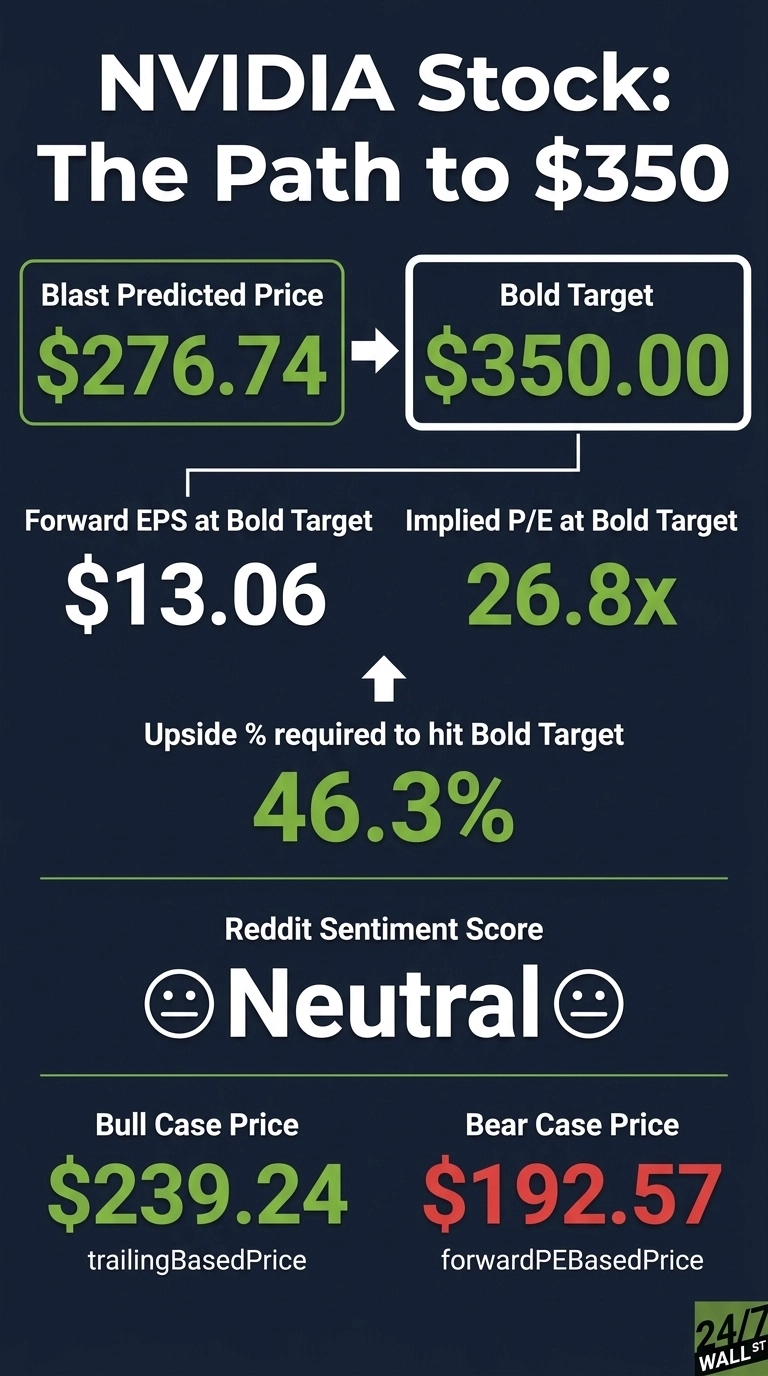
The consensus target is $328.72, or 37.4% upside. Ratings stand at 10 Strong Buys, 48 Buys, 2 Holds and 1 Sell. Our model is more cautious, with a base case of $276.74 (15.67% upside). Its range runs from $237.97 to $323.41, and it carries high confidence.
I think the model is too conservative. It cuts its adjustment in half because of NVIDIA’s size and gives earnings growth only a 0.03 contribution. Meanwhile, 95% of analysts are bullish, and fiscal 2028 EPS estimates got 46 upward revisions and zero cuts in the past 30 days.

Here’s What It Takes for NVIDIA to Reach $350
Reaching $350 from today’s price of $239.24 would require a gain of 46.3%.
With forward EPS of $13.0631, a price of $350 implies a forward P/E of 27x. Our base case already implies 34x on the model’s own math, so the $350 target actually sits 7 turns below that figure. Compared with today’s forward multiple, though, it needs about 8 turns of expansion.
I think that expansion is possible. Our 1.14 adjustment factor reflects a 1.15 technology sector multiplier and strong analyst support. Earnings growth also brings the multiple down quickly.
Based on fiscal 2028 consensus EPS of $15.6951, $350 works out to just 22x. Management expects about 70% revenue growth in fiscal 2028, even with supply limits.
The top five hyperscalers are expected to grow capex from nearly 800 billion in 2026 to 1.3 trillion in 2027. Jensen Huang said, “AI has reached its inflection point. It’s doing useful work. Its tokens are productive and profitable. Now, compute is revenue.”
The main risk is NVIDIA’s $279B in supply commitments, which would turn into a burden if AI spending pauses. That same expansion also runs through the power, cooling, and networking suppliers we profiled in a free report on seven AI infrastructure stocks that aren’t chipmakers.

Where NVIDIA Trades Today vs. Its Earnings Power
The stock trades at about 18x forward earnings, cheap for a company expecting growth near 70%.
Shares sit near the top of their 52-week range of $163.90 to $240.10, and the stock has returned 14383.2% over the past 10 years. Since the multiple has declined while earnings kept growing, there is room for the bull case to play out.
$350 Is a Stretch, but Here’s Why It’s Possible
Hitting $350 requires a 46.3% gain. I see it as a stretch, though an possible one. Supply has to ease, gross margins have to hold in the 72% to 73% range for fiscal 2028, and Vera Rubin has to deliver what management calls “the fastest product ramp in NVIDIA’s history.” A broad decline in hyperscaler spending would undermine the thesis.
Returns at this level shouldn’t be expected every year, but we’ve outlined the blueprint for how NVIDIA could reach $350 in 2027.
Contact [email protected] for any questions or corrections.
Vandita Jadeja is a financial publisher with over a decade of experience writing about financial topics, including investment, savings, retirement, insurance and banking. Vandita is a Chartered Accountant who loves to debunk financial concepts for readers.
Her work has appeared on sites that include The Motley Fool, InvestorPlace, and Benzinga. She covers investing and focuses on stock picks and price prediction for 24/7 Wall St.
When not looking for the next stock investment opportunity, she can be found traveling, reading, chasing sunsets and enjoying her iced latte.