ASML Vs. Taiwan Semiconductor: Who Can More Fully Satisfy AI Demand?
Both ASML and TSMC say AI demand outstrips everything they can build, but each company is betting on a different strategy to close that gap. One controls the scarcest tool in chipmaking while the other controls the fabs, the nodes,…

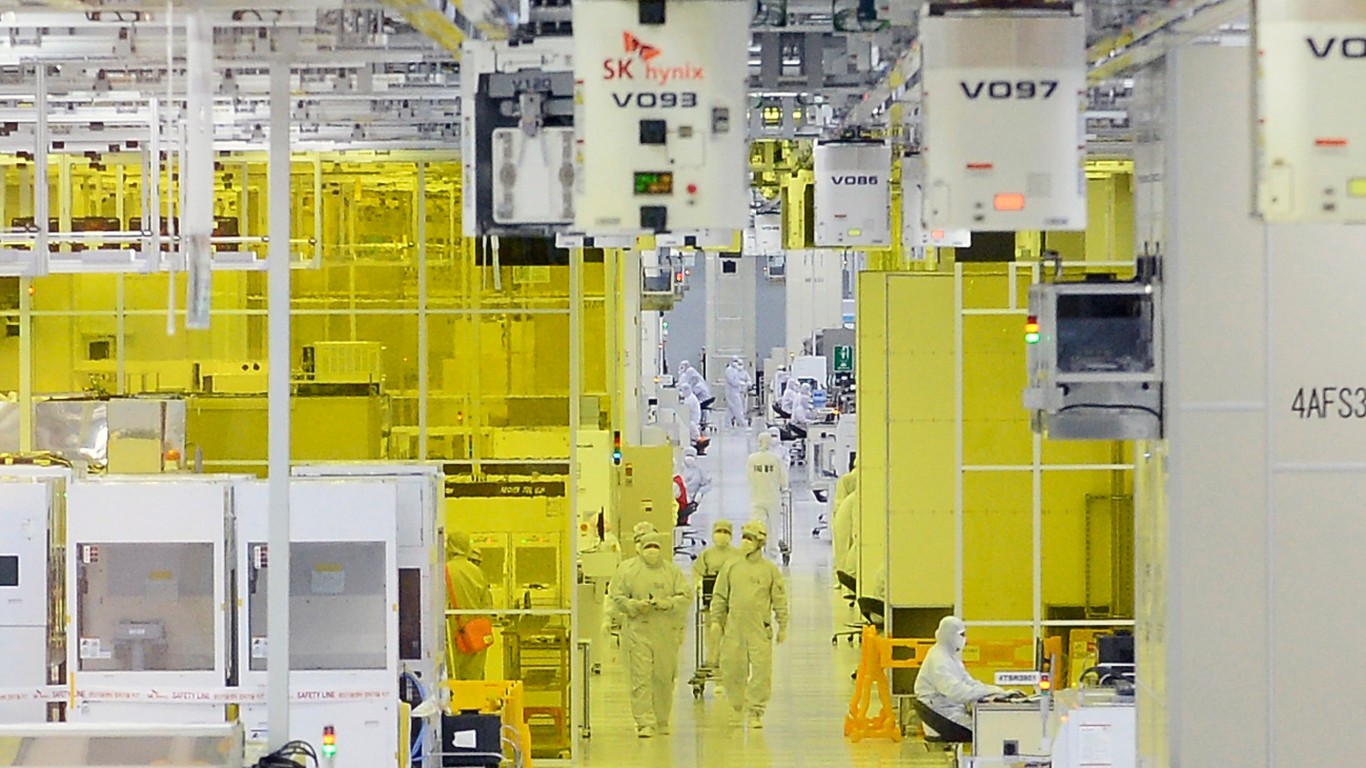
ASML (NASDAQ:ASML | ASML Price Prediction) and Taiwan Semiconductor Manufacturing (NYSE:TSM) reported third-quarter results a day apart. Both said the same thing: AI demand is bigger than what they can build. ASML makes the EUV machines, and TSMC runs them to print 2nm and 3nm chips. For anyone looking at picks-and-shovels plays beyond the chipmakers themselves (we examined seven of the power, cooling, and networking suppliers behind the data-center expansion in a free report), the question is which one can close its supply gap faster.
Upgrades Lift ASML While 2nm Squeezes TSMC
ASML posted revenue of $13.06B, up 55.2% YoY. That kind of growth tells you chipmakers are buying tools as fast as ASML can ship them. EPS of $14.48 came in well above the $10.66 consensus, though a $570.65M one-time investment gain flatters that number. The cleaner signal was Installed Base Management, which reached €3.3 billion, above guidance. The CFO explained why: “The ability to enable an increase in capacity through upgrades on the same footprint is very compelling for our customers.”
TSMC earned $4.60 per ADR, beating the $4.46 estimate. High-performance computing (HPC) made up 68% of revenue, which shows how far AI has reshaped the customer base. Gross margin fell to 66.4% because 2nm, now at 8% of wafer revenue, still costs more to make than it earns back. Scaling up a new node quickly comes at that price.
| Business Driver | ASML | TSMC |
|---|---|---|
| Main Growth Engine | Memory system sales seen up around 75% in 2026 | AI wafers on 2nm and 3nm |
| Capacity Lever | Faster NXE:3800F at 260 wafers per hour | N2 capacity set to more than double in 2027 |
| Margin Risk | Costs of scaling up production and suppliers | Overseas fab dilution growing to 3%–4% |
ASML Charges for Scarcity While TSMC Builds Through It
ASML CEO Christophe Fouquet admitted that planned 2027 and 2028 supply “will not fully meet the demand of our customers.” Customers already want slots for 2029 and even 2030. ASML has finished price-increase talks on its most critical tools, with the full effect landing from 2028 onward. Being sold out gives ASML pricing power.
TSMC is spending its way toward more supply instead. CEO C.C. Wei said “the gap between demand and supply is still quite big.” The company is keeping 2026 capex at $60 billion to $64 billion with nearly 20 fabs worldwide in progress. It also plans to wait on High NA EUV until 2030, once the tool costs make sense for mass production.
ASML’s 2028 Capacity Number Is the Catalyst to Watch
ASML’s Capital Markets Day on June 10, 2027 should reveal whether it plans expansion beyond the 30% increase. China, at around 20% of total net sales, leaves ASML exposed to export controls. For TSMC, watch Arizona’s second fab starting volume production in the third quarter of 2027 and its lack of back-end packaging capacity.
Why I Lean Toward TSMC to Close the Gap
ASML is the tighter chokepoint, but TSMC controls more of the ways to add output: fabs, node transitions and advanced packaging. TSMC also trades near 21 times forward earnings, compared with ASML’s 29. That gap means investors pay a lower multiple of forward earnings for TSMC’s AI production exposure than for ASML’s. A much larger 2028 ramp from ASML would shift that comparison.
Contact [email protected] for any questions or corrections.
Alex Sirois is a financial writer with experience spanning both retail and institutional investing. He has written for InvestorPlace and held roles at BNY Mellon and Bernstein, giving him a perspective that bridges Main Street portfolios and Wall Street analysis.
Alex holds an MBA from George Washington University and has built his career across multiple industries, including e-commerce, education, and translation — a breadth of experience that informs how he breaks down complex financial topics for everyday investors. His writing is conversational, actionable, and grounded in long-term, buy-and-hold investing principles.
At 247 Wall St., Alex focuses on delivering analysis that is both accessible and useful, with a clear emphasis on helping readers make more informed decisions with their money.