Famous Billionaire Calls AI a Bubble — But That Is Not What His Money Says
Ken Griffin built one of the world's most powerful hedge funds by trusting data over hype, so when he calls AI a bubble, investors listen. But a closer look at where Citadel actually parks its billions raises an uncomfortable question…


Artificial intelligence has become Wall Street’s biggest investment opportunity and potentially its biggest vulnerability. Technology companies are committing hundreds of billions of dollars to data centers, chips, and computing infrastructure, betting that AI will transform the economy. Investors have responded by pushing valuations higher, even as questions mount about whether the spending will produce adequate returns. AI investment has grown so large that the U.S. economy itself has become increasingly dependent on the spending boom.
Wall Street’s concerns about AI spending are hardly new, but a warning from one of the world’s most successful hedge fund managers deserves attention — especially when his own portfolio seems to tell a different story.
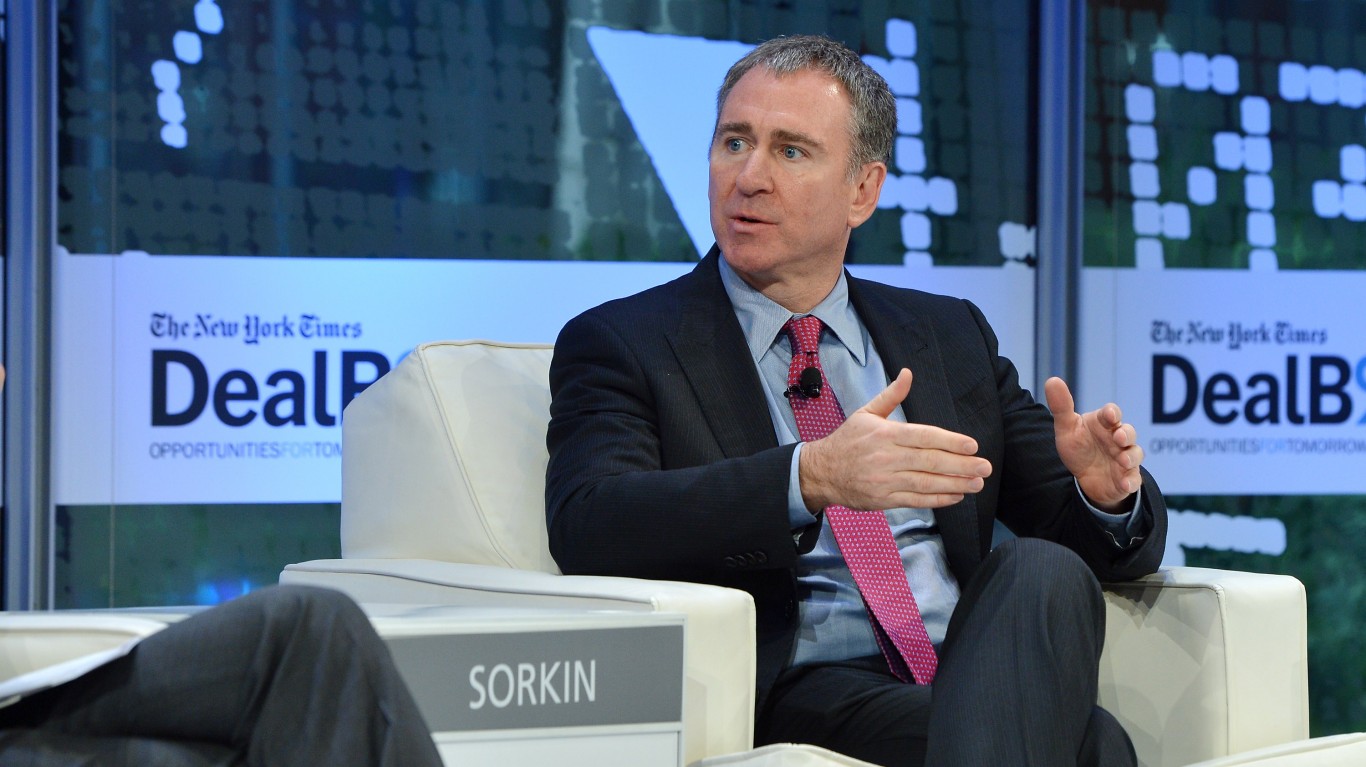
Billionaire Ken Griffin, founder of Citadel, believes we’re almost certainly experiencing an AI bubble. Yet his firm’s multibillion-dollar investments in technology stocks suggest he hasn’t abandoned the opportunity.
Ken Griffin Sees an AI Bubble Forming
Speaking at Citadel’s Future of Global Markets Conference on Oct. 20, Griffin told Bloomberg that speculative excess was accompanying artificial intelligence’s transformation of the economy.
“There’s almost certainly bubbles within this moment in time,” Griffin said, adding that economic transformations are often accompanied by speculative bubbles.
His concern centers on the enormous amount of money pouring into AI infrastructure without a clear understanding of future demand. UBS projects hyperscalers will spend $4.1 trillion on AI infrastructure between 2026 and 2028, nearly triple their spending over the preceding six years.
Griffin compared graphics processing units GPUs — the chips powering AI systems — to airline seats. Once capacity exceeds demand, operators may slash prices because the additional cost of serving another customer is relatively low.
It’s similar to the fiber-optic boom around 2000. Telecommunications companies installed enormous amounts of capacity, only to watch prices collapse when supply overwhelmed demand. Today’s AI infrastructure spending spree could follow a similar trajectory.
Griffin also questioned whether businesses were extracting enough value from expensive AI models to justify their costs.
Still, he acknowledged that revolutionary technologies often produce enduring winners. He even expressed regret about not holding onto Amazon (NASDAQ:AMZN | AMZN Price Prediction) during the internet revolution.
His Billions Tell a Different Story
Yet take a look at what Citadel actually owns. According to its amended second-quarter SEC Form 13F filing, Citadel Advisors held billions of dollars in major AI companies as of June 30.
| Company | Reported Stock Value |
| Amazon | $2.59 billion |
| Nvidia (NASDAQ:NVDA) | $2.36 billion |
| Microsoft (NASDAQ:MSFT) | $1.41 billion |
| Broadcom (NASDAQ:AVGO) | $1.1 billion |
| Alphabet (NASDAQ:GOOGL) | $1.1 billion |
Sources: Citadel Advisors amended June 30, 2026, Form 13F, filed Sept. 2; institutional holdings summaries.
That’s approximately $8.6 billion invested in five companies central to AI’s expansion. Surprisingly, Amazon was Citadel’s second-largest individual stock holding, while Nvidia ranked third.
The filing also showed Citadel increased its Amazon share count by 34% during the quarter and Microsoft by 43%, although it reduced Nvidia shares by approximately 37%.
Admittedly, Citadel isn’t making a simple bullish wager. Its filing also disclosed substantial call and put options on technology companies, including Nvidia and Micron Technology (NASDAQ:MU). Those positions can hedge risks or express opposing market views.
The filing also only represents a snapshot at the end of June; Citadel’s current net exposure could be completely different today. Nevertheless, the firm’s holdings reveal substantial participation in the same industry Griffin warns may be overheating.
The Bubble May Create Tomorrow’s Winners
Griffin’s argument isn’t necessarily contradictory. He recognizes that excessive investment can destroy shareholder wealth while simultaneously laying the groundwork for revolutionary businesses.
Amazon survived the dot-com collapse and eventually became a dominant cloud-computing provider. Today, Amazon, Alphabet, Microsoft, and Oracle (NYSE:ORCL) have accumulated $2.3 trillion in cloud backlog, providing tangible evidence that AI demand extends beyond speculative enthusiasm.
Ironically, excess computing capacity could benefit Amazon and Microsoft as cloud providers even while squeezing margins for companies selling expensive AI hardware.
And Griffin has firsthand evidence that AI creates value. He said AI agents have reduced some sophisticated Citadel research tasks from weeks to hours.
Key Takeaway
In short, Griffin isn’t telling investors to abandon AI. He’s warning them against confusing an extraordinary technology with an investment that’s worth any price. His firm’s portfolio reflects that balance — substantial exposure to AI leaders alongside options that can manage risk.
For everyday investors, the better strategy is to favor companies generating real profits, avoid excessive concentration, and remain disciplined about valuations. The AI bubble may eventually burst, but the technology isn’t going away.
And the next Amazon could emerge from the wreckage.
Contact [email protected] for any questions or corrections.
After two decades of patrolling the dark corners of suburbia as a police officer, Rich Duprey hung up his badge and gun to begin writing full time about stocks and investing. For the past 20 years, he’s been cruising the markets looking for companies to lock up as long-term holdings in a portfolio while writing extensively on the broad sectors of consumer goods, technology, and industrials. Because his experience isn’t from the typical financial analyst track, Rich is able to break down complex topics into understandable and useful action points for the average investor. His writings have appeared on The Motley Fool, InvestorPlace, Yahoo! Finance, Money Morning, and, of course, 24/7 Wall St. He has been featured in both U.S. and international publications, including MarketWatch, Financial Times, Forbes, Fast Company, and USA Today.