China’s Mid-Tier Emergence Threatens ASML Over the Next 3-5 Years
A state-owned Chinese firm just started mass producing the exact lithography machines ASML depends on for its China revenue, and the timeline for disruption is shorter than Wall Street expects.


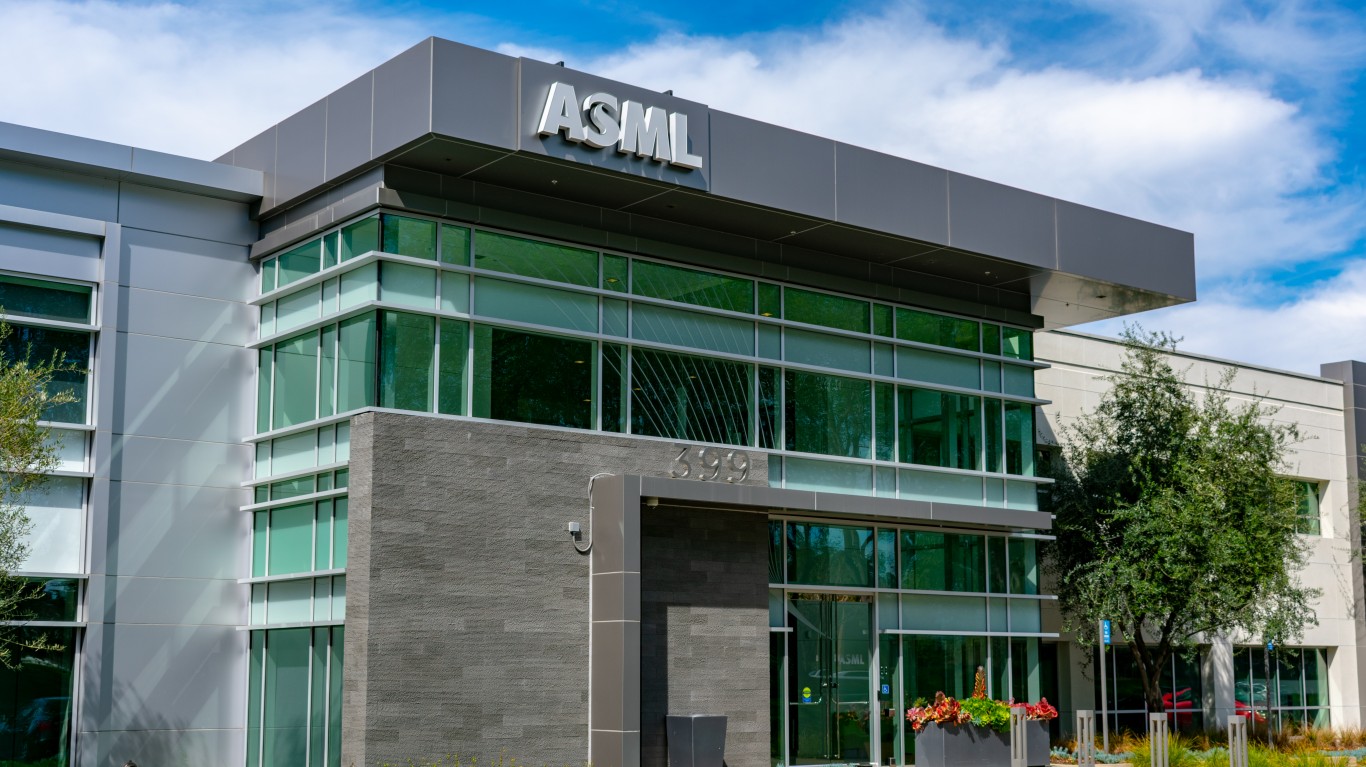
The rating on ASML (NASDAQ:ASML | ASML Price Prediction) is a Hold at $1,560.54, leaning cautious as China builds its own deep ultraviolet (DUV) lithography machines. Shares fell 6.93% in the latest session. Investors are now weighing whether a mid-tier Chinese rival can wear down ASML’s business over the next three to five years.
ASML is the only supplier of extreme ultraviolet (EUV) systems, and it competes with Canon and Nikon in DUV. China is expected to make up around 20% of 2026 net sales. Reuters reported that state-owned Shanghai Aishengna Electronic Technology Group has begun mass producing domestic immersion DUV machines. The company absorbed teams from SMEE, and its first tools are headed to chipmakers such as SMIC.
AI Demand Outruns ASML’s Supply Through 2028
Third-quarter revenue reached $13.06 billion. That was up 55.2% year over year and ahead of the $11.68 billion estimate. Gross margin expanded to 57.5%. Management says planned supply for 2027 and 2028 will fall short of demand, and customers are already asking to place orders for 2029 and 2030.
ASML also completed value-based price increases on its most critical products, with most of the impact landing from 2028 onward. The stock trades at a forward P/E of 29 versus a trailing 41, which points to fast earnings growth. Free cash flow of $12.7 billion in the quarter supports a €12 billion buyback. Christophe Fouquet, the CEO, called the chance of major competition in China “still pretty low.”
China’s DUV Push Targets ASML’s Larger System Line
In the third quarter, non-EUV system sales of €4.3 billion exceeded EUV sales of €4.1 billion. Its EUV growth outlook excludes China, according to management. That puts ASML’s China exposure squarely in DUV, the segment Aishengna is aiming. A working domestic tool gives Chinese fabs a backup if export restrictions tighten, and Fouquet admitted that restricted access creates “a lot more motivation.”
The valuation demands near-flawless execution at 49 times EBITDA. Third-quarter EPS of $14.48 also included a one-time equity gain of about $570 million. Among the hedge funds tracked, 8 trimmed and 5 added in the latest filing period.
Chinese Machines Still Trail ASML by Generations
Reuters’ source said Aishengna’s machine needs further testing and remains far from matching ASML’s models. Per Asia Times, citing JPMorgan Chase (NYSE:JPM), Chinese DUV still lags ASML by several generations, and JPMorgan analysts called the resulting selloff disproportionate. Fouquet said the industry has heard a Chinese rival was coming “for the last 25 years.”
Demand is locked in for years. The China threat, however, plays out on a longer timeline that current results cannot capture. Key signals include China’s share of sales each quarter, any new DUV export rules and next year’s Capital Markets Day.
42 Analysts Still See Upside the Stock Gave Back
ASML trades at $1,560.54 against a consensus target of $2,145.58, which means 37.5% upside. Price targets are no guarantee. The 42 covering analysts rate the stock as follows:
- Strong Buy: 7
- Buy: 31
- Hold: 3
- Sell: 1
Shares are up 46.58% year to date, compared with 12.05% for the S&P 500. Over 12 months the gain is 55.3%, versus 14.41% for the index. The trend has turned in the past month: ASML fell 10.72% while the index slipped 1.21%. That leaves the stock below its 200-day moving average of $1,584.68.
ASML Earns a Hold Until China’s DUV Tools Prove Themselves
At $1,560.54, ASML is a Hold.
An AI order book that runs into 2028 supports earnings, and the power, cooling, and networking suppliers feeding that same expansion show up in a free report on seven AI stocks that aren’t chipmakers. At the same time, China’s DUV program goes after the business that produces ASML’s China revenue. That makes 29 times forward earnings hard to justify.
The case for buying gets stronger if China stays near 20% of sales through 2027 and Aishengna’s tools stall in qualification. The case for selling builds if China’s share slips, new rules limit DUV servicing or SMIC qualifies domestic immersion tools at volume.
Two or three quarterly reports should show whether Chinese fabs are moving orders. The current valuation already prices in some upside, while the China risk remains hard to measure. ASML’s AI boom is real, and until China’s DUV threat is either confirmed or ruled out, the balance of evidence supports a Hold rating.
Contact [email protected] for any questions or corrections.
Alex Sirois is a financial writer with experience spanning both retail and institutional investing. He has written for InvestorPlace and held roles at BNY Mellon and Bernstein, giving him a perspective that bridges Main Street portfolios and Wall Street analysis.
Alex holds an MBA from George Washington University and has built his career across multiple industries, including e-commerce, education, and translation — a breadth of experience that informs how he breaks down complex financial topics for everyday investors. His writing is conversational, actionable, and grounded in long-term, buy-and-hold investing principles.
At 247 Wall St., Alex focuses on delivering analysis that is both accessible and useful, with a clear emphasis on helping readers make more informed decisions with their money.