There Is One Thing ASML’s $400 Million Machine Still Cannot Do. AI Chips Keep Making It Worse.
ASML's $400 million lithography machine powers every cutting-edge AI chip on the planet, yet one stubborn physical constraint keeps chipmakers stitching together workarounds that quietly erode margins. The fix exists on paper, but the timeline creates a problem no one…

Roughly $400 million. That is the widely reported list price of a single high-numerical-aperture EUV lithography system from ASML (NASDAQ:ASML | ASML Price Prediction), the most expensive tool in commercial chipmaking and the one AI accelerator designs increasingly need.
Even at that price, current high-numerical-aperture exposure fields cannot print the largest data center chip designs from companies such as NVIDIA (NASDAQ:NVDA) and Alphabet (NASDAQ:GOOG, NASDAQ:GOOGL) in a single shot. Existing EUV systems can still manufacture those chips, but only through workarounds that add cost.
The scope matters. Today’s tools do make Nvidia’s biggest accelerators. What is constrained is printing the very largest single dies in one exposure using the current photomask format.
You are looking at a bottleneck the industry has committed years and billions of dollars to remove, and a stock that has already priced in a lot of that fix. That is the tension of holding ASML today.
Why Stitching Around The Limit Hurts Fab Economics
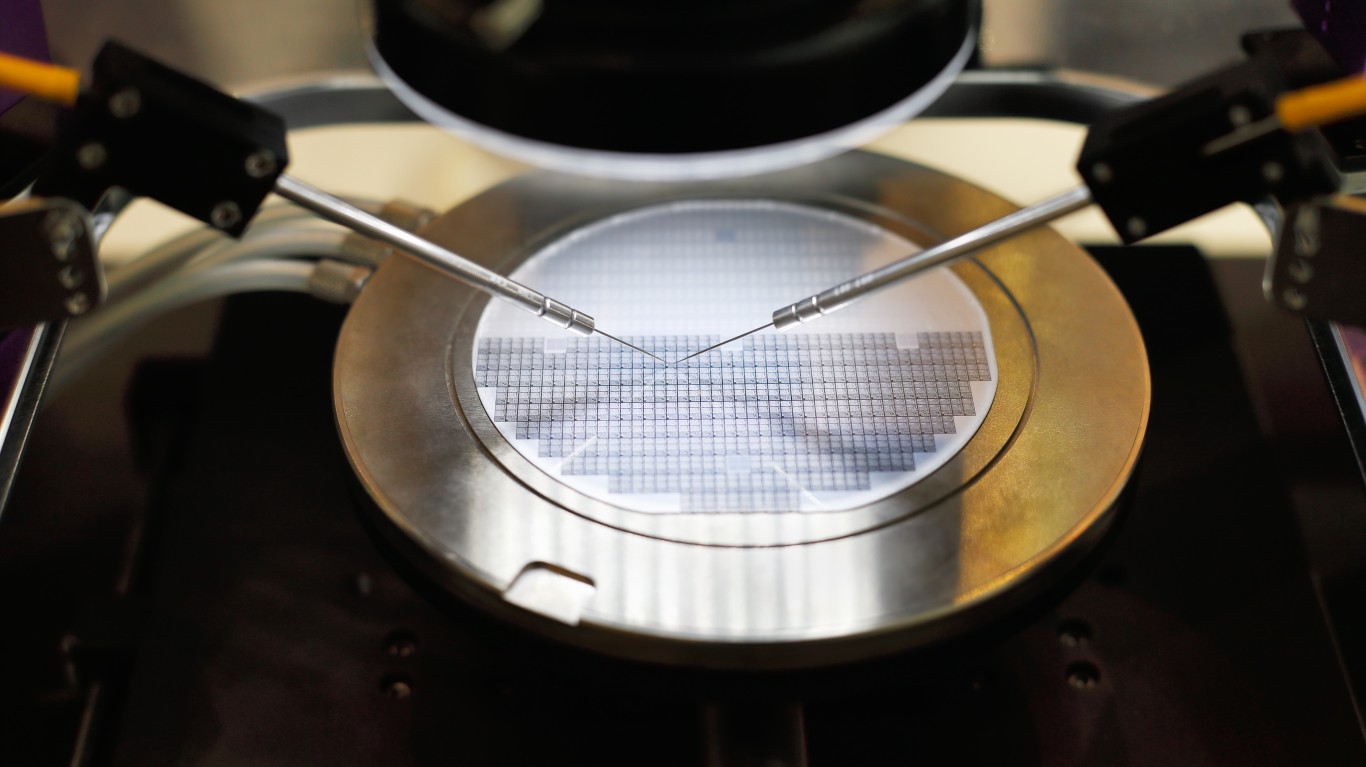
Chipmakers get around the exposure-field limit by stitching: taking multiple exposures on the same wafer and combining them to form one large design. It works. It also adds process steps, overlay complexity, and yield risk on the most expensive silicon in the world.
The fix is a larger photomask format. ASML, Taiwan Semiconductor Manufacturing (NYSE:TSM), and industry partners are developing 12-inch photomasks that would let a high-numerical-aperture system expose bigger chip designs in a single shot, while substantially lifting those systems’ productivity.
The timeline is where the pressure sits. ASML has targeted 2031 for a pilot line using the larger format, and TSMC has said full readiness is expected around 2033.
Set that schedule against how quickly AI accelerator designs are growing toward the reticle limit. Customers are not going to pause a training-cluster roadmap for five to seven years while the mask format catches up, so stitching stays in the process, and so does its cost drag.
Meanwhile, ASML’s near-term output is capped by physics and clean-room space. Full-year 2026 plans call for around 65 Low NA EUV systems and about 130 DUV immersion systems, with a planned 30% capacity increase for 2027 and another 30% under investigation for 2028.
Market Reaction And Why The Bear Case Is Real
Shares settled at $1,698.30 on September 11, 2026, down 6.17% from $1,810.07 on August 12, 2026. The near-term direction has softened even as the AI narrative has not.
Zoom out and the picture flips. The stock is up 59.52% year to date and 112.6% over the past year, so much of the AI capacity story is already priced in.

The bear case starts with the operating math from the Q2 2026 report. Revenue rose 21.25% year over year to $10.65 billion, yet operating income grew only 10.14% and net income only 9.02%, because ramping capacity costs money before it prints revenue.
Then come the constraints ASML lists in its own outlook: export control restrictions on system shipments to certain customers, tariff announcements, geopolitical developments, and production capacity constraints. None of those go away, even with strong AI demand.
China is the concrete example. Management said previously that China’s total net sales in 2026 will decline sharply compared to the very strong business there in 2024 and 2025, and export limits on the most advanced tools remain a live constraint on where the $400 million machine can even ship.
There is also a structural risk that the whole premise loses relevance. If advanced packaging and chiplets keep gaining, customers may not need enormous monolithic dies to hit their performance targets, which would soften demand for the larger-mask solution well before it arrives.
Where ASML Stock Sits
ASML raised its full-year 2026 revenue guidance to EUR 43 billion to EUR 45 billion with gross margin of 54% to 56%, and sell-side analysts carry an average price target of $2,157.87 against the current $1,698.30.

Shares trade at roughly 57 times trailing earnings and about 28 times forward earnings, with a market capitalization near $652 billion. That valuation assumes the fix arrives on schedule.
CEO Christophe Fouquet framed the setup this way on the Q2 call: “Ongoing AI-related investments and continued progress in AI technologies are driving demand for advanced Logic and Memory chips, further strengthening the semiconductor industry’s growth outlook.” The demand is real, but so are the shipment caps sitting between that demand and ASML’s income statement.


The setup looks balanced. The order book, upgrade business, and installed base support the current valuation, although the specific cure for the $400 million machine’s single-exposure limit won’t arrive until a 2031 pilot line and around 2033 for full readiness, and packaging progress could dilute its value before then.
ASML remains a core semiconductor equipment name trading at a full price. The next event on the company’s calendar is Capital Markets Day on June 10, 2027, where the larger-mask roadmap and High-numerical-aperture readiness will get their next serious update.
Contact [email protected] for any questions or corrections.
Omor Ibne Ehsan is a writer at 24/7 Wall St. He is a self-taught investor with a focus on growth, cyclical, and dividend equities that have strong fundamentals, value, and long-term potential. He also has an interest in high-risk, high-reward investments such as penny stocks.