Taiwan Semiconductor Will Transition Into an Indispensible Utility of Global Computing Within 5 Years
Every AI chip, every smartphone processor, and every data center upgrade has to pass through the same tollbooth. Here is why one investor keeps buying that tollbooth without apology, and why the geopolitical risk around it changes the math less…

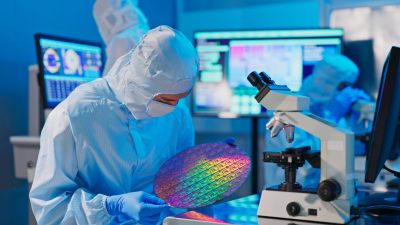
Every time I have extra cash, I buy more Taiwan Semiconductor Manufacturing (NYSE:TSM | TSM Price Prediction). I have stopped apologizing for it. My thesis fits in one sentence. Within five years, TSMC will work like a utility for global computing: a toll road that AI accelerators, smartphone processors and data center chips have to use, and it pays shareholders for every trip.
Why Every AI Player Pays the Toll
On the third-quarter call, management said it plainly: “all the AI players are working with TSMC.” Chips at 7nm and below made up 79% of wafer revenue. Production at 2nm grew from 3% of wafer revenue in Q2 to 8% in Q3. High-performance computing now brings in 68% of revenue. The company also says “demand is still far above our capability to supply today.” I look for exactly that in a utility: a broad customer base (534 customers and 12,682 products in 2025) that keeps asking for more capacity than the company can build.
Receipts Behind My Buying
Start with growth. Third-quarter revenue reached $46.72 billion, up 41.2% YoY in USD terms. Management raised its full-year 2026 outlook to around 44% growth. Its Q4 guidance of $52.3 billion to $54.3 billion works out to 58% year-over-year growth at the midpoint.
Next comes profitability. Gross margin came in at 66.4%, operating margin at 58.7% and ROE at 45.5%. EPS per ADR of $4.60 beat the $4.46 consensus.
Then there is income. The quarter produced $14.90 billion in free cash flow, and the company holds $126 billion in cash and marketable securities. The quarterly dividend rose from NT$6.00 to NT$7.00, and management says it is committed to a “sustainable and steadily increasing cash dividend per share.” Over the past ten years, the shares have returned 1543.82%.
Why My Money Skips Intel and GlobalFoundries
There’s real momentum at Intel (NASDAQ:INTC). Even so, its foundry unit posted a $2.1 billion quarterly operating loss, its Q2 GAAP net loss came to $11.03 billion (mostly from a non-cash charge), and its dividend yield is 0. For a retirement account, I want income today. Specialty processes are the focus at GlobalFoundries (NASDAQ:GFS). Its Q2 revenue grew 5.81% at a 28.3% gross margin. TSMC’s margins and growth rate are both far higher.
Risk I Refuse to Ignore
Taiwan is the risk that could hurt this position. European auditors call cross-strait tensions “a source of persistent insecurity” for the chip sector. Building overseas also costs money. Margin dilution from overseas fabs should increase from about 2% to 3%-4%, and 2026 capex runs $60 billion to $64 billion. The stock has fallen 8.77% over the past month.
TSMC’s expanding presence keeps the thesis intact. The second Arizona fab starts volume production in Q3 2027, and Japan gets 3nm in 2028. Those overseas costs buy geographic resilience, and I am willing to pay for that.
What Keeps My Buy Button Active
N2 capacity should more than double in 2027. A14 volume production begins in 2028, and management expects it to become a bigger node. Its position is clear: “We have no intention of leaving any food on the table for others.” I plan to keep collecting the toll alongside TSMC for decades.
Contact [email protected] for any questions or corrections.
Alex Sirois is a financial writer with experience spanning both retail and institutional investing. He has written for InvestorPlace and held roles at BNY Mellon and Bernstein, giving him a perspective that bridges Main Street portfolios and Wall Street analysis.
Alex holds an MBA from George Washington University and has built his career across multiple industries, including e-commerce, education, and translation — a breadth of experience that informs how he breaks down complex financial topics for everyday investors. His writing is conversational, actionable, and grounded in long-term, buy-and-hold investing principles.
At 247 Wall St., Alex focuses on delivering analysis that is both accessible and useful, with a clear emphasis on helping readers make more informed decisions with their money.