If Amazon Grows At 10% a Year, Here’s What $1,000 Becomes By 2030
Amazon's stock sits well below its 52-week high while its core businesses accelerate at triple-digit rates, and that gap creates a question every investor holding cash should run the numbers on before 2030 arrives.

What would $1,000 in Amazon (NASDAQ:AMZN | AMZN Price Prediction) turn into by 2030? The timing makes the question worth asking. Shares are trading at $252.75 noon, down 3.67% on the session and below the $287.20 52-week high, even as the business underlying speeds up.
Our price-prediction model starts from a reference price of $262.37 and maps out where that stake could land.

What $1,000 in Amazon Could Become
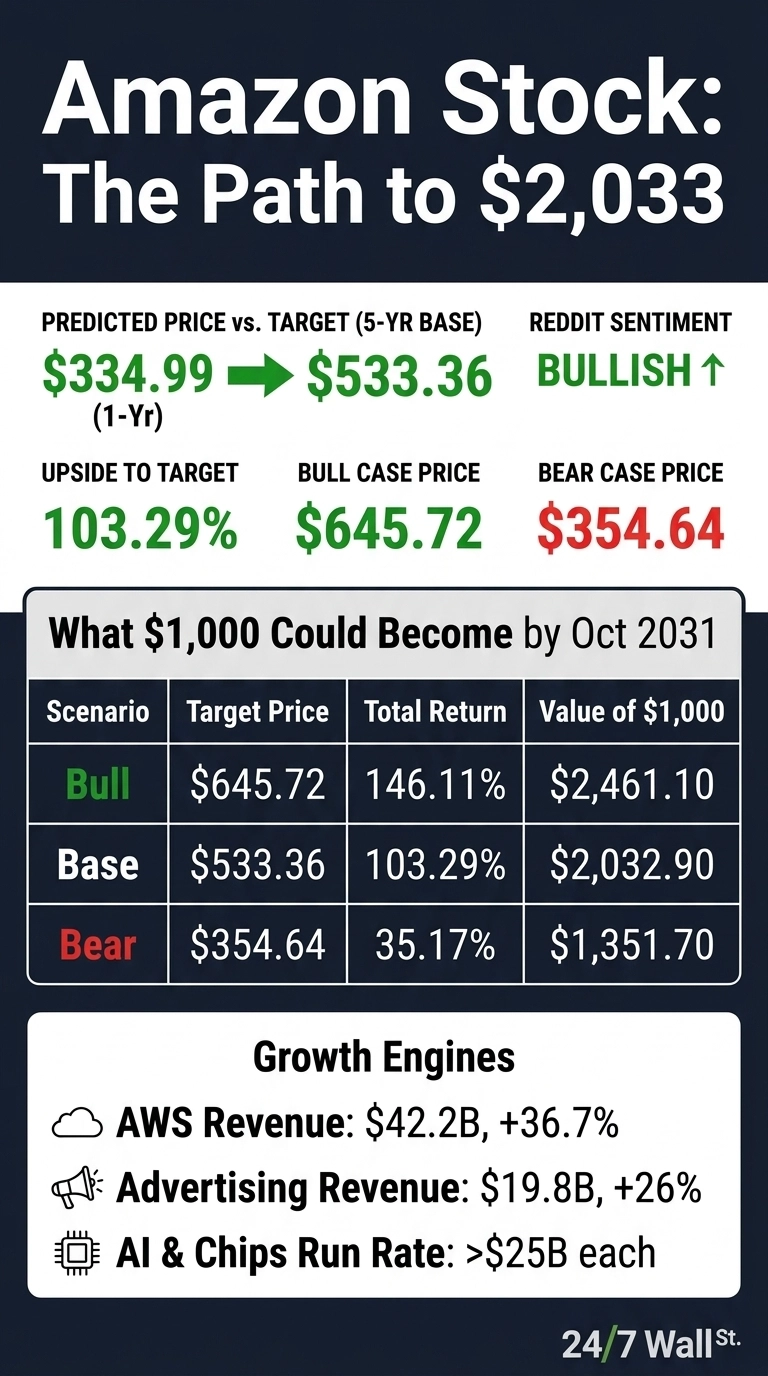
In the model’s base case, a $1,000 investment could be worth about $2,032.90 by October 2031, returning 103.29% in total. That figure rests on a five-year base-case target of $533.36 per share, which works out to an annualized return of 15.24%.
Why October 2031 and not 2030? The model produces one-year and five-year targets. 2030 sits between the two, so the five-year horizon is the anchor. For an example 2030 reading, the base case puts shares at $485.68 on October 22, 2030, which would turn $1,000 into roughly $1,851.13.
What about the headline’s claim? If the stock compounds at 10% a year for four years from the $262.37 reference, shares would reach $384.14 and $1,000 would become $1,464.10. That is a simple illustration. The model’s own base case compounds faster than 10% a year.
Bull, Base and Bear Outcomes for a $1,000 Stake
| Scenario (Five-Year, October 2031) | Target Share Price | Total Return | Value of $1,000 |
|---|---|---|---|
| Bull | $645.72 | 146.11% | $2,461.10 |
| Base | $533.36 | 103.29% | $2,032.90 |
| Bear | $354.64 | 35.17% | $1,351.70 |
Example October 2030 checkpoints on the same three paths: a bull price of $584.96 (about $2,229.52 for the stake), a base price of $485.68 (about $1,851.13), and a bear price of $339.88 (about $1,295.42). On a one-year view, the base target is $334.99, meaning 27.68% upside. The model gives a confidence score of 0.7.
Analysts come out in roughly the same place. The consensus target is $331.72, with 16 strong buy ratings, 43 buys, 2 holds and zero sells.

Three Engines Driving Amazon’s Upside
AWS Is Accelerating Again
AWS revenue reached $42.2 billion last quarter, up 36.7%. That was the fifth straight quarter of faster growth, and the AWS backlog stands at $496 billion.
Amazon’s AI and chips businesses each run at an annualized rate above $25 billion, both growing at triple-digit rates. On the earnings call, the CEO said AWS could become “very possibly a trillion-dollar annual revenue business for us in time.”
All of that AWS expansion has to be powered, cooled, and connected by somebody, and we rounded up seven suppliers riding that wave in a free report on the AI infrastructure trade.
Advertising Is a High-Margin Profit Lever
Ad revenue rose 26% to $19.8 billion, helped by more shoppers using agentic and conversational shopping tools. Alexa for Shopping has reached more than 350 million customers over the last 12 months.
Guidance Supports the 10% Premise
Third-quarter guidance calls for net sales of $197 billion to $202 billion, which is growth of 9% to 12%. Without the shift in Prime Day timing, growth would be nearly 400 basis points higher.
On 24/7 Wall St.’s AI Investor Podcast, a host described this setup: a “really good path to grow sales, maybe only 8 to 10%, but profits 20% plus.”
Risks That Could Shrink Your $1,000
- Capex strain: Amazon raised its 2026 cash capex plan to about $220 billion from $200 billion, pointing to higher memory costs. Trailing free cash flow has fallen to -$7.6B.
- Earnings quality: Q2 GAAP EPS of $5.75 got a lift from a $53.4B non-operating Anthropic gain. Comparable EPS was closer to $1.88.
- Macro pressure: Management highlighted tariffs, recession risk, supply volatility and a foreign-exchange drag of about 80 basis points in Q3.
- Volatility: With a beta of 1.456, the stock tends to swing harder than the market. Its 52-week low is $196.
What to Watch on the Road to 2030
Across the projected scenarios, a $1,000 Amazon stake ranges from $1,351.70 to $2,461.10 by October 2031, and the base case is $2,032.90. Example 2030 checkpoints fall between $1,295.42 and $2,229.52.
These figures are projections rather than investment advice, and none of them is guaranteed. Keep an eye on AWS growth and capex returns in the next earnings report.
Contact [email protected] for any questions or corrections.
Vandita Jadeja is a financial publisher with over a decade of experience writing about financial topics, including investment, savings, retirement, insurance and banking. Vandita is a Chartered Accountant who loves to debunk financial concepts for readers.
Her work has appeared on sites that include The Motley Fool, InvestorPlace, and Benzinga. She covers investing and focuses on stock picks and price prediction for 24/7 Wall St.
When not looking for the next stock investment opportunity, she can be found traveling, reading, chasing sunsets and enjoying her iced latte.