If Eli Lilly Grows At 10% a Year, Here’s What $1,000 Becomes By 2030
Eli Lilly just posted 47.7% revenue growth and its weight-loss drugs are reshaping global healthcare, but whether that momentum turns a four-year investment into a windfall or a disappointment depends on factors most investors overlook.


Eli Lilly (NYSE:LLY | LLY Price Prediction) is one of the most closely followed growth stories in large-cap healthcare, so it makes sense to ask what a $1,000 investment could turn into by 2030. In intraday trading the shares were at $1,267.90, up 4.89% on the session from $1,208.74.
That $1,208.74 figure is the starting price the forecast model uses. The move came as healthcare stocks rallied across the sector. Lilly increased revenue 47.7% year over year last quarter, and that pace is a good reason to look further out.

What $1,000 Becomes at 10% a Year
Start with the basic math. If Lilly compounds at a steady 10% a year, a $1,000 investment increased to $1,464.10 after four years, which brings you to around 2030. Over five years it hits $1,610.51. Treat both as example figures. They are not model forecasts.
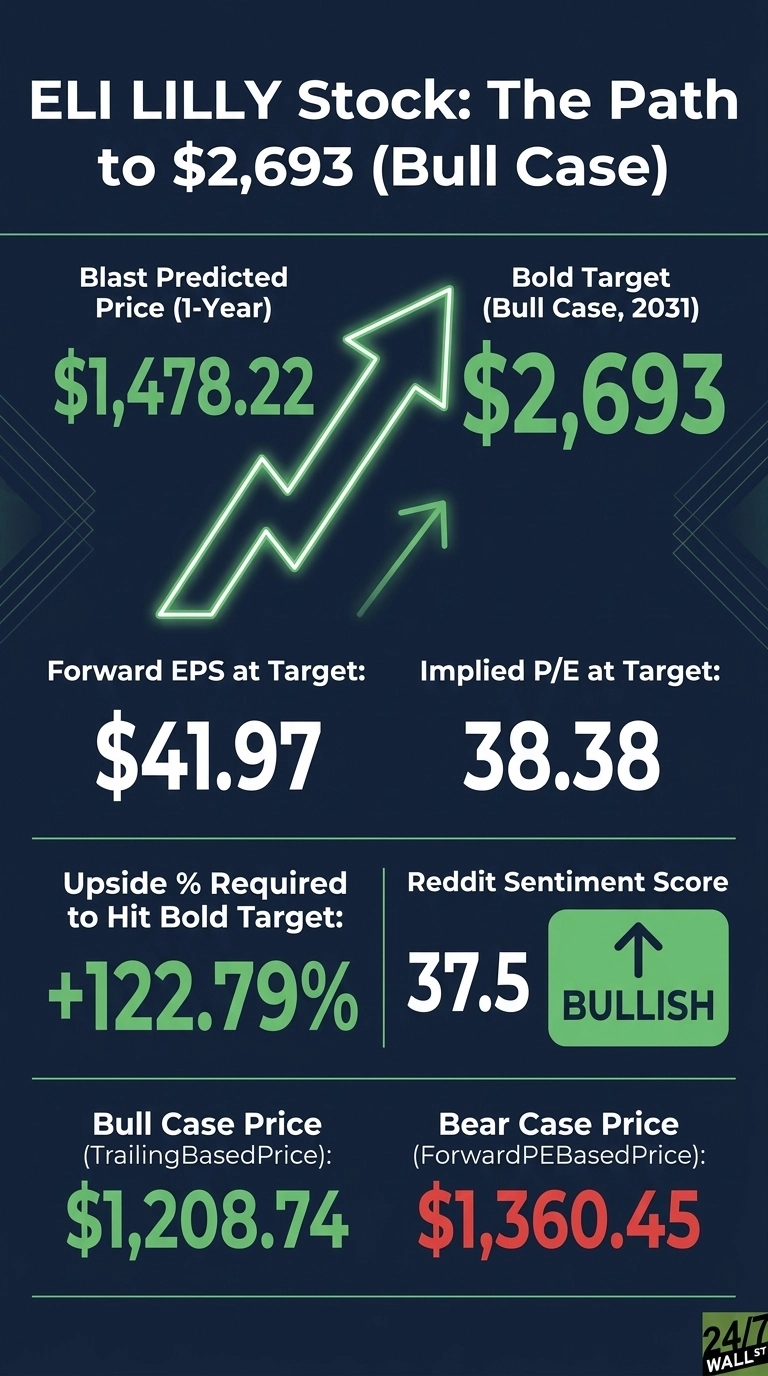
The forecast model runs to a five-year horizon ending October 15, 2031, the modeled horizon closest to 2030. In its base case, a $1,000 investment would increase to about $1,830.10 by 2031, a total return of 83.01%. That figure rests on a per-share target of $2,212.06 and implies an annualized return of 12.85%, which beats the 10% hook.
Bull, Base and Bear Outcomes for Your $1,000
| Scenario (2031 horizon) | Target Share Price | Total Return | Value of $1,000 |
|---|---|---|---|
| Bull | $2,693 | 122.79% | $2,227.90 |
| Base | $2,212.06 | 83.01% | $1,830.10 |
| Bear | $1,456.52 | 20.5% | $1,205 |
On the way to 2031, the base path places shares at $2,074.95 in October 2030. Measured from the model’s starting price, that would leave a $1,000 investment near $1,716.62. The bull and bear 2030 path points work out to $2,062.20 and $1,157.92. These 2030 numbers are example markers, not separate targets.
Over the next 12 months, the model’s base target is $1,478.22, an upside of 22.29%, with a bull case of $1,699.82 and a bear case of $1,245.07. Model confidence is 0.9 (high).
Wall Street’s consensus target is $1,330.14. Analyst ratings break down as 6 strong buy, 19 buy, 3 hold, 1 sell and 1 strong sell.

Three Drivers Powering Lilly’s Upside Case
A Weight-Loss Franchise Still Expanding
Mounjaro brought in $9.94 billion in the second quarter, up 91%. International sales rose 172% after the drug was added to China’s National Reimbursement Drug List. Zepbound added $4.93 billion, up 46%.
In the U.S. obesity market, about 6 out of 10 incretin prescriptions were for a Lilly medicine. A UBS analyst said on CNBC that “we think Lilly will dominate with 65% of that market over the next five or seven years.”
Earnings That Keep Beating
Q2 EPS of $8.38 exceeded the $6.58 estimate, giving Lilly 5 consecutive beats. Management raised full-year 2026 revenue guidance to $85 billion to $87 billion, up from $82 billion to $85 billion.
A Pipeline Built for the Next Decade
Lilly plans to file retatrutide in quarter one, 2027. The oral GLP-1 Foundayo is set for a global launch in 2027, and the company has more than 40 active phase three programs. CEO David A. Ricks said “Lilly’s future, after 150 years, has never been brighter.”
Risks That Could Shrink Your 2030 Payoff
Pricing is the biggest pressure point. Realized prices fell 13% in Q2, while a 60% jump in volume did the heavy lifting. Acquired IPR&D charges of $2.78 billion in the quarter led management to lower the top of its EPS guidance to $36.50 from $37. Mounjaro and Zepbound make up the majority of revenue, so any slowdown in that franchise would hit the whole company.
Competition from Novo Nordisk (NYSE:NVO) and newer GLP-1 entrants could pressure market share. Possible pharmaceutical tariffs and manufacturing limits add more uncertainty.
Valuation is the final risk. At a trailing P/E of about 40, the stock leaves little room for disappointment. The bear case annualizes at just 3.8%, well below the 10% hook.
Where Your $1,000 Could Land by 2030 and Beyond
At the modeled 2031 horizon, a $1,000 stake in Lilly ranges from $1,205 in the bear case to $2,227.90 in the bull case, with a base case of $1,830.10. The example 2030 markers run from $1,157.92 to $2,062.20.
Over the coming quarters, the retatrutide filing and the Foundayo launch are the milestones most likely to move these scenarios. All of these figures represent projections rather than certainty. Consider it a projection, not investment advice.
Contact [email protected] for any questions or corrections.
Vandita Jadeja is a financial publisher with over a decade of experience writing about financial topics, including investment, savings, retirement, insurance and banking. Vandita is a Chartered Accountant who loves to debunk financial concepts for readers.
Her work has appeared on sites that include The Motley Fool, InvestorPlace, and Benzinga. She covers investing and focuses on stock picks and price prediction for 24/7 Wall St.
When not looking for the next stock investment opportunity, she can be found traveling, reading, chasing sunsets and enjoying her iced latte.