NVIDIA Just Took CPU Business From AMD and Intel. What It Does to the Target
NVIDIA's Vera CPU is already shipping to hyperscalers and management expects CPU revenue to more than double, putting AMD and Intel on defense in a market they once owned. Whether that threat translates into stock upside depends on a valuation…

CPUs have become a real business for NVIDIA (NASDAQ:NVDA | NVDA Price Prediction). The Grace CPU’s trailing 12-month revenue exceeded $5 billion, management says, and its next CPU, Vera, is in full production.
They also expect CPU revenue to “more than double in fiscal 28”. That growth comes in server and PC markets that Advanced Micro Devices (NASDAQ:AMD) and Intel (NASDAQ:INTC) have long controlled.
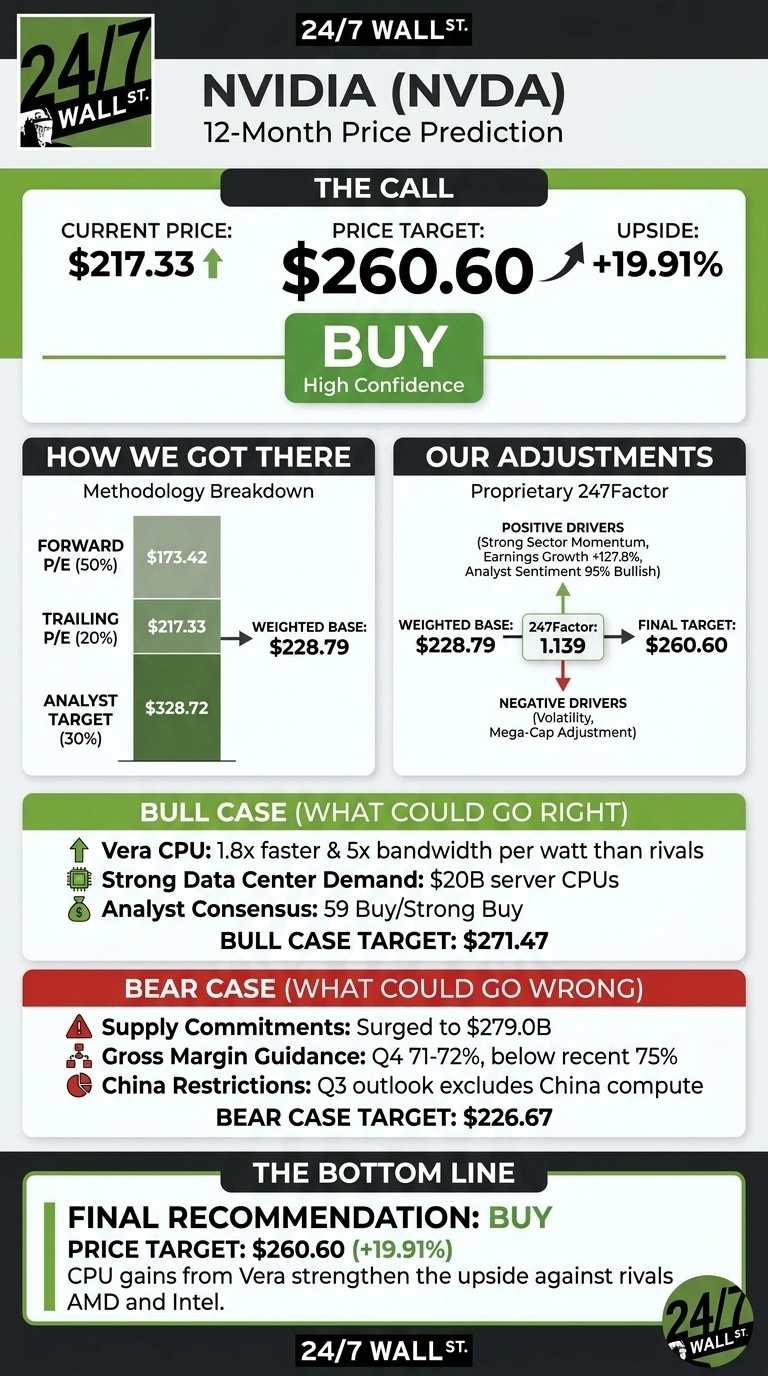
NVIDIA’s 24/7 Wall St. price target is $260.60. That is 19.91% above the current $217.33. Our model rates the stock a buy and has high confidence in that call.
| Metric | Value |
|---|---|
| Current Price | $217.33 |
| Price Target from 24/7 Wall St. | $260.60 |
| Upside | 19.91% |
| Recommendation | BUY |
| Confidence Level | 90% |

Shares Slip Even as Vera Ramps
NVIDIA shares fell 4.09% over the past week and 2.34% over the past month. They are still up 16.66% year to date. Over the past 52 weeks the stock has traded between $163.90 and $243.37. Barron’s reported today that even rumors of a large Chinese chip purchase failed to lift the stock.
The decline came after a strong quarter. Q2 fiscal 2027 revenue reached $96.221 billion, beating the $92.07 billion estimate. EPS came in at $2.22 against expectations of $2.0887. Data Center revenue rose 117%. For Q3, management guided to revenue of $108 billion, plus or minus 2%.

Why Bulls See $271 or More
In our bull case, NVIDIA reaches $271.47 within a year. Vera is the reason the CPU angle matters. NVIDIA says the chip runs 1.8x faster on a key benchmark and provides five times the bandwidth per watt of any other data center CPU. Shipments are already underway to OCI, SpaceX AI and AWS.
Management also cited demand for about $20 billion in total server CPUs. NVIDIA says it makes about $40 billion per gigawatt on Vera Rubin, up from $25 billion on Blackwell.
Wall Street generally agrees with the bulls: 59 analysts rate the stock Buy or Strong Buy, and only one rates it Sell.

What Could Go Wrong With Supply and Margins
The bear case works out to $226.67. Supply commitments rose to $279 billion. Days sales outstanding extended to 60 days from 45. Q4 gross margin guidance comes in at 71% to 72%, and the Q3 outlook excludes Data Center compute revenue from China.
The counterpoint is that most of those commitments are memory purchases for Vera Rubin, and they reflect excess demand. Jensen Huang said NVIDIA has “supply for 70%” of what customers want.
How NVIDIA Compares to AMD and Intel
AMD competes with NVIDIA on both CPUs and AI accelerators. AMD’s Data Center revenue grew 107% last quarter, close to NVIDIA’s growth rate. Yet AMD’s trailing P/E is near 203, while NVIDIA’s is near 27.
Intel is both a rival and a partner. NVIDIA bought $5 billion of Intel stock, and Xeon 6 is the host CPU in NVIDIA’s DGX Rubin NVL8 systems. Intel’s gross margin is 34.8% and its trailing earnings are negative. Compared with both peers, our target looks conservative.
| Company | Trailing P/E | Gross Margin | Data Center Growth |
|---|---|---|---|
| NVIDIA | 27 | 71.1% | 117% |
| AMD | 203 | 49.5% | 107% |
| Intel | Negative | 34.8% | 59% |
Our Verdict: CPU Gains Strengthen the Upside
A buy rating and high confidence come with the 24/7 Wall St. price target of $260.60.
The deciding factor is valuation: NVIDIA’s multiple is lower than its slower CPU rivals’ while it wins share from them. I’d view the stock positively if Vera deployments expand across hyperscalers. I’d grow cautious if gross margins slip below guidance or supply shortages last beyond fiscal 2028.
| Year | Price Target from 24/7 Wall St. |
|---|---|
| 2026 | $226.66 |
| 2027 | $270.78 |
| 2028 | $300.30 |
| 2029 | $318.98 |
| 2030 | $354.85 |
The projections rest on NVIDIA continuing its current strategy. Faster CPU adoption could lift the numbers.
China restrictions or custom chips built by hyperscalers could pull them lower. The same expansion is also lifting a quieter group of suppliers behind the data centers, which we rounded up in a free report on seven AI infrastructure names that aren’t chipmakers.
Contact [email protected] for any questions or corrections.
Vandita Jadeja is a financial publisher with over a decade of experience writing about financial topics, including investment, savings, retirement, insurance and banking. Vandita is a Chartered Accountant who loves to debunk financial concepts for readers.
Her work has appeared on sites that include The Motley Fool, InvestorPlace, and Benzinga. She covers investing and focuses on stock picks and price prediction for 24/7 Wall St.
When not looking for the next stock investment opportunity, she can be found traveling, reading, chasing sunsets and enjoying her iced latte.