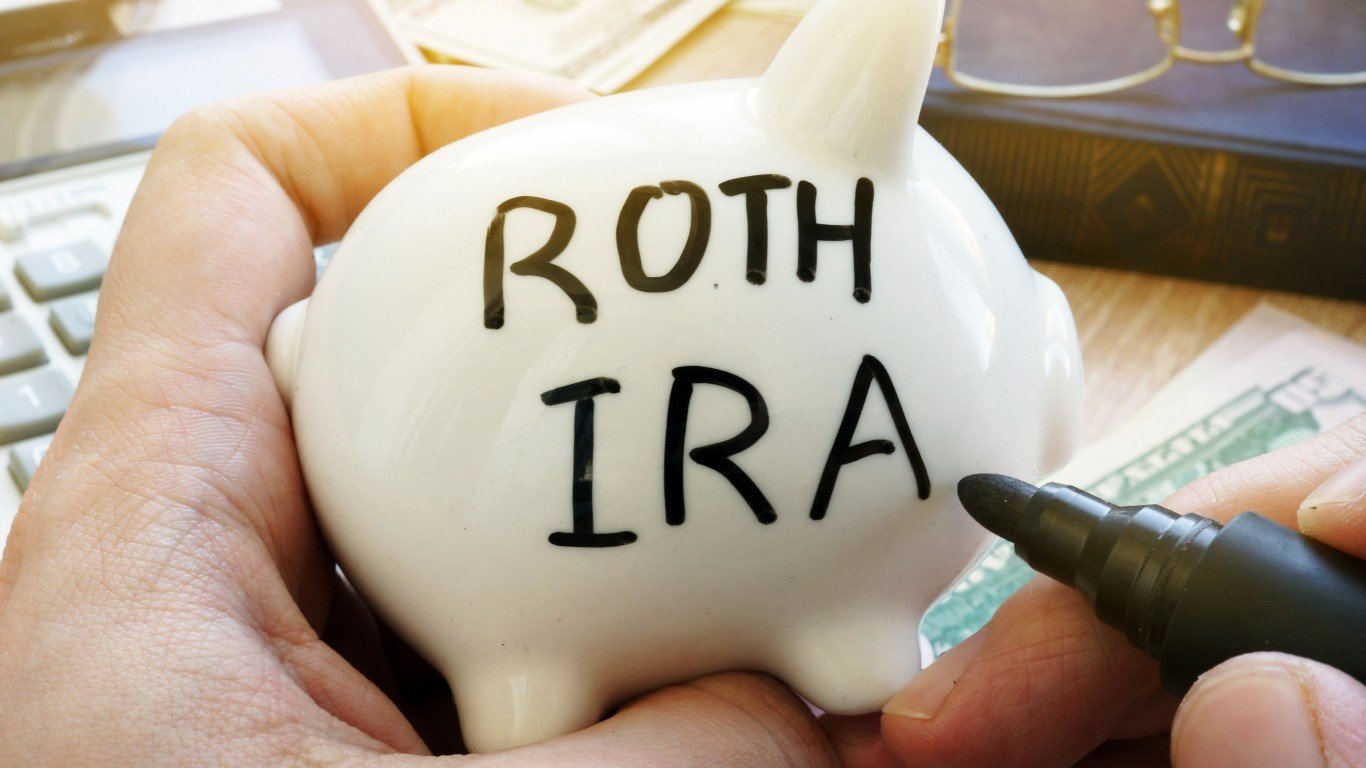
How Much Do You Need in a Roth IRA to Replace a $115,000 Salary Tax-Free?

This post may contain links from our sponsors and affiliates, and Flywheel Publishing may receive compensation for actions taken through them.

A $115,000 salary works out to about $9,583 a month. At the listed holding’s 7.96% weighted yield, generating $115,000 takes about $1,444,724, with no federal income tax on qualified Roth withdrawals.
Under 26 U.S.C. § 408A(d)(1)[1], a qualified Roth distribution doesn’t count as gross income. That generally means you’re 59½ and past the five-year mark. The IRS also doesn’t force you to take anything: “The RMD rules do not apply to Roth IRAs or Designated Roth accounts while the owner is alive.” In a taxable account, REIT and BDC distributions are often ordinary income, while option-fund distributions can include ordinary income, capital gains, and return of capital.
What $115,000 Costs at Each Yield Level
| Yield | Math | Capital Needed |
|---|---|---|
| 3% | $115,000 divided by 0.03 | $3,833,000 |
| 4% | $115,000 divided by 0.04 | $2,875,000 |
| 5% | $115,000 divided by 0.05 | $2,300,000 |
| 7% | $115,000 divided by 0.07 | $1,643,000 |
| 8% | $115,000 divided by 0.08 | $1,437,500 |
| 14% | $115,000 divided by 0.14 | $821,000 |
At 3% to 4%, dividend growth stocks give you the biggest bill and the steadiest income. At 5% to 7%, REITs, preferreds and option-writing funds cut the bill, but payout growth slows. At 8% to 14%, BDCs and leveraged funds need the least money, and the principal often shrinks over time.
Six Funds Behind the 8.2% Plan
Using current payouts and prices, the mix yields about 8.0%, close to the plan, so that’s a good sign.
Covered Calls for Monthly Income (20%)
NEOS S&P 500 High Income ETF (CBOE:SPYI) owns S&P 500 stocks and sells index call options for monthly income. The fund yields about 11.6%. The calls cap upside, and payouts can include return of capital, a tax classification that reduces cost basis in a taxable account but doesn’t necessarily mean the fund is depleting your invested principal.
A Low-Volatility Dividend Basket Gets 15%
The Invesco S&P 500 High Dividend Low Volatility ETF holds 50 steady, high-yield S&P 500 stocks, for a yield near 4.5%. Staples, telecom, and utilities can trail in strong markets, though.
15% in Net-Lease Real Estate
NNN REIT (NYSE:NNN) owns 3,817 single-tenant properties leased to tenants like 7-Eleven, with 99%[2] occupancy and a yield near 6.0%. Higher interest rates, however, raise its borrowing costs.
Private Lending Through a BDC, at 15%
Capital Southwest (NASDAQ:CSWC) lends to smaller private companies, mostly through first lien loans. Its regular payout yields about 9.9% before supplemental dividends. The risk: non-accruals, meaning loans that stopped paying, rose to 1%[3] of the portfolio.
A Cyclical Chemicals Play Takes 10%
LyondellBasell Industries (NYSE:LYB | LYB Price Prediction) makes plastics and chemicals. In 2026, it cut its quarterly dividend from $1.37 to $0.69, so it now yields about 4.3%. The risk: it’s a cyclical business, and third-quarter adjusted EPS of $2.54[4] missed expectations.
The Largest Slice: 25% in REITs and Preferreds
Cohen & Steers REIT & Preferred & Income Fund (NYSE:RNP) holds REITs and preferred stock and has paid $0.136 a month since 2022, good for about 8.6%. Because it uses borrowed money, losses get bigger in a downturn.
Why a 3.5% Yield Can Beat 12%
At 3.5%, you’d need about $3,286,000. That hurts. But if the income grows 8% a year, it rises to about $229,886 in nine years. A flat 12% payout still sends you $115,000, and inflation keeps shrinking what that buys.
How Big Roth Balances Really Get Built
For 2026, the contribution limit is $7,500 ($8,600 at 50 or older), and higher incomes phase you out. Yearly contributions alone rarely reach seven figures. Most large Roth balances come from rolling over Roth 401(k) money or converting traditional IRA money. A conversion has no income cap, but you pay income tax on what you convert, which is why the low-tax years between your last paycheck and your first required withdrawal matter so much (we sized up that window in a free Roth guide here). High earners use the backdoor Roth: make a nondeductible IRA contribution, then convert it.
Three Moves Worth Making Now
- Add up what you actually spend. Your salary covers payroll taxes and retirement savings you won’t owe once you’ve retired, so your real target may come in below $115,000.
- Map out conversions for your low-income years, such as the gap between retiring and starting Social Security, when converted dollars fall into lower brackets.
- Read each fund’s distribution notices for principal repayments before you count that payout as income.
Tax-free income is worth more than it looks. Start conversions early, and $9,583 a month can come untaxed.
Contact [email protected] for any questions or corrections.
David Beren has been a Flywheel Publishing contributor since 2022. Writing for 24/7 Wall St. since 2023, David loves to write about topics of all shapes and sizes. As a technology expert, David focuses heavily on consumer electronics brands, automobiles, and general technology. He has previously written for LifeWire, formerly About.com. As a part-time freelance writer, David’s “day job” has been working on and leading social media for multiple Fortune 100 brands. David loves the flexibility of this field and its ability to reach customers exactly where they like to spend their time. Additionally, David previously published his own blog, TmoNews.com, which reached 3 million readers in its first year. In addition to freelance and social media work, David loves to spend time with his family and children and relive the glory days of video game consoles by playing any retro game console he can get his hands on.