Jeff Bezos Says Retirees Should Buy the S&P 500 Instead of AI Stocks — but That Could Be Riskier Than You Think
Jeff Bezos tells retirees to skip AI stocks and buy the S&P 500 instead, but a closer look at where that index actually puts your money reveals a surprise even Bezos seems to have missed.

Artificial intelligence has become Wall Street’s favorite investment theme, helping push stocks to record highs while raising concerns about how long the boom can last. For retirees, the stakes are especially high. A younger investor can spend decades recovering from a market collapse. Someone depending on investments to pay the bills doesn’t necessarily have that luxury.
The conventional wisdom has always been to diversify rather than chase the hottest stocks. Yet the explosive growth of a handful of technology companies has changed what diversification actually means– and even billionaire Jeff Bezos may be overlooking how much risk remains.
Bezos Has Some Surprisingly Conservative Advice
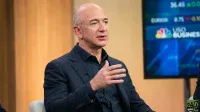
Amazon (NASDAQ:AMZN | AMZN Price Prediction) founder Jeff Bezos is hardly known for playing it safe. Yet when Fox News anchor Bret Baier asked whether retirees should own artificial intelligence stocks during an Oct. 7 interview, Bezos offered some decidedly old-fashioned advice.
“I would usually tell a retiree to buy the S&P 500,” he said.
Bezos believes AI is a transformative technology, but distinguishing winners from losers isn’t easy. During investment booms, he explained, both promising and questionable businesses attract capital. When bubbles burst, investors can lose money even when the underlying technology succeeds.
His advice echoes Warren Buffett’s longstanding recommendation that ordinary investors own low-cost index funds rather than attempt to beat the market.
However, Buffett’s favorite retirement investment strategy carries more risk today than many investors realize.
The S&P 500 Has a $4,000 Problem
The S&P 500 contains roughly 500 leading American companies, but it doesn’t distribute investors’ money equally among them. Its market-cap weighting gives the biggest companies the greatest influence.
According to State Street’s October 2026 holdings data, the index’s 10 largest companies represent approximately 40% of its value. For a retiree investing $10,000 in the SPDR S&P 500 ETF Trust (NYSEARCA:SPY):
- Approximately $4,000 goes into just 10 companies.
- Roughly $6,000 gets distributed among the remaining holdings.
- Nvidia (NASDAQ:NVDA) alone accounts for nearly 8% of the portfolio.
Microsoft (NASDAQ:MSFT), Alphabet (NASDAQ:GOOGL), and Meta Platforms (NASDAQ:META) also rank among the largest holdings. All have enormous financial exposure to the AI spending boom. Ironically, Bezos’ own Amazon is part of the concentration problem, with a nearly 4% weighting.
Charles Schwab’s September 2026 sector analysis showed information technology represented 39.7% of the S&P 500. That’s before counting AI-heavy companies classified in other sectors.
The S&P 500 increasingly resembles a technology fund rather than a broadly balanced investment portfolio.
Diversification Is About More Than Owning 500 Stocks
Granted, buying the S&P 500 remains less risky than betting retirement savings on Nvidia alone. Its largest companies also generate real earnings and cash flow, unlike many speculative businesses during the dot-com bubble.
But a portfolio can own hundreds of stocks and remain vulnerable to one investment theme. If enthusiasm for AI fades, the same companies that powered the market higher could drag the entire index lower.
One alternative is the Invesco S&P 500 Equal Weight ETF (NYSEARCA:RSP), which allocates approximately 0.2% to each constituent at quarterly rebalancing. That reduces dependence on megacap technology stocks, although it can lag when those companies lead the market.
Investors can also broaden their portfolios beyond the traditional S&P 500 with international equities, smaller companies, and bonds.
For retirees, holding sufficient cash and short-term bonds to cover near-term expenses can reduce the need to sell stocks during a downturn.
Key Takeaway
In short, Bezos is right that retirees generally shouldn’t gamble their savings on individual AI stocks. But owning the S&P 500 doesn’t eliminate exposure to an AI-driven market correction.
With approximately $0.40 of every index-fund dollar concentrated in 10 companies, diversification requires looking beyond the number of stocks a fund owns.
Smart investors should keep low-cost index funds as a foundation, but balance them with assets that don’t depend on the same handful of technology giants to deliver returns. The goal isn’t avoiding AI. It’s ensuring retirement doesn’t depend on AI getting everything right.
Contact [email protected] for any questions or corrections.
After two decades of patrolling the dark corners of suburbia as a police officer, Rich Duprey hung up his badge and gun to begin writing full time about stocks and investing. For the past 20 years, he’s been cruising the markets looking for companies to lock up as long-term holdings in a portfolio while writing extensively on the broad sectors of consumer goods, technology, and industrials. Because his experience isn’t from the typical financial analyst track, Rich is able to break down complex topics into understandable and useful action points for the average investor. His writings have appeared on The Motley Fool, InvestorPlace, Yahoo! Finance, Money Morning, and, of course, 24/7 Wall St. He has been featured in both U.S. and international publications, including MarketWatch, Financial Times, Forbes, Fast Company, and USA Today.