Jeff Bezos Says He Usually Tells Retired Investors To Buy The Same Thing, And It’s Not Just AI Stocks
When Fox News asked Jeff Bezos what a retiree should own in an age of AI hype, his answer surprised the anchor and left a single word doing all the heavy lifting.

This post may contain links from our sponsors and affiliates, and Flywheel Publishing may receive compensation for actions taken through them.
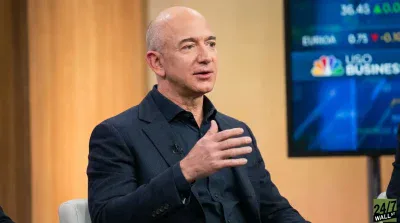
Jeff Bezos, who founded Amazon (NASDAQ:AMZN | AMZN Price Prediction), was asked in a Fox News interview who gets hurt when the AI bubble pops. He named the “speculators”. He said they can lose money because they are investing in all of these things, but the innovations do not disappear.
Fox News anchor Bret Baier followed up by asking whether we are in a bubble right now. Bezos said it is “hard to know”. He added that what he does know is that the technology is real.
Then came the question that matters most to anyone living off savings. Baier asked whether Bezos would tell a retiree to own “AI stocks” today. Bezos answered that he would usually tell a retiree to buy the S&P 500.
The word usually has real weight in that answer. It leaves room for exceptions.
An AI Question Answered With a Fund Full of AI Giants
Baier asked about AI stocks, and Bezos answered with a broad index. That index already holds the largest AI companies. Each one is sized by its market value.
Fund holdings data for the Vanguard S&P 500 ETF, the largest fund tracking the index, show these weights as of August 31:
- NVIDIA (NASDAQ:NVDA): 8%. The AI chip designer is the largest company in the S&P 500, so it is the biggest single AI position an index holder has.
- Microsoft (NASDAQ:MSFT): 6%. Its Azure cloud and Copilot software make it the index’s main link to corporate AI spending.
- Alphabet (NASDAQ:GOOGL): 5%, combined across its two share classes. Google Cloud and the Gemini models give it its AI exposure.
- Amazon: 4%. Its AWS cloud unit and its in-house Trainium chips connect it to AI.
- Broadcom: 3%. It designs custom AI accelerators and networking gear for the largest cloud providers.
- Meta Platforms: 2%, according to Yahoo Finance. It uses AI to rank ads and content across its apps and is building its own frontier models.
- Micron: 2%. Its memory chips go into the servers that run AI workloads.
The same fund holdings data show that the fund’s ten largest holdings made up 38% of the fund as of August 31.
A retiree who follows Bezos’s advice has the AI trade anyway. That exposure comes in proportion to company size. Has a sector this way is different from betting your savings on it.
A Billionaire Who Concentrates His Own Capital
Bezos places his own money into concentrated positions. The Wall Street Journal reported last month that Bezos has fueled Blue Origin with $30 billion of his fortune.
The fund he guided retirees toward holds his own company, Amazon, at 4% as of August 31, per fund holdings data. The difference comes down to scale and purpose. He makes concentrated investments with his own money. He suggested the index for someone drawing down savings. Those are different jobs.
Buffett Gave His Own Family a Similar Instruction
Fortune reported that Bezos once asked Warren Buffett why more people do not copy his investment strategy. So the position is a familiar one for Bezos. The question shows he has long been drawn to plain, patient approaches that most investors pass over.
Buffett’s version is the best known. Yahoo Finance reported that Buffett wants 90% of his wife’s inheritance put into one investment, a single low-cost index holding. His instruction pairs that holding with short-term government bonds. Even the most famous version of this advice mixes the index with bonds.
Bezos named one fund in one television answer. He left a full portfolio, including bonds and cash, untouched. He also said usually.
Some credible critics say the index alone falls short for retirees. Yahoo Finance reported in March that BlackRock (NYSE:BLK) has warned that investing in the S&P 500 isn’t enough for retirement and recommends a strategy that prioritizes income.
That income-first review is the whole premise of a free guide we put together on why the 4% rule fails for today’s retirees and what to run instead: here.
Why “Usually” Is the Most Accurate Word He Said
Bezos hedged, and the hedge is the most accurate part of his answer. For a retiree, a broad index is a reasonable starting point, not a complete plan. Before buying, check the fund’s expense ratio, review its top holdings on the issuer’s site, and test whether your withdrawal rate leaves room for bonds, cash and income.
Contact [email protected] for any questions or corrections.
AJ spent 10 years writing about financial markets at The Motley Fool. His coverage centers on technology stocks and the broader macroeconomic trends, from interest rates to geopolitics, that shape where markets are headed next. AJ is drawn to the stories where big-picture economics and individual companies collide.