POET Is Targeting the Problem Standing Between AI and More Speed
POET Technologies has a single analyst, no profitability, and a stock sitting near multi-year lows, yet Wall Street is pointing to a price that would demand a complete transformation of the business by 2027. The math behind that target is…


Every AI cluster runs into the same wall. GPUs compute faster than conventional optics can move data between them. POET Technologies (NASDAQ:POET) goes after that constraint with its Optical Interposer, a wafer-level platform that puts photonic and electronic components on a single chip. It also removes the costly, labor-intensive assembly that conventional photonics depends on.
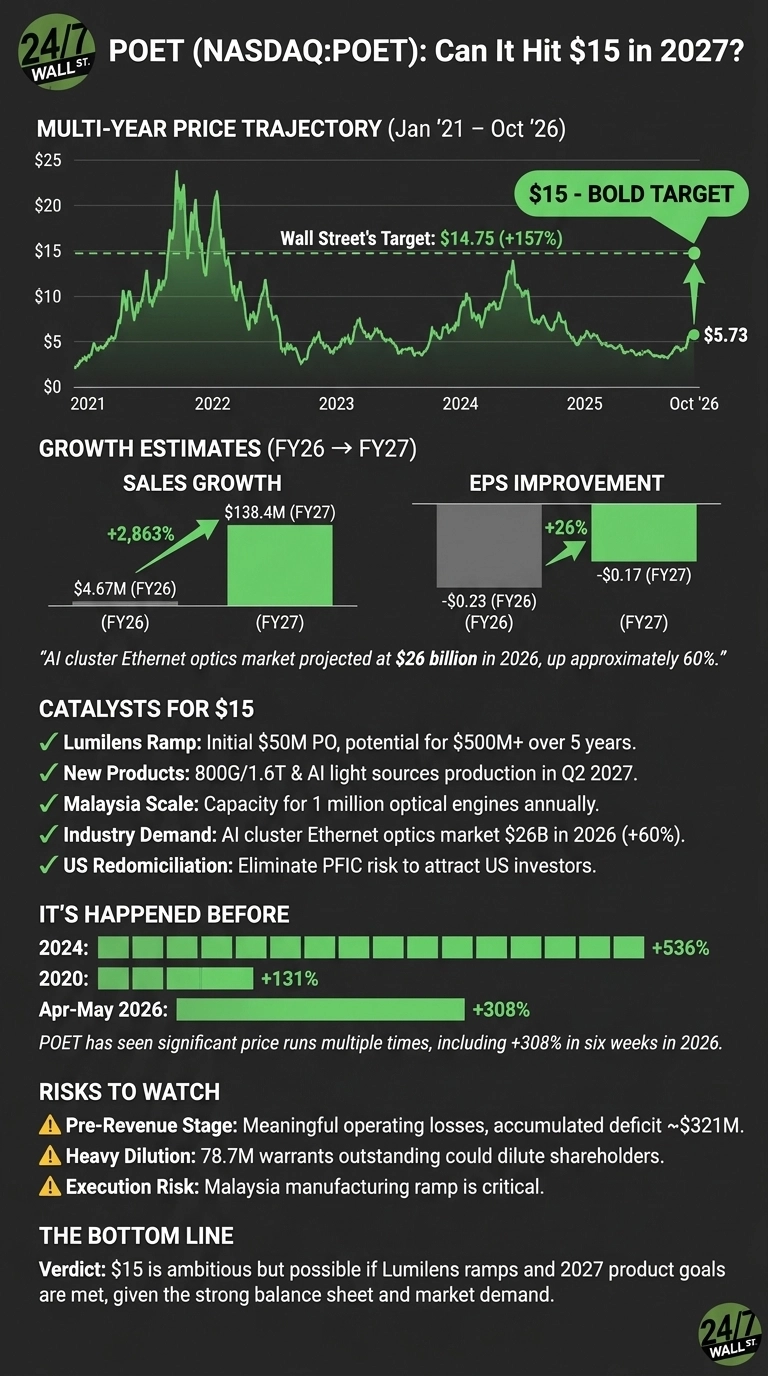
Shares have had a rough stretch. They are down 9.48% year to date and 26.25% over the past month, to $5.73. Let’s look at what POET needs to do to hit $15 per share in 2027.
Wall Street Sees 157% Upside in POET
Wall Street’s average price target of $14.75 suggests 157% upside. Most of that optimism comes from one forecast. Analysts expect 2027 revenue of $138.4 million, compared with $4.67 million in 2026.
The 2027 loss is expected to narrow to -$0.17 per share from -$0.23. Only one analyst covers the stock, and POET has no beat run. Second-quarter EPS of -$0.07 met expectations, but revenue of $569,925 missed the $691,530 estimate.
Can POET Really Hit $15? Let’s Do the Math
POET isn’t profitable yet, so price-to-sales is the better metric. At $5.73, the stock trades at about 7x estimated 2027 sales. At $15, that multiple would be about 19x. It’s a premium valuation, but a justified one if revenue really does multiply as forecast.
POET also holds about $796 million in cash and short-term investments against a market cap of about $991.6 million. In other words, investors are putting little value on the operating business.
What Could Push POET to $15?
- Lumilens ramp: An initial $50 million purchase order could grow to $500 million+ over five years. CEO Suresh Venkatesan said it “establishes the framework for what we believe could become a substantial long-term supplier relationship supporting frontier AI infrastructure.”
- New products: 800G/1.6T transmit engines and AI light sources are scheduled for production in Q2 2027.
- Malaysia scale: Globetronics gives POET capacity for 1 million optical engines annually.
- Industry demand: The AI cluster Ethernet optics market is projected at $26 billion in 2026, up about 60%.
- U.S. redomiciliation: Moving to the U.S. would remove the PFIC tax issue, which could bring in more U.S. investors.
POET’s History Says $15 Is Possible
A move to $15 would require a 162% gain. POET has done this before. Shares climbed 536% in 2024 and 131% in 2020.
This year the stock ran from $5.61 in April to $22.89 by mid-May, a 308% move in about six weeks.
$15 Is a Stretch, but Here’s Why It’s Possible
A 162% gain is ambitious, but Wall Street’s target already sits close to $15. A funded balance sheet, a major customer agreement and new production lines due in 2027 all support the case.
There are hurdles. Losses are heavy, 78.7 million warrants could dilute shareholders, and the Malaysia ramp still has to deliver. Oversized gains at this level are rare, and this is the pattern for how POET could post them in 2027.
Contact [email protected] for any questions or corrections.
Vandita Jadeja is a financial publisher with over a decade of experience writing about financial topics, including investment, savings, retirement, insurance and banking. Vandita is a Chartered Accountant who loves to debunk financial concepts for readers.
Her work has appeared on sites that include The Motley Fool, InvestorPlace, and Benzinga. She covers investing and focuses on stock picks and price prediction for 24/7 Wall St.
When not looking for the next stock investment opportunity, she can be found traveling, reading, chasing sunsets and enjoying her iced latte.