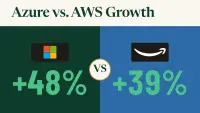
AWS Holds the Scale Crown, Azure Leads the Velocity Charge
AWS and Azure both posted record quarters, but the two cloud giants are winning in completely different ways, and only one of them is actually funding its AI buildout from its own cash.

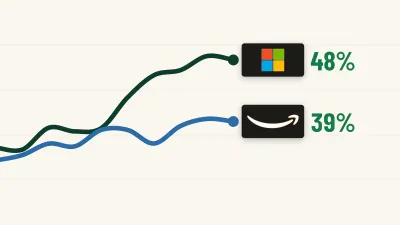
Amazon (NASDAQ:AMZN | AMZN Price Prediction) and Microsoft (NASDAQ:MSFT) reported a day apart, and the cloud race now has two leaders. AWS brought in more money, with $45.98 billion in revenue. Azure grew faster, at 48%. Both are spending record sums on AI capacity, so investors need to know which engine better justifies the bill.
AWS Speeds Up at Scale While Azure Tops 48%
AWS revenue rose 39%, the sixth straight quarter of faster growth. That pace is rare for a business with a $184 billion run rate. CEO Andy Jassy put it simply: “In AWS, our plan is working.” Bedrock token volume grew nearly 17x, a sign that inference has moved past the pilot stage.
Microsoft’s speed comes from software layered on top of its infrastructure. Foundry has over 120,000 customers, and Copilot daily users grew over 5x year over year. CFO Amy Hood said “Customer demand continues to exceed available supply,” and she forecast Azure to 49% to 50% constant-currency growth next quarter. Microsoft expects growth to speed up again.
| Business Driver | AWS | Azure |
|---|---|---|
| Quarterly Revenue | $45.98B | $33.17B |
| Growth | 39% | 48% |
| Signed Backlog | $578B | $677B (company-wide RPO) |
| AI Platform | Bedrock, AgentCore | Foundry, Copilot |
Chip Owner Versus Stack Integrator
Amazon designs its own chips. Most of Bedrock runs on Trainium, and customers using Amazon silicon saved more than $2 billion in Q3. Amazon plans to sell Trainium outside AWS in late 2027, which would create a second business. AWS operating margin reached 38.7%, though the CFO warned that lower-margin AI work will weigh on that figure as it grows.
Microsoft treats its infrastructure as one shared pool that serves Azure, Copilot and its databases. Satya Nadella said the advantage “compounds when we work them across.” The cost shows up in margins: Microsoft Cloud gross margin slipped to 66%. Even so, Microsoft produced $18.6 billion of free cash flow. Amazon’s trailing free cash outflow reached $42.4 billion, which is the real cost of the race for scale.
Capacity Deliveries Decide Who Pulls Ahead Next
Over the last six months, investors preferred speed. Microsoft shares rose 26.69% while Amazon’s fell 11.65%.
I am watching Microsoft’s third-party GPU contracts, which shifted to the second half of its fiscal year. For Amazon, the test is whether AWS can deliver growth above 40% in both 2027 and 2028 while 2026 capex runs near $220 billion.
Microsoft Holds the Edge on Funding the AI Buildout
Microsoft is growing Azure faster and still funding the expansion from its own cash, a profile that carries fewer balance-sheet surprises. Amazon’s case rests on having its chips to lower costs over time. AWS growth above 40% next year and a return to positive free cash flow would shift that comparison. The hyperscaler bill also lands on the suppliers behind every new data center, and we pulled together seven of them, from power to cooling, in a free report you can grab here.
Contact [email protected] for any questions or corrections.
Alex Sirois is a financial writer with experience spanning both retail and institutional investing. He has written for InvestorPlace and held roles at BNY Mellon and Bernstein, giving him a perspective that bridges Main Street portfolios and Wall Street analysis.
Alex holds an MBA from George Washington University and has built his career across multiple industries, including e-commerce, education, and translation — a breadth of experience that informs how he breaks down complex financial topics for everyday investors. His writing is conversational, actionable, and grounded in long-term, buy-and-hold investing principles.
At 247 Wall St., Alex focuses on delivering analysis that is both accessible and useful, with a clear emphasis on helping readers make more informed decisions with their money.