“The Bond Market Puked on Him”: Kevin Warsh’s Credibility Takes a Hit After His Second Fed Meeting
Kevin Warsh's second Fed meeting ended with bond traders sending a unmistakable message through the long end of the Treasury curve, and one of Wall Street's most respected Fed watchers had a colorful way of describing what happened next.

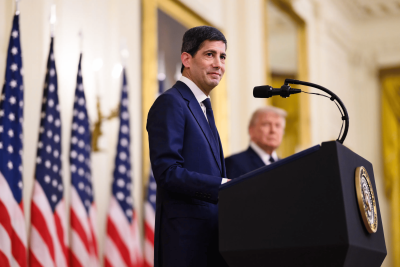
The verdict from one of the most closely read Fed watchers in the business was blunt. “Warsh didn’t convey the message clearly or explicitly, and the bond market puked on him,” Jon Hilsenrath wrote after Kevin Warsh’s second meeting as Fed Chair. The evidence sat right there on the screen: the 30-year Treasury yield jumped as much as 14 basis points to nearly 5.23%, its highest level since 2007. A 19-year high, delivered in the hours after the chairman stepped down from the podium.
A 9-3 Vote and the First Three-Way Directional Dissent Since 2016
The Federal Open Market Committee voted 9-3 on Wednesday, July 29, to hold the federal funds rate steady in the 3.5%-3.75% range. That headline masked the real story. Three regional Fed presidents, Beth Hammack of Cleveland, Neel Kashkari of Minneapolis, and Lorie Logan of Dallas, dissented in favor of a quarter-point hike, citing inflation running above the Fed’s 2% target for more than five years.
It was the first time since September 2016 that three policymakers dissented with a unified directional view on rates. Warsh, who became Fed Chair on May 22, 2026, described the internal debate in characteristically punchy terms: “I asked for a good family fight, and I got one,” calling the discussions “collegial and constructive.” The dissenters had data on their side. Headline PCE inflation ran at 4.07% in May 2026, up from 2.88% in January, with core PCE at 3.41%.
The Yield Curve Told a Different Story
What rattled traders was not just the size of the move but its shape. The 10-year Treasury yield rose more than 7 basis points to 4.677% in the same window, while the 2-year yield actually fell even as the 30-year spiked. Short-end investors were pricing in a cautious Fed. Long-end investors were pricing in something closer to a credibility problem.
Christian Hoffmann, head of fixed income at Thornburg Investment Management, said the surge in long yields reflected a market “openly questioning” Warsh’s credibility. The curve steepening was visible in the underlying data too. The 10-year minus 2-year spread widened to 0.45% by July 29, up from a 12-month low of 0.27% on June 22.
The Silence Strategy
The bond market’s reaction traces back to a deliberate choice. Warsh has pulled the Fed away from forward guidance, arguing the committee needs flexibility and markets should trade real data rather than Fed hints. He said as much on Wednesday: “Prices reacted in real time to incoming information and the reduction in forward guidance may have been a factor,” adding that “markets have made decisions because we stepped back, in part, from trying to influence those markets.” He declined to say what would trigger a hike.
The approach has moved markets before. Earlier in his tenure, a six-word line, “This committee will deliver price stability,” reset investor expectations, and a separate moment was described as taking away “Wall Street’s radar” by stripping out the cues traders had leaned on.
What to Watch
This is only Warsh’s second meeting as chair. The strategic-ambiguity playbook works if inflation cools and long yields ease. It curdles if the bond market keeps reading silence as either confusion or capitulation on price stability. The 3.75% upper bound has now held since December 10, 2025. The next signal will come from the long end, not the podium.
Contact [email protected] for any questions or corrections.
AJ spent 10 years writing about financial markets at The Motley Fool. His coverage centers on technology stocks and the broader macroeconomic trends, from interest rates to geopolitics, that shape where markets are headed next. AJ is drawn to the stories where big-picture economics and individual companies collide.