AppLovin Rallies 6% Ahead of Earnings as Beaten-Down Ad-Tech Stocks Rebound; Unity Climbs 4%, The Trade Desk Edges Higher
AppLovin stock has shed 64% this year and carries the title of worst-performing S&P 500 name, yet traders are piling in the day before its quarterly report drops. Whether the AI ad engine behind the company can back up management's…


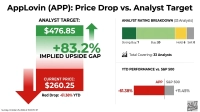
Ad tech’s most battered large-cap name is snapping back a day before its third-quarter report. AppLovin (NASDAQ:APP | APP Price Prediction) stock is at $243.12 in afternoon trading, up 6% from the prior close of $228.85. AppLovin stock is still down 64% year to date (YTD) despite the bounce, and Yahoo Finance has called it the worst-performing S&P 500 stock this year.
Traders appear to be taking positions ahead of the report, which is expected on November 4 after the close. Growth and tech stocks are bouncing back from a volatile session, with the midterm elections in focus, and the rest of the beaten-down ad-tech group is joining in.

AppLovin’s Guidance Sets a High Bar for Q3
On August 5, AppLovin guided for Q3 2026 revenue of $2.055 billion to $2.085 billion, or growth of 46% to 48% year over year (YoY). Model improvements are already live. Management also called for adjusted earnings before interest, taxes, depreciation and amortization (EBITDA) of $1.71 billion to $1.74 billion, with no credit taken for releases not yet deployed.
The rocky Q2 2026 for AppLovin preceded that outlook. The company earned $3.76 per share, inching past the $3.75 consensus, but its revenue of $1.92 billion, up 52.8% YoY, missed expectations of $1.94 billion.

AppLovin Co-Founder and CEO Adam Foroughi pinned the shortfall on timing during the call. “Our pace of meaningful model improvement was lighter than normal during the quarter and the next step-up in model performance landed just after quarter end,” Foroughi said. He added that “Q3 is off to a strong start, and the business is back on the trajectory we expect.”
AppLovin Outpaces Its Ad-Tech Peers
Checking in on the peers, Unity Software (NYSE:U) stock is at $40.35, up 4%. Both Unity and AppLovin depend heavily on mobile game developers, and Unity’s gain comes nearest to AppLovin’s.
Meanwhile, The Trade Desk (NASDAQ:TTD) stock is at $12.64, up 0.7%. That modest gain trails AppLovin’s by a wide margin, which cuts against the picture of a consistent ad-tech rally.
How AppLovin’s Ad Engine Stands Apart
AppLovin runs an artificial intelligence (AI) ad engine called AXON that matches advertisers with in-app inventory, mostly inside mobile games, and after selling its legacy games business now earns from the auction itself, where better models let advertisers spend more at their target returns. During Q2, AppLovin opened its platform publicly as AppLovin Ads Manager, aiming at mid-market consumer advertisers, while Foroughi said gaming remains the majority of AppLovin’s revenue and described model performance as the single biggest driver of gaming growth.
Unity’s model starts with software: game developers license its engine, and monetization and ad tools sit on top of that base. The Trade Desk works from the buyer’s side as a demand-side platform, helping agencies and brands purchase programmatic ads across connected TV and the open web. That combination of MAX, AppLovin’s mediation auction for app publishers, with AXON on the advertiser side is what most clearly separates the company from both peers.
What AppLovin’s Q3 Report Has to Prove
AppLovin’s next test is whether the model gains Foroughi described show up as revenue at or above the top of its guidance range. The bulls can point to the company’s free cash flow of $1.29 billion in Q1 2026 and to consumer advertiser spend that hit a record in Q2, finishing 28% above Q4 2025 levels. AppLovin also said the Securities and Exchange Commission (SEC) concluded a voluntary inquiry with no recommended action.

The bears have their own list, starting with worries about ad demand, competition and weakness in growth stocks. Even after its Q2 earnings per share inching past the consensus, AppLovin stock fell sharply following that report. Compute and stock-based compensation costs could pressure margins if growth slows. Keeping your APP stock exposure limited could be a smart policy until the debate over AppLovin’s growth resolves.
Contact [email protected] for any questions or corrections.
David Moadel is financial writer specializing in stocks, ETFs, options, precious metals, and Bitcoin. David has written well over 1,000 articles for leading online publications, helping investors understand markets, income strategies, and risk.His work has appeared in The Motley Fool, InvestorPlace, U.S. News & World Report, TipRanks, ValueWalk, Benzinga, Market Realist, TalkMarkets, Finmasters, 24/7 Wall St., and others.With a master’s degree in education, David has taught at the elementary, high school, and college levels. That teaching background shapes his writing style: clear, educational, and practical. David has also built a loyal social-media audience by providing trustworthy financial content on YouTube, X/Twitter, and StockTwits.