AppLovin Is Still Down 60% This Year: Did Today Just Mark the Bottom for APP Stock?
AppLovin has shed 60% this year and now sits at a crossroads with earnings on deck, forcing investors to decide whether a compressed multiple and surging cash flow signal a floor or a trap.


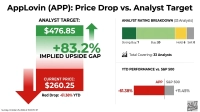
A sharp rally into earnings has reopened the debate over whether the year’s steepest ad-tech selloff has run its course. AppLovin (NASDAQ:APP | APP Price Prediction) stock trades at $271.96 in the afternoon session, up 11%. Even after that jump, AppLovin stock is down 60% year to date (YTD), making it the worst performer in the S&P 500 this year.
The bounce comes just ahead of quarterly results. AppLovin reports its Q3 2026 results after the close on November 4, which makes that report the company’s next real test. Whether the rebound marks a bottom depends on which side of the bull-bear debate those numbers support.
Why AppLovin Bulls Think the Selloff Went Too Far
TIKR data show analysts expect AppLovin to post 2026 adjusted earnings per share (EPS) of $16.65, above the $13.67 they projected a year ago. Per TIKR, the decline came almost entirely from a lower multiple, with AppLovin at under 13x forward earnings versus a five-year average of 25x.
Capital spending at AppLovin is tiny, so nearly all of its operating cash flow becomes free cash flow. The company’s Q2 2026 report showed free cash flow of $863.32 million and buybacks of $551.3 million.
RBC has a $500 price target on AppLovin, issued October 28. Consumer advertising offers the strongest growth signal, with AppLovin saying spending by consumer advertisers in Q2 ran 28% above their Q4 2025 peak. Co-founder and CEO Adam Foroughi said on the August 5 call, “Growing well past peak season levels in a seasonally slow quarter tells you how steep this curve is.”

What Keeps AppLovin Bears Cautious Into the Report
Second-quarter execution at AppLovin handed skeptics their sharpest argument. Foroughi spoke on the call. He acknowledged, “Our pace of meaningful model improvement was lighter than normal during the quarter and the next step-up in model performance landed just after quarter end.” Analysts have cut their 2027 AppLovin estimates by 5% since June’s end.
AppLovin’s cash tax bill is a second pressure point, with the company paying $639.8 million in the first half of 2026 versus $100.6 million a year earlier. That jump helps explain why AppLovin now guides 2026 free cash flow to 75% of adjusted earnings before interest, taxes, depreciation and amortization (EBITDA), down from 87.6% in 2025. A Q4 2026 outlook below the 36% revenue growth that consensus implies could push AppLovin’s 2027 estimates lower still.
What AppLovin’s Q3 Report Has to Prove
For Q3, AppLovin guided for revenue of $2.06 billion to $2.09 billion and adjusted EBITDA of $1.71 billion to $1.74 billion. Landing in that range matters, though the Q4 outlook is what’s likely to carry more weight in the 2027 debate.
Investors can now watch for whether AppLovin’s guidance shows that the model improvements that comes after Q2 are still building.

How Trade Desk and Unity Frame AppLovin’s Slide
The Trade Desk (NASDAQ:TTD) is trading at $13.37, up 4%. Despite that gain, Trade Desk stock is down 65% YTD, a steeper drop than AppLovin’s. That decline came with two straight quarterly EPS misses at The Trade Desk, including a Q2 report in which revenue grew just 3% year over year (YoY).
Meanwhile, shares of Unity Software (NYSE:U) are at $41.84, up 3%. Year to date, Unity stock is down just 5%, a far milder decline that cuts against the idea of a sector-wide collapse. Growth in Q2 came from Unity’s Grow Solutions ad network, where revenue rose 35% YoY to $389 million on the strength of Unity Vector AI.
AppLovin runs an AI-driven mobile-app advertising platform built on its Axon engine, while The Trade Desk operates an independent demand-side platform (DSP) that buys ads across the open internet and connected TV (CTV). Unity pairs a game-engine subscription business with its ad network, which gives it a second revenue stream outside advertising.
Whether AppLovin’s Slide Has Found a Floor
Bullish investors can point to rising earnings estimates, a contracted multiple and heavy cash generation as signs the worst may be priced in at AppLovin.
On the other hand, the skeptics could counter that slower model gains, a heavier tax bill and a soft Q4 guide could keep estimates falling. Results due after the close on November 4 could shift the debate one way or the other. A cautious approach might make sense until there’s more follow-through to the upside with AppLovin stock.
Contact [email protected] for any questions or corrections.
David Moadel is financial writer specializing in stocks, ETFs, options, precious metals, and Bitcoin. David has written well over 1,000 articles for leading online publications, helping investors understand markets, income strategies, and risk.His work has appeared in The Motley Fool, InvestorPlace, U.S. News & World Report, TipRanks, ValueWalk, Benzinga, Market Realist, TalkMarkets, Finmasters, 24/7 Wall St., and others.With a master’s degree in education, David has taught at the elementary, high school, and college levels. That teaching background shapes his writing style: clear, educational, and practical. David has also built a loyal social-media audience by providing trustworthy financial content on YouTube, X/Twitter, and StockTwits.