The Same $10,000 in Microsoft and Meta Could Produce Very Different Results by 2030
Two AI giants, two completely different business models, and a five-year window that could leave one investor sitting on a much larger gain than the other. The gap between their bull and bear outcomes tells a story worth understanding before…

This post may contain links from our sponsors and affiliates, and Flywheel Publishing may receive compensation for actions taken through them.

Put $10,000 into Microsoft (NASDAQ:MSFT | MSFT Price Prediction) and another $10,000 into Meta Platforms (NASDAQ:META), and you own two AI leaders that make money in very different ways.
The model prices Microsoft at $520.68 and Meta at $614.99. In the latest session, the shares closed at $507.12 and $606.73. The closest forecast horizon to 2030 is the five-year target, which ends November 2, 2031, so every dollar figure below uses that window. Any 2030 number is marked illustrative.
What $10,000 Could Become in the Base Case
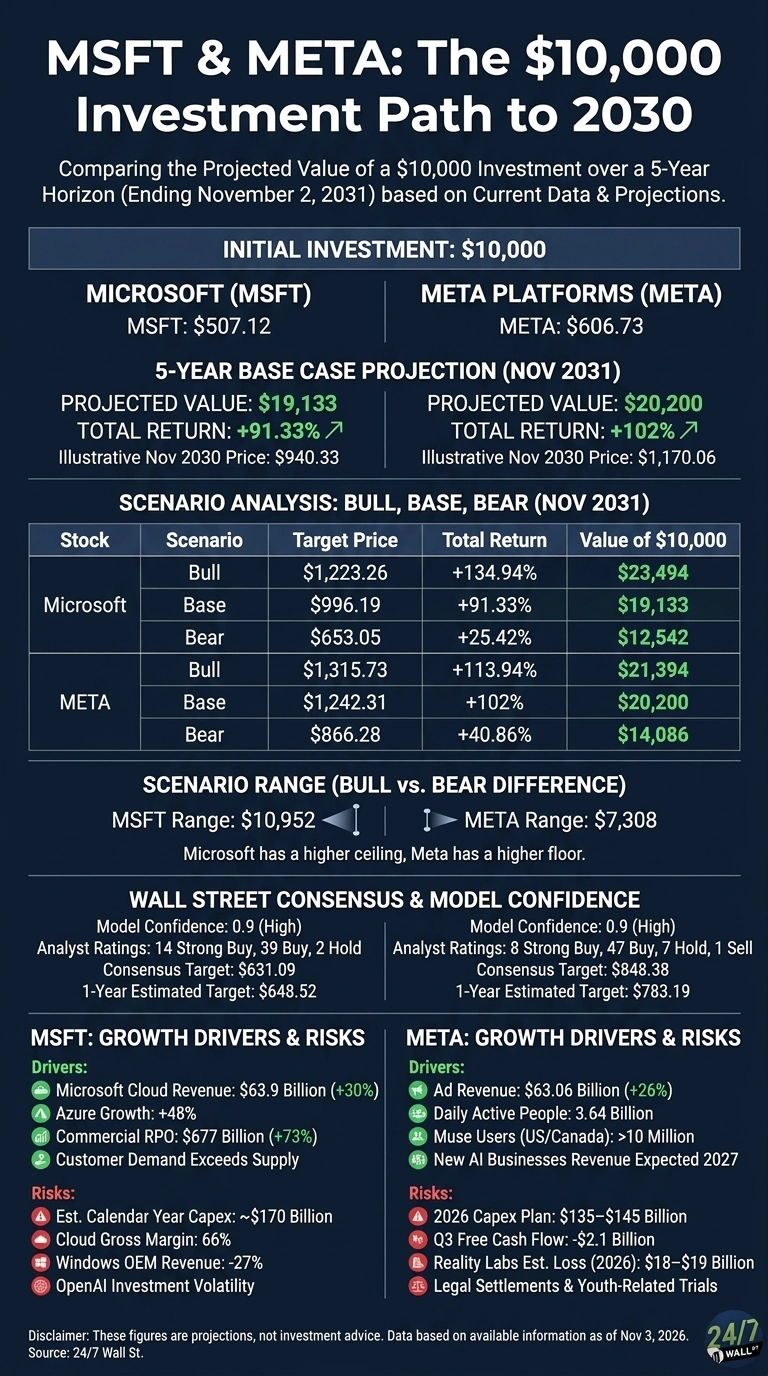
In the base case, a $10,000 investment in Microsoft could be worth about $19,133 at the end of the five-year window, returning 91.33% in all. The projection uses a forecast per-share target of $996.19.

The same $10,000 in Meta could be worth about $20,200, returning 102%, based on a target of $1,242.31. The illustrative base-case prices for November 2030 are $940.33 for Microsoft and $1,170.06 for Meta.

Bull, Base and Bear Scenarios Side by Side
| Stock | Scenario | Target Price | Total Return | Value of $10,000 |
|---|---|---|---|---|
| Microsoft | Bull | $1,223.26 | 134.94% | $23,494 |
| Microsoft | Base | $996.19 | 91.33% | $19,133 |
| Microsoft | Bear | $653.05 | 25.42% | $12,542 |
| Meta | Bull | $1,315.73 | 113.94% | $21,394 |
| Meta | Base | $1,242.31 | 102% | $20,200 |
| Meta | Bear | $866.28 | 40.86% | $14,086 |
The scenario ranges are where the two stocks split apart. Microsoft’s bull and bear results are $10,952 apart, compared with $7,308 for Meta. Microsoft has the higher ceiling, and Meta has the higher floor.
Wall Street Consensus and Model Confidence
Both forecasts carry 0.9 confidence, which the model marked high. Analysts on Microsoft break down as 14 strong buy, 39 buy and 2 hold ratings, with a consensus target of $631.09.

Meta has 8 strong buy, 47 buy, 7 hold and 1 sell ratings and a target of $848.38. Over one year, the estimated targets are $648.52 for Microsoft and $783.19 for Meta.

Why Microsoft’s Engine Keeps Compounding
Microsoft Cloud revenue reached $63.9 billion last quarter, up 30%. Azure grew 48%, and management guided to 49 to 50% constant-currency growth next quarter.
Commercial remaining performance obligation, which is signed revenue not yet recognized, rose 73% to $677 billion. CFO Amy Hood said “Customer demand continues to exceed available supply.” That backlog explains why Microsoft’s bull case runs the highest.
Why Meta Offers a Cheaper Starting Point
Meta’s advertising revenue rose 26% to $63.06 billion, with ad impressions up 10% and average price per ad up 14%. Its apps reach 3.64 billion people daily. Meta trades at a forward P/E of 18, compared with 25 for Microsoft, which helps hold up its bear case.
Muse, its personal agent, drew more than 10 million U.S. and Canadian users in about six weeks. CFO Susan Li expects new AI businesses to “begin contributing incremental revenue in 2027.”
Risks That Could Shrink Either Stake
The biggest shared risk is spending. Microsoft expects calendar-year capex of about $170 billion, and Microsoft Cloud gross margin slid to 66%.
That capital eventually flows to the power, cooling and networking suppliers feeding the data-center expansion (we covered seven of them in a free AI infrastructure report). Windows OEM revenue fell 27%, and gains or losses on the OpenAI stake can move GAAP earnings.
Meta’s risks hit sooner. It plans to spend $135–145 billion on capex in 2026, and free cash flow came in at negative $2.1 billion last quarter.
A $9.9 billion settlement charge caused GAAP EPS of $3.83 to miss expectations, and more youth-related trials are scheduled. Reality Labs is expected to lose $18–19 billion this year. Investors are already responding: Meta shares fell 16.67% over the past month.
These figures are projections, not investment advice.
How Far Apart Your $10,000 Could Land
Over the five-year window that serves as the anchor for 2030, $10,000 in Microsoft models out between $12,542 and $23,494. In Meta, the range runs from $14,086 to $21,394.
Meta’s base case ends up slightly ahead, while Microsoft has the wider range of results. Each is a forecast scenario, not a guarantee. To see which path is playing out, track Azure supply, Muse monetization and capex returns.
Contact [email protected] for any questions or corrections.
Vandita Jadeja is a financial publisher with over a decade of experience writing about financial topics, including investment, savings, retirement, insurance and banking. Vandita is a Chartered Accountant who loves to debunk financial concepts for readers.
Her work has appeared on sites that include The Motley Fool, InvestorPlace, and Benzinga. She covers investing and focuses on stock picks and price prediction for 24/7 Wall St.
When not looking for the next stock investment opportunity, she can be found traveling, reading, chasing sunsets and enjoying her iced latte.