If You Invest $500 a Month in Meta Starting Now, This is What You’d Have in 2030
Meta is spending more on AI than almost any company on earth, and that bet could either supercharge your monthly contributions or drag them down. Here is what four years of disciplined investing actually looks like across the bull, base,…

This post may contain links from our sponsors and affiliates, and Flywheel Publishing may receive compensation for actions taken through them.

Putting $500 a month into Meta Platforms (NASDAQ:META | META Price Prediction) builds a position in one of the market’s biggest AI spenders without needing to pick a perfect entry point.
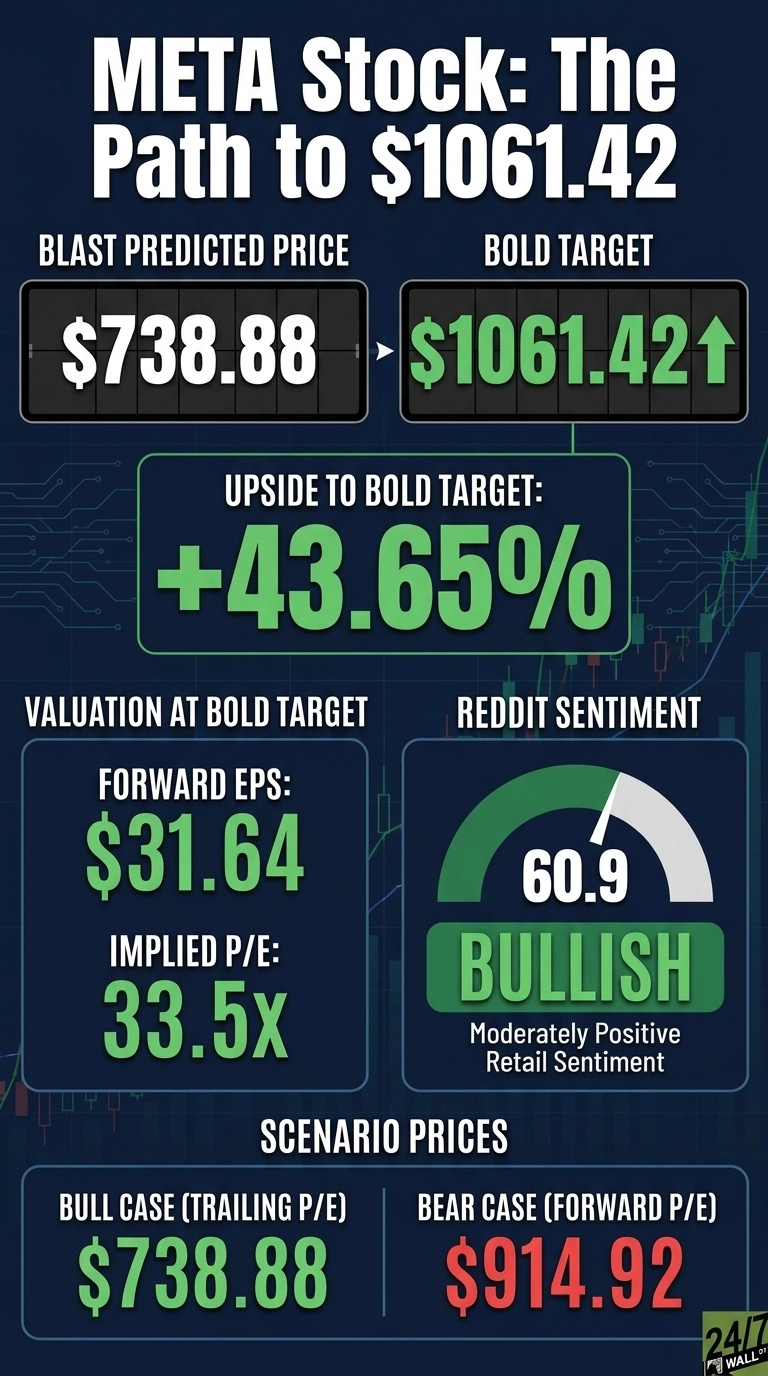
Shares traded at $733.35 in premarket action, slightly below the $738.88 close our price model uses as its starting point. Below is what that monthly contribution could be worth by 2030 and at the model’s full five-year horizon.

What $500 a Month Could Become by 2030
In the base case, four years of contributions ($24,000 invested) could be worth about $31,733.51 by 2030. That means you would gain 32.22% on the money you put in. Treat the 2030 figure as illustrative, because 2030 falls between the model’s 1-year and 5-year horizons.
Tied to the projected five-year horizon (2031-10-07), 60 contributions totaling $30,000 could reach about $42,629.06, a 42.10% gain. Behind that number is a base-case share price of $1,423.93, for a 92.71% total return (14.02% annualized). Your monthly plan makes less than a lump sum would because the later deposits have less time to grow.
The math assumes each $500 goes in at the start of the month and grows at each scenario’s projected annualized return. It leaves out dividends, taxes and fees.
Bull, Base and Bear Scenarios for Your Monthly Stake
| Scenario | 5-Year Target Price | Share Price Total Return | $500/Month Value at 5 Years | Illustrative 2030 Value |
|---|---|---|---|---|
| Bull | $1,722.16 | 133.08% | $47,512.35 (58.37%) | $34,556.35 (43.98%) |
| Base | $1,423.93 | 92.71% | $42,629.06 (42.10%) | $31,733.51 (32.22%) |
| Bear | $945.92 | 28.02% | $34,096.47 (13.65%) | $26,587.91 (10.78%) |
Over the shorter term, the model’s 1-year base target is $923.03, or 24.92% upside, inside a range of $786.35 to $1,061.42. The model’s confidence score is 0.9 on a 0 to 1 scale.
Wall Street’s consensus target is lower, at $794.96, based on 8 Strong Buy, 47 Buy, 7 Hold and 1 Sell ratings.

Three Forces Behind Meta’s Price Path
AI is lifting the ad business. Second-quarter revenue reached $60.8 billion, up 28% year over year. Ad impressions rose 14% and the average price per ad rose 12%. Meta is selling more ads and charging more for each one. Its Advantage Plus tools, which automate ad campaigns, passed an annual revenue run rate of $75 billion.
New revenue lines are forming. After Meta integrated Muse Spark, its AI model, the number of people using Meta AI each day rose 60%. More than 1 million businesses now use Meta’s business agents every week. Wells Fargo argued that Muse can soar much higher, and MarketWatch reported a rare “golden cross” buy signal as users turn to Meta’s AI agent.
On the earnings call, the CEO said “AI is accelerating our core business today, powering our next generation of products, and opening the door to entirely new enterprise opportunities.”
The valuation leaves room to grow. The model uses forward EPS of $31.636 and a forward P/E of 23x, along with a consensus growth rate of 0.1961. For a company with operating margins of 41.44%, that is a reasonable starting multiple.
What Could Derail Your $500-a-Month Plan
Spending is the biggest risk. Meta expects 2026 capital expenditures of $130 to $145 billion, and second-quarter free cash flow fell to $784 million. Q2 EPS of $6.18 missed the $7.10 estimate, weighed down by $2.4 billion in legal charges and $1.2 billion in severance costs.
That capex has to be spent somewhere, which is why we featured seven power, cooling and networking suppliers riding the same expansion in a free AI infrastructure report.
Other risks remain. Meta faces several youth-related trials in the U.S. that could lead to material losses, and EU regulators are pressing it on ads. Reality Labs lost about $19.2 billion in 2025.
The stock is also volatile, with a beta of 1.185, and it has grown only 2.8% over the past year despite strong revenue growth. If AI returns come in slower than hoped, the downside gain of 13.65% on your contributions becomes the more realistic outcome.
Where Your Monthly Contributions Could Land
By 2030, $500 a month in Meta could be worth anywhere from $26,587.91 to $34,556.35 in this illustrative view. At the full five-year horizon, the range is $34,096.47 to $47,512.35.
These numbers depend on Meta’s AI spending paying off, so watch free cash flow and capex guidance in each earnings report. This is a projection rather than a recommendation, and none of these outcomes is guaranteed.
Contact [email protected] for any questions or corrections.
Vandita Jadeja is a financial publisher with over a decade of experience writing about financial topics, including investment, savings, retirement, insurance and banking. Vandita is a Chartered Accountant who loves to debunk financial concepts for readers.
Her work has appeared on sites that include The Motley Fool, InvestorPlace, and Benzinga. She covers investing and focuses on stock picks and price prediction for 24/7 Wall St.
When not looking for the next stock investment opportunity, she can be found traveling, reading, chasing sunsets and enjoying her iced latte.