Apple Vs. Alphabet: The Midterms Just Separated Them from The Mag 7 Pack
One company banks record profits while the other burns cash and issues stock to build its future. After a week of earnings and election relief, the market sees them very differently, and one valuation gap looks hard to ignore.

This post may contain links from our sponsors and affiliates, and Flywheel Publishing may receive compensation for actions taken through them.
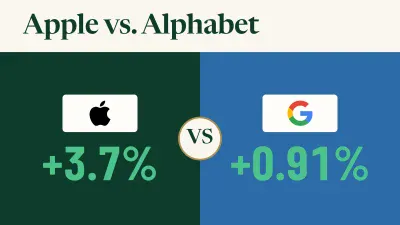
Within a week of each other, Apple (NASDAQ:AAPL | AAPL Price Prediction) and Alphabet (NASDAQ:GOOGL) reported earnings. Then came a blue wave in the midterms that removed investor uncertainty. Apple posted a record September quarter on iPhone and Services. Alphabet doubled Cloud revenue, but an equity loss cut into EPS. From November 3 through November 5, Apple rose 3.7% and Alphabet gained 0.91%.
Foldables Carry Apple While TPUs Carry Alphabet
Apple’s revenue came in at $114.48B, up 11.7%. EPS of $2.10 beat the $1.98 consensus. That is a clean beat, although tariff refunds added $0.05 per share. iPhone revenue reached $57.6 billion, up 17%. CEO John Ternus called the foldable iPhone Duo “the most transformational iPhone since the original.” COO Sabih Khan said it “is constrained as of today.” Strong demand is encouraging, but those supply limits could hold back holiday sales.
Alphabet’s revenue rose 24.65% to $127.58B, slightly missing expectations. GAAP EPS of $2.12 missed the $2.97 consensus. Most of that gap came from an $8.70B equity securities loss, which cut EPS by $0.55. Google Cloud revenue rose 103% to $30.71B. CEO Sundar Pichai cited “strong demand for our TPU systems across a wide range of customers.”
| Business Driver | Apple | Alphabet |
|---|---|---|
| Main Growth Engine | iPhone Duo, iPhone 18 Pro | Cloud AI infrastructure, TPUs |
| AI Approach | Private, on-device Siri AI | Full-stack Gemini |
| Biggest Drag | Memory costs | Equity losses, capex |
Apple Returns Cash While Alphabet Borrows to Build
Apple spent only $9.04B on capex for the full fiscal year. In the quarter alone, it returned $28 billion to shareholders. Apple’s model requires little capital. Alphabet spent $51.36B on capex in a single quarter, and free cash flow came in at negative $9.07B. To fund the expansion, it issued $28.7B in notes and sold stock through an at-the-market (ATM) program, which dilutes existing shareholders. Cloud operating income rose to $11.12B from $3.59B, which suggests the spending is already paying off.
Memory Prices and Cloud Returns Will Decide Who Leads Next
Apple expects December-quarter gross margin of 45% to 46%, down from 47.9%. Ternus called memory prices “unprecedented.” I will be watching whether price increases on new products can offset those costs. With Alphabet, keep an eye on Search. Bloomberg flagged the risk that Google’s own AI could eat into Search, yet Pichai said query growth is the highest it’s been in the last five years.
Why Alphabet’s Discount Interests Me More Than Apple’s Premium
Apple trades at about 45 times earnings. Alphabet trades at roughly 13, after falling 18.4% over the past month. Apple’s appeal rests on a strong ecosystem and buybacks. For me, Alphabet is the more interesting research case, because Cloud growth is exceeding anything Apple’s hardware cycle can deliver. That view changes if Cloud growth slows while free cash flow remains negative.
Contact [email protected] for any questions or corrections.
Alex Sirois is a financial writer with experience spanning both retail and institutional investing. He has written for InvestorPlace and held roles at BNY Mellon and Bernstein, giving him a perspective that bridges Main Street portfolios and Wall Street analysis.
Alex holds an MBA from George Washington University and has built his career across multiple industries, including e-commerce, education, and translation — a breadth of experience that informs how he breaks down complex financial topics for everyday investors. His writing is conversational, actionable, and grounded in long-term, buy-and-hold investing principles.
At 247 Wall St., Alex focuses on delivering analysis that is both accessible and useful, with a clear emphasis on helping readers make more informed decisions with their money.