Coca-Cola vs P&G: Staples Rotation Crowns a Clear Income Winner
Tech is bleeding while soda and detergent makers rally, and Jim Cramer wants to camp out in staples "for a bit." Two dividend legends have very different runs behind them, and only one suits someone living off portfolio income.

This post may contain links from our sponsors and affiliates, and Flywheel Publishing may receive compensation for actions taken through them.
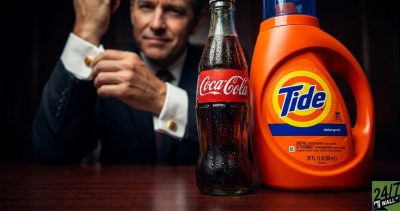
Which dividend stock fits a retirement-focused portfolio better as money rushes out of technology? Coca-Cola (NYSE:KO | KO Price Prediction) and Procter & Gamble (NYSE:PG) both have dividend records going back decades. Right now, though, they occupy very different points in their runs.
Staples Stocks Are Gaining While Tech Slides
Recent sector performance supports the rotation story. The Technology Select Sector SPDR (NYSEARCA:XLK) fell 12.0% over the past week and 17.8% over the past month. Over the same periods, the Consumer Staples Select Sector SPDR (NYSEARCA:XLP) rose 1.9% and 9.9%. When growth stocks wobble, investors move into companies whose detergent and soda sales tend to hold up through any market cycle. Jim Cramer summed up the mood on CNBC on October 30, 2026: “I like the idea of camping out in the staples for a bit.” The words “for a bit” raise a fair question: is this a permanent shift or just a temporary parking spot?
Coca-Cola closed most recently at $95.73 and P&G at $167.10. Coca-Cola is up 36.9% year to date and 39.7% over one year. P&G is up 16.6% and 14.6%. P&G has led the rotation itself, though, gaining 11.4% over the past month against Coca-Cola’s 10.7%. So the choice comes down to the stock that has already run versus the one catching up.
Dividend Safety: P&G Takes the Income Crown
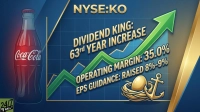
P&G just completed its 70th consecutive year of dividend increases and its 136th consecutive year of payments. Its dividend history shows a raise every year, with the quarterly payout climbing from $0.285 in 1999 to $1.0885. Coca-Cola reported 63 consecutive years of increases as of its fourth-quarter 2025 release, and it lifted the quarterly payout from $0.51 to $0.53 in 2026.
P&G yields 2.6%, compared with 2.2% for Coca-Cola. Both pay out a similar share of earnings: about 65% for P&G and 62% for Coca-Cola. P&G generated $15.84 billion in fiscal 2026 free cash flow and plans to pay out more than $10 billion in dividends. Coca-Cola guides to at least $13.0 billion in free cash flow, against $8.8 billion in dividends paid in 2025. Winner: P&G, thanks to its higher yield and longer run. (Both names sit firmly in Dividend Kings territory, and we ranked ten kings by valuation in a free report you can grab here.)
Valuation: P&G Costs Less per Dollar of Earnings
P&G is valued at 25 times trailing earnings and 23 times forward earnings, with an EV/EBITDA of 16.3. Coca-Cola goes for 28 times trailing earnings, 27 times forward earnings, and 21.2 times EBITDA. It also trades close to its 52-week high of $97.39, while the average analyst target of $97.75 points to little room left. Winner: P&G.
Growth and Durability: Coca-Cola Has the Stronger Engine
In the third quarter, Coca-Cola’s revenue rose 7.4% to $13.38 billion, and unit case volume grew 5%. Comparable operating margin expanded to 32.9% from 31.9%. Management raised its comparable EPS growth target to at least 11%. One drawback is that selling Coca-Cola Beverages Africa back to an independent bottler creates about an 8% revenue drag in 2027.
P&G’s organic sales grew 4%. Even so, it maintained its full-year core EPS guidance at $6.89 to $7.11 due to a $1.4 billion after-tax commodity drag. Core gross margin fell 150 basis points. Winner: Coca-Cola.
Verdict: P&G Edges Ahead on Retirement Income Metrics
P&G leads on two of the three dimensions, and they are the two that matter most to someone living off portfolio income. It offers a higher yield, a longer dividend record, and a lower multiple. Those strengths matter more if Cramer’s “for a bit” turns out to be right and the cheaper stock has less to give back. Coca-Cola is the better fit for investors who are still years from retirement and not yet drawing income and want faster earnings growth, as long as they are comfortable paying a premium after a big run. Going forward, keep an eye on whether P&G’s price increases keep up with commodity costs, and on how Coca-Cola’s 2027 outlook handles the Africa drag.


Contact [email protected] for any questions or corrections.
Trey has been an editor and author at 24/7 Wall St. for more than a decade, where he has published thousands of articles analyzing corporate earnings, dividend stocks, short interest, insider buying, private equity, and market trends. His comprehensive coverage spans the full spectrum of financial markets, from blue-chip stalwarts to emerging growth companies.
Beyond 24/7 Wall St., Trey has created and edited financial content for Benzinga and AOL's BloggingStocks, contributing additional hundreds of articles to the investment community.
Trey's editorial expertise extends across multiple publishing environments. He served as production editor at Dearborn Financial Publishing and development editor at Kaplan, where he helped shape financial education materials. Earlier in his career, he worked as a writer-producer at SVE. His freelance editing portfolio includes work for prestigious clients such as Sage Publications, Rand McNally, the Institute for Supply Management, the American Library Association, Eggplant Literary Productions, and Spiegel.
Outside of financial journalism, Trey writes fiction and has been an active member of the writing community for years, moderating workshop sessions at regional conventions.