Jobless Claims Just Matched a 57-Year Low on the Day Stocks Crashed
A blockbuster labor report and a brutal sell-off landed on the same morning, yet they had nothing to do with each other. One of them poses a bigger threat to the biggest index fund in America, and it may not…

This post may contain links from our sponsors and affiliates, and Flywheel Publishing may receive compensation for actions taken through them.
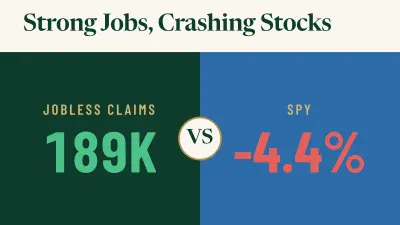
Before the opening bell on November 5, 2026, the government reported that initial jobless claims fell 6,000 to 189,000 in the week ending October 31. That matched the mid-July reading as the lowest level since 1969. Economists had expected 196,000.
By the close, the S&P 500 had fallen about 4.4%. The State Street SPDR S&P 500 ETF Trust (NYSEARCA:SPY) finished at $733.00, down $33.81.
The Nasdaq Composite dropped 5.52%, a larger loss than the Dow’s about 3.4%. The selling was concentrated in AI and data center stocks after Democratic midterm wins raised fears of data center moratoriums.
The two events fell on the same day but stemmed from different causes. SPY sits in the upper part of its 52-week range of $629.28 to $781.62, so the question is which of the day’s risks deserves more weight.
Few Layoffs, but Slower Rehiring for the Jobless
Continuing claims, which count people still collecting benefits, rose 23,000 to 1,718,000. The insured unemployment rate held at 1.1%. Together, those numbers show that employers are rarely cutting staff but that people already out of work are taking longer to find new jobs.
Some economists say low claims reflect a shrinking labor supply as immigration slows. Others see a job market that is actually tightening, and job openings per unemployed person rose to 1.06 in September from 1.02 in August.
Either explanation can keep wages firm and inflation sticky. That matters for SPY because sticky inflation raises the odds of a rate hike.
Productivity Jumped While Labor Costs Fell
Third-quarter productivity grew at a 3.6% annualized pace, ahead of forecasts of 2.8%. Output rose 3.7% while hours barely moved.
Unit labor costs, the labor expense behind each unit of output, fell 0.7%. Economists had expected a 0.6% rise. Falling labor costs support profit margins and weaken the case for a hike.
October job cuts were 71% lower than a year earlier, at 43,994. Hiring plans totaled 444,692, the highest for any October since 2009. However, Andy Challenger, chief revenue officer of the outplacement firm that tracks these numbers, said employers are holding on to the workers they have and most announced hiring is short-term holiday work.
Why a Strong Economy Did Not Shield SPY
SPY weights companies by market value, so chip and cloud leaders make up the biggest positions. As of March 17, 2026, NVIDIA (NASDAQ:NVDA | NVDA Price Prediction) alone was 7.58% of the fund.
Data center bans would hurt AI spending no matter how many Americans are working. Good jobs data lowers recession risk, but it cannot offset a policy risk aimed at the index’s largest holdings.
Rate Hike Odds Add a Second Risk
The Fed held its target range at 3.75% to 4.00% at its most recent meeting. Futures now price a 67% chance of a quarter-point hike on December 9, and strong labor data hurts stocks if it drives the Fed toward that hike.
The 10-year Treasury yield fell to about 4.83% from 4.90% as money moved toward safety. Economists’ forecasts for October payrolls, due at 8:30 a.m. ET on November 6, range from 59,000 to about 65,000.
What the Sell-Off Means for SPY Holders
SPY’s long-term case likely remains intact, because the economy underneath it is producing more with fewer layoffs and falling labor costs. The sell-off repriced a political risk concentrated in AI stocks, and riding out a repricing like this is easier with a plan for both sides of the move (we wrote a free handbook on exactly that, here).
Investors exploring alternatives can compare the Invesco S&P 500 Equal Weight ETF (NYSEARCA:RSP), which has a different structure. It gives every member the same weight, which cuts its exposure to the data center fight.
This view would weaken if payrolls come in above the forecast range and SPY then closes below its $733.00 November 5 close, because that would mean rate risk is adding to policy risk. Keep an eye on the December 9 Fed meeting, state data center bills, and the next weekly claims report.
Contact [email protected] for any questions or corrections.
Omor Ibne Ehsan is a writer at 24/7 Wall St. He is a self-taught investor with a focus on growth, cyclical, and dividend equities that have strong fundamentals, value, and long-term potential. He also has an interest in high-risk, high-reward investments such as penny stocks.