How to Build $5,450 a Month in Tax-Free Dividend Income Inside a Roth IRA
Six high-yield holdings can turn a Roth IRA into a tax-free paycheck, but one fund's payout is almost entirely return of capital and another dividend vanished for over a year. Can you trust the income, and how do you fund…

This post may contain links from our sponsors and affiliates, and Flywheel Publishing may receive compensation for actions taken through them.
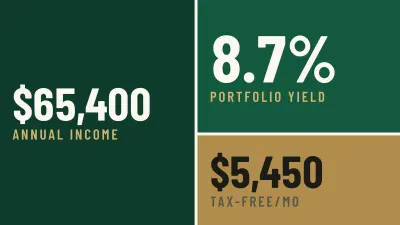
A Roth IRA that pays $5,450 a month returns $65,400 a year, and qualified withdrawals are tax-free at the federal level. I pulled yields for the six-holding portfolio below.
Together they yield about 8.7%, which means the Roth needs roughly $754,000 to hit that target. Each yield below takes the latest payout and annualizes it against today’s share price.
NEOS Nasdaq 100 High Income ETF
NEOS Nasdaq 100 High Income ETF (NASDAQ:QQQI) holds Nasdaq-100 stocks and sells call options on the index. In plain terms, it collects cash up front and gives up some upside in return. It carries a 20% weight and yields 15.5%, which works out to about 36% of the portfolio’s income. Part of that high yield comes from a falling price: shares dropped 9% in the past week.
The fund’s Form 8937 for the year ending May 2025 classified between 94% and 99% of each payout as return of capital. In a taxable account, return of capital reduces your cost basis and can increase your taxable gain when you sell. Inside a Roth IRA, that distinction generally doesn’t affect annual taxes, and qualified withdrawals are tax-free.
Schwab US Dividend Equity ETF
Schwab US Dividend Equity ETF (NYSEARCA:SCHD) owns established U.S. dividend payers and serves as the portfolio’s growth engine. It has a 15% weight, yields 3.0%, and supplies about 5% of the income. It charges 0.06% a year, and its adjusted price has risen 264% over the past ten years.
EPR Properties
A real estate investment trust, EPR Properties (NYSE:EPR) owns theaters, eat-and-play venues, ski resorts, and attractions. It pays $0.31 a month. With a 15% weight and a 6.2% yield, it provides about 11% of the income.
Last quarter’s payout ratio was 60% of adjusted funds from operations. EPR also suspended its dividend after its April 2020 payment and didn’t resume until July 2021, at a lower $0.25. Theaters still account for 34% of its revenue.
Hercules Capital
Hercules Capital (NYSE:HTGC) is a business development company, meaning a publicly traded lender. It lends to venture-backed tech and life sciences companies. It has a 15% weight, yields 11.5%, and accounts for about 20% of income.
Its $0.47 quarterly payout combines a $0.40 base dividend with a $0.07 supplemental. About 89% of its loans are first lien, and its average credit grade improved to 2.12. Because its loans float with rates, a 25bp cut in the prime rate reduces annual earnings by about $0.03 per share.
Altria
Marlboro and on! nicotine pouch maker Altria (NYSE:MO | MO Price Prediction) has a 15% weight, yields 5.7% and covers about 10% of the income. August’s raise was its 61st increase in 57 years. The $4.44 annual dividend equals about 78% of the midpoint of 2026 earnings guidance. Smoking keeps shrinking, though: industry cigarette volume fell an estimated 5%.
Eldridge BBB-B CLO ETF
Eldridge BBB-B CLO ETF (NYSEARCA:CLOZ) buys pieces of collateralized loan obligations, which are bundles of corporate loans split into layers by risk. It targets the riskier layers rated BBB+ to B-, so it carries more credit risk than funds holding top-rated AAA layers.
It has a 20% weight, yields 8.0%, supplies about 18% of the income, and charges 0.50%. Its coupons float with short-term rates, so its income drops when the Fed cuts.
Why These Payouts Belong in a Roth
REIT dividends get the lower qualified-dividend tax rates only in limited cases under 26 U.S.C. § 1(h)(11)(D)(iii). BDC and CLO income is also mostly taxed as ordinary income. Inside a Roth, qualified distributions stay out of gross income entirely under 26 U.S.C. § 408A(d)(1).
Moving $754,000 Into a Roth
Annual contributions alone will take a long time. The 2026 limit is $7,500, or $8,600 for those 50 and older. For joint filers, eligibility phases out between $242,000 and $252,000. The bigger ways take different forms. They include converting traditional IRA or 401(k) money, rolling a Roth 401(k) into a Roth IRA and, for high earners, the backdoor Roth.
Consider a married couple with no other income who converts about $151,000 a year for five years. After the $32,200 standard deduction, taxable income is about $118,800, inside the 22% bracket that ends at $211,400. Federal tax comes to about $15,560 a year, or $77,800 over five years.
That income also stays under the $218,000 joint threshold where Medicare premium surcharges start. Those quiet years between your last paycheck and your first required withdrawal are the cheapest conversion window you will ever see, which is the whole subject of our free Roth Window guide.
Withdrawals become qualified at age 59½, once five years have passed since your first Roth contribution (26 U.S.C. § 408A(d)(2)). Each conversion also starts its own five-year clock for the 10% early-withdrawal penalty (IRS Publication 17).
Where to Start Before Year-End
A conversion counts for 2026 only if it’s completed by December 31. This year, estimate your 2026 taxable income and convert enough to fill your current bracket without spilling into the next one.
Contact [email protected] for any questions or corrections.
David Beren has been a Flywheel Publishing contributor since 2022. Writing for 24/7 Wall St. since 2023, David loves to write about topics of all shapes and sizes. As a technology expert, David focuses heavily on consumer electronics brands, automobiles, and general technology. He has previously written for LifeWire, formerly About.com. As a part-time freelance writer, David’s “day job” has been working on and leading social media for multiple Fortune 100 brands. David loves the flexibility of this field and its ability to reach customers exactly where they like to spend their time. Additionally, David previously published his own blog, TmoNews.com, which reached 3 million readers in its first year. In addition to freelance and social media work, David loves to spend time with his family and children and relive the glory days of video game consoles by playing any retro game console he can get his hands on.