Rate Hikes Could Be Coming: History Likes These 4 Consumer Staples Stocks
The Fed ended its pause, and traders now price in another hike by December. Three past tightening cycles reveal which household-name staples stocks protected portfolios, and one of them beat the market every single time.

This post may contain links from our sponsors and affiliates, and Flywheel Publishing may receive compensation for actions taken through them.

Although Wall Street enjoyed more than nine months of a steady Federal Reserve, with the target rate capped at 3.75% from December 11, 2025 through September 16, 2026, that calm ended when policymakers lifted the ceiling to 4.00%, where it has sat since September 17. The quarter-point move ended the pause. But prediction markets expect more. On Kalshi, the contract for a 25-basis-point hike at the December 9 meeting last traded at $0.70, meaning roughly 70% odds, while a hold traded at $0.33. One sector to examine as borrowing costs climb: consumer staples.
Why Essentials Hold Up When Money Gets Expensive
Staples sell what households replace on a schedule: detergent, diapers, soda and groceries. When higher rates squeeze budgets and slow the economy, shoppers put off a new couch long before they skip toothpaste. Strong brands can raise prices to offset rising costs while keeping most customers, and discount retailers scoop up trade-down traffic from shoppers hunting for value.
Three Hiking Cycles Put the Theory to the Test
I measured dividend-adjusted returns from the month-end prior to the first hike of each cycle to the month-end of its final hike, against the benchmark S&P 500 as tracked by the SPDR S&P 500 ETF Trust (NYSEARCA:SPY).
| Stock | 2004 to 2006 | 2015 to 2018 | 2022 to 2023 |
|---|---|---|---|
| Procter & Gamble (NYSE:PG | PG Price Prediction) | 7.3% | 35.5% | 4.2% |
| Coca-Cola (NYSE:KO) | -11.3% | 22.7% | 4.0% |
| Walmart (NASDAQ:WMT) | -11.4% | 72.5% | 21.1% |
| Costco (NASDAQ:COST) | 53.6% | 35.8% | 8.9% |
| S&P 500 (SPY) | 17.5% | 27.9% | 7.4% |
The record is mixed. Costco topped the index in all three cycles and Walmart beat it in two, yet Coca-Cola and Walmart both lost ground from 2004 to 2006, a reminder that a defensive label carries no guarantee. The sharpest pattern shows up in the worst stretch: in calendar 2022, as the Fed delivered one hike after another, the index fell 18.2%, while Coca-Cola gained 10.6%, Walmart slipped 0.5% and P&G dipped 5.0%.
Procter & Gamble: Volume-Led Growth and a 70-Year Dividend Streak
Procter & Gamble sells Tide, Pampers and Gillette, purchases that rarely wait for cheaper credit. Fiscal first-quarter organic sales rose 4%, with volume contributing 2.4 points and pricing just 0.4 points, and core EPS of $2.00 beat the $1.89 estimate. The $1.0885 quarterly dividend marks its 70th consecutive year of increases. Shares are up 17.45% year to date and trade near 24x the $7.00 center of fiscal 2027 core EPS guidance. Input costs pose a risk: management noted a roughly $1.4 billion after-tax commodity headwind and said "the industry generally is pricing up" to recover it.
Coca-Cola: Pricing Power on Full Display
Coca-Cola offers the purest pricing-power case. Third-quarter revenue climbed 7.4% to $13.38 billion as pricing actions added 4 points, yet global unit case volume still grew 5%. CEO Henrique Braun said the results show "the brands have the equity and the right to take price," and the company raised its free cash flow outlook to at least $13.0 billion. Shares have jumped 37.07% year to date, leaving a P/E of 31 and a 2.13% yield. Mix poses a concern: poor mix cut 3 points as volume growth leans toward lower-priced developing markets.
Walmart: The Trade-Down Magnet
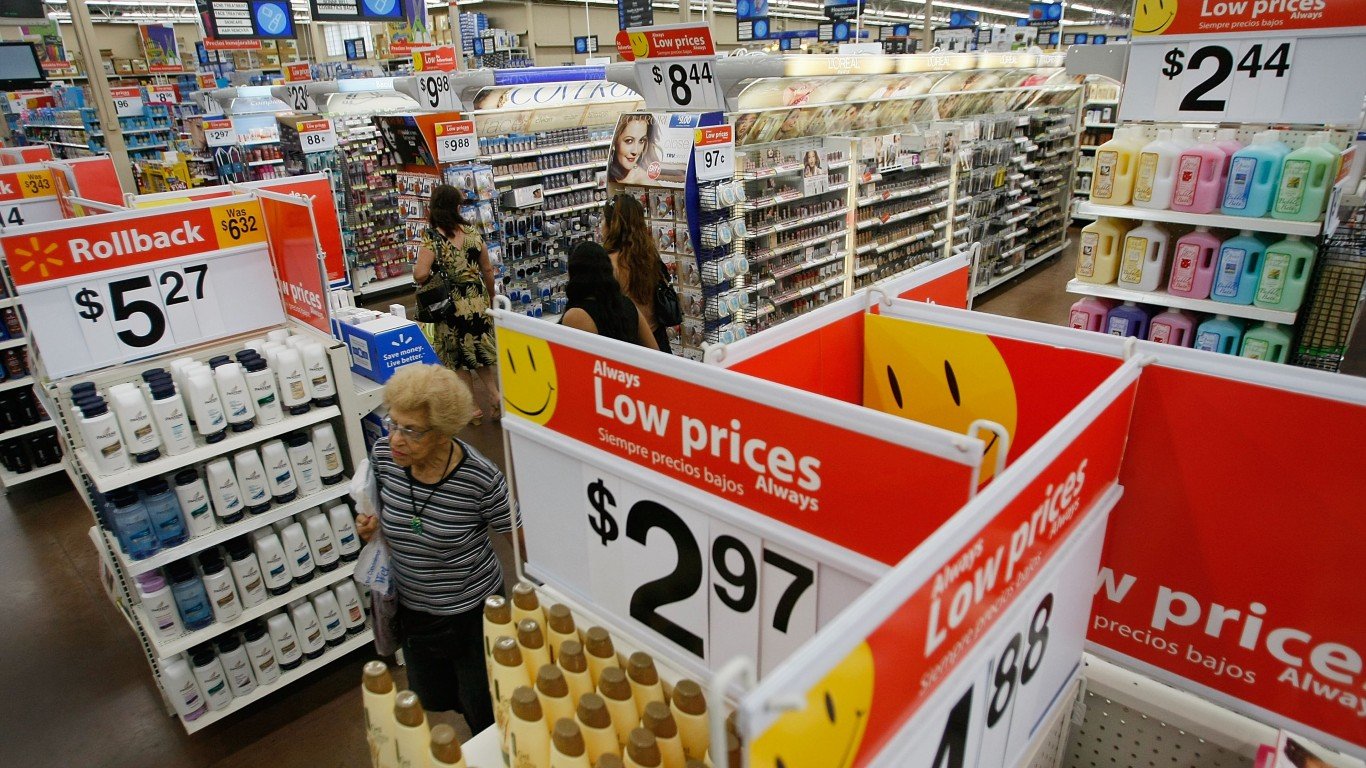
Walmart gains share when budgets tighten. Fiscal second-quarter adjusted EPS of $0.81 beat the $0.74 estimate, global e-commerce jumped 23%, and management raised fiscal 2027 EPS guidance to $2.80 to $2.87. The retailer doled out more than 11,000 rollbacks as CFO John David Rainey observed that "customers are making tradeoffs." Investors already pay for that record with a P/E of 46. Margin pressure stands as a risk, with more than $2 billion of incremental fuel costs expected for the year beyond original guidance.
Costco: The Only Name That Beat the Index Every Time
Costco has outpaced the index in all three hiking cycles since 2004, including 53.6% versus 17.5% from 2004 to 2006. Membership fees support the model: fee income rose 7.3% to $1.85 billion, and the worldwide renewal rate held at 89.8%. Comparable sales rose 9.4%, or 6.7% excluding gas and currency, and fiscal 2026 EPS reached $20.76. Valuation is the worry. At about 51x trailing earnings, Costco leaves little margin, and it fell 19.1% in calendar 2022 as the broader market also declined.
What to Watch Before the December Fed Decision
As the final installment of this five-part series on Fed rate increases, the staples chapter lands on one theme: tightening rewards companies that set prices and keep customers coming back. Three signals matter before December 9: whether Kalshi’s hike odds hold near 70%, whether the "materially higher cost headwinds" P&G expects in its fiscal second quarter arrive, and whether Walmart’s price investments lift U.S. comparable sales. On valuation, P&G at roughly 24x forward earnings compares with trailing P/E ratios of 46 for Walmart and about 51 for Costco. I’ve highlighted all-weather dividend payers before, and the same logic applies here. Across the three hiking cycles measured here, the S&P 500 rose each time. Staples simply buffer the ride while the Fed tightens.
Contact [email protected] for any questions or corrections.
Lee Jackson has covered Wall Street analysts' equity and debt research and equity strategy daily for 24/7 Wall St. since 2012. His broad, diverse career, including a stint as creative services director at an NBC affiliate in Austin, Texas, gives him unique insight into the financial industry.
Lee Jackson's journey in the financial industry spans more than 30 years, including nearly two decades as an institutional equity salesperson at Bear Stearns, Lehman Brothers, and Morgan Stanley. His career spanned pivotal sell-side Wall Street events, from the dot-com rise and bubble to the Long-Term Capital Management debacle, 9/11, and the Great Recession of 2008. This reflects his resilience and adaptability amid market volatility.
Lee Jackson’s practical financial industry experience, gained through a career at some of the biggest banks and brokerage firms, is complemented by a lifetime of writing across various platforms. This unique combination allows him to shed light on the intricacies of Wall Street in a way only someone with deep insider experience and knowledge can. Moreover, his extensive network across Wall Street continues to provide direct access for him and 24/7 Wall St., a privilege few firms enjoy.
Since 2012, Jackson’s work for 24/7 Wall St. has been featured in Barron’s, Yahoo Finance, MarketWatch, Business Insider, TradingView, Real Money, The Street, Seeking Alpha, Benzinga, and other media outlets. He attended the prestigious Cranbrook Schools in Bloomfield Hills, Michigan, and has a degree in broadcasting from the Specs Howard School of Media Arts.