Fed Chair Kevin Warsh Just Issued a 6-Word Warning That Could Spell Disaster for AI Stocks
Two AI stocks lost nearly half their value in a month while Microsoft barely moved. The split has less to do with chips than with one question every data center builder now has to answer, and rising rates are forcing…

This post may contain links from our sponsors and affiliates, and Flywheel Publishing may receive compensation for actions taken through them.
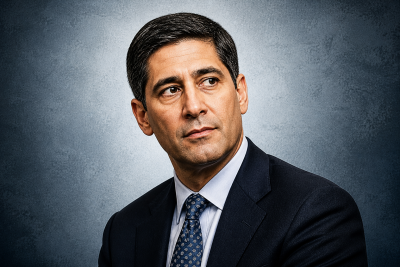
On October 28, Fed Chair Kevin Warsh summed up the AI market’s weak spot in six words: “Interest rates get in the cracks.” Then he added: “Interest rates affect directly or indirectly almost everything.” That includes the AI data center buildout, and a large share of it is paid for with borrowed money.
In the month ending November 6, CoreWeave (NASDAQ:CRWV) fell 47.54% and Nebius Group (NASDAQ:NBIS | NBIS Price Prediction) dropped 45.4%. Over the same month, Microsoft (NASDAQ:MSFT) edged up 0.16%. The market now sorts AI companies by one question: who pays for data centers with cash, and who borrows to build them?
Two Rate Squeezes Hitting at Once
The Fed raised its benchmark rate by a quarter point in September and held it at 3.75% to 4.00% in October. As of November 3, CME FedWatch put the odds of another quarter-point hike in December at 72%. Long-term rates are adding a second pressure. The 10-year Treasury yield reached 5.24% on October 9 and still stood at 4.84% on November 5. That same day, the VIX volatility index rose to 28.18, its highest reading since early August.
Borrowers Are Feeling It First
CoreWeave shows the problem most clearly. Its revenue backlog is $104.2 billion, but to deliver it the company plans to spend $35 billion to $39 billion on capital projects this year, and its debt is 8.94 times its equity. Second-quarter interest expense was $640 million, up from $267 million a year earlier. Management expects $860 million to $940 million in the third quarter.
Nebius plans $20 billion to $25 billion of capital spending this year, backed by $37.5 billion in signed future revenue. It sold $4.34 billion of convertible notes in the first half. Three customers made up 24%, 21% and 14% of its second-quarter revenue, so a single customer that pulls back would hurt.
Oracle (NYSE:ORCL) holds $664 billion in signed future revenue. But it spent $28.5 billion on capital projects last quarter and burned $5.4 billion in free cash flow. Interest expense rose 55%. When asked when free cash flow turns positive, CFO Hilary Maxson said: “We have not given a particular time frame on that yet.” The stock is down 39.64% this year.
Free Cash Flow Splits the Group
Microsoft produced $18.6 billion of free cash flow last quarter, even after $45.2 billion in capital spending. CFO Amy Hood said the company has not yet borrowed in the debt markets. Alphabet is moving toward the borrowers’ side. Its free cash flow was negative $9.07 billion after $51.36 billion of capital spending, and it raised $28.7 billion from new bonds.
Micron Technology (NASDAQ:MU) shows that having cash does not fully protect a company. Micron generated $62.3 billion of free cash flow in fiscal 2026, yet its stock fell 36.57% over the past month. The reason: its high-bandwidth memory (HBM) orders come from the same companies that borrow to build. If lenders get conservative, those buyers can afford less memory, even while chips stay scarce.
What to Watch Before December
Keep an eye on CoreWeave’s third-quarter earnings report. If interest expense reaches the top of its guidance, or the company reduces its spending plan, the cost of borrowing is starting to limit growth. After that comes the Fed’s December meeting. A rate hike would raise financing costs on data center contracts that were priced when money was cheaper. Demand for AI has held up (we highlighted seven of the power, cooling, and networking suppliers riding that demand, away from the chipmakers, in a free report you can grab here). The open question is whether the borrowing behind the expansion still pays off at today’s rates.
Contact [email protected] for any questions or corrections.
After two decades of patrolling the dark corners of suburbia as a police officer, Rich Duprey hung up his badge and gun to begin writing full time about stocks and investing. For the past 20 years, he’s been cruising the markets looking for companies to lock up as long-term holdings in a portfolio while writing extensively on the broad sectors of consumer goods, technology, and industrials. Because his experience isn’t from the typical financial analyst track, Rich is able to break down complex topics into understandable and useful action points for the average investor. His writings have appeared on The Motley Fool, InvestorPlace, Yahoo! Finance, Money Morning, and, of course, 24/7 Wall St. He has been featured in both U.S. and international publications, including MarketWatch, Financial Times, Forbes, Fast Company, and USA Today.