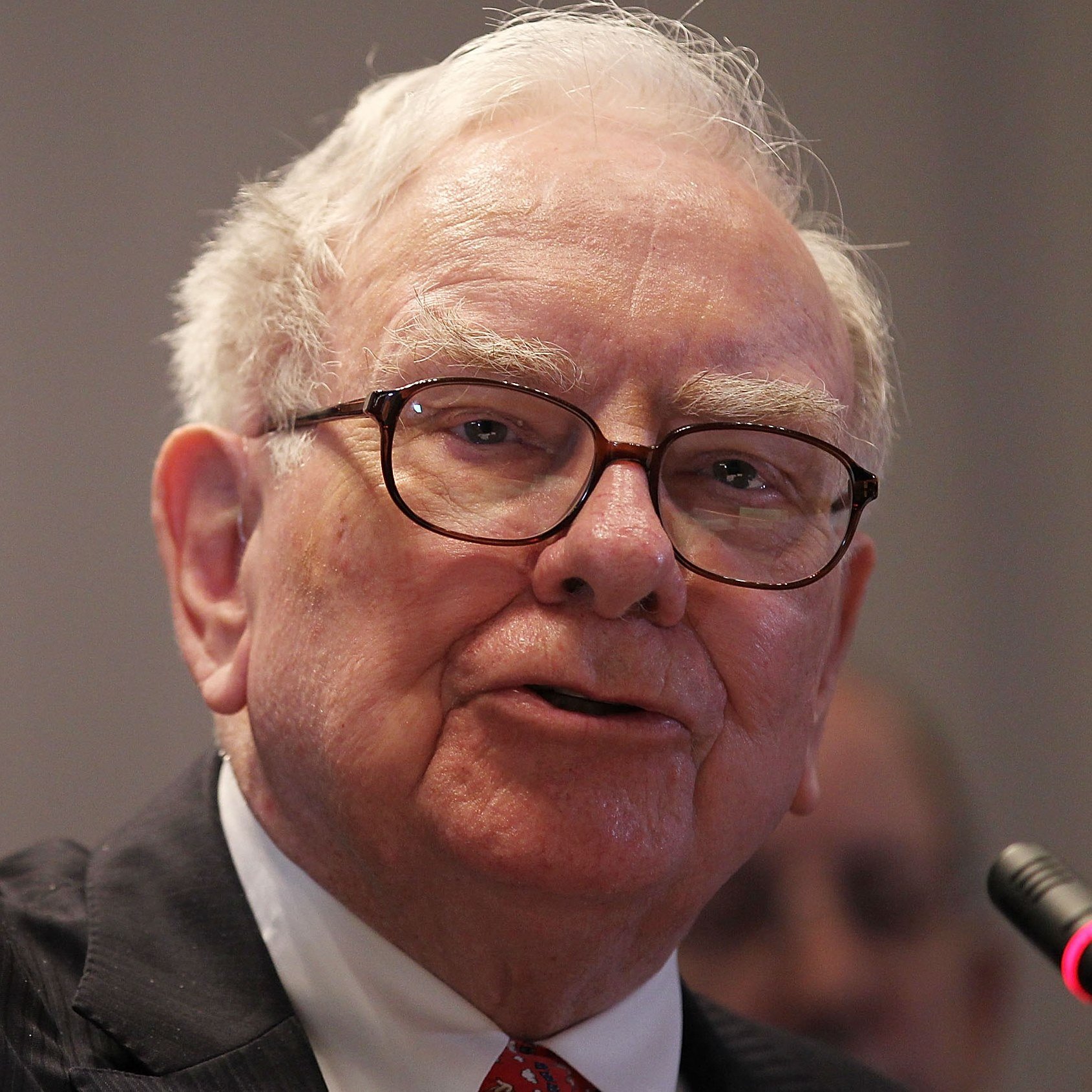
Warren Buffett Told His Wife’s Trustee Exactly Where to Put Her Money. Stocks Just Fell 4.4%.
Warren Buffett's instruction for his wife's money is 90% in a low-cost S&P 500 index fund and 10% in short-term government bonds. After Thursday's 4.4% drop, here is how that rule holds up for a retired couple with $2 million…

This post may contain links from our sponsors and affiliates, and Flywheel Publishing may receive compensation for actions taken through them.
Warren Buffett told the trustee for his wife’s money exactly where to put it, in one sentence: “Put 10% of the cash in short-term government bonds and 90% in a very low-cost S&P 500 index fund.” It comes from his 2013 shareholder letter, and it covers the cash his will leaves to a trust for her benefit. He added that he expected the trust to do better than most investors who pay high-fee managers, and told readers to keep costs minimal.
That sentence is worth a hard look this week. The S&P 500 fund fell 4.4% on Thursday, closing at $733.00 after $766.81 on Wednesday. Friday’s close of $735.29 sits 5.6% below the Oct 6 record of $779.09. Gary, 66, and Linda, 63, are retired with $2,000,000 invested: $1,400,000 in an IRA, $450,000 in a taxable account and $150,000 in a Roth. They spend $120,000 a year, collect $4,500 a month in Social Security ($3,400 for Gary and $1,100 for Linda, $54,000 a year), and draw $66,000 a year from savings. Gary wants to know if 90/10 is safe for them, and if you are near retirement you may be asking the same thing.
The direct answer: the stock share matters less than the size of the bond sleeve, and for them 10% is a little thin. Under 90/10 they would hold $200,000 in short-term government bonds, 3.0 years of withdrawals. That covered the two most recent crashes but would have run out about 29 months before the 2007 to 2009 crash was repaired. A reserve of about $358,050, roughly 18% of savings, covers all three. An 82/18 split fits them; the one condition that flips it toward 70/30 is a withdrawal rate near 5% instead of their 3.3%.
What 90/10 looks like on $2 million
Ninety percent of $2,000,000 is $1,800,000 in the stock fund, and 10% is $200,000 in short-term government bonds. Their withdrawal of $66,000 a year is 3.3% of the $2,000,000 portfolio, a modest rate because Social Security pays 45% of their $120,000 spending.
| Crash | S&P 500 fund drop | Loss on $1,800,000 of stock | Wait to get back to the old high | Withdrawals during the wait ($66,000 a year) | Did $200,000 in bonds cover it? |
|---|---|---|---|---|---|
| 2020 (Covid) | 34.1% | $613,800 | 5.9 months | $32,450 | Yes |
| 2022 | 25.4% | $457,200 | 24.5 months | $134,750 | Yes |
| 2007 to 2009 | 56.5% | $1,017,000 | 65.1 months | $358,050 | No, $158,050 short |
Gary and Linda under 90/10: $1,800,000 in the stock fund, $200,000 in short-term government bonds. Closing prices, price only, dividends excluded; bonds assumed to hold their value.
Thursday’s drop would have taken about $79,365 off the $1,800,000 stock side, about 4.0% of the whole $2,000,000, leaving $1,720,635 in stock. From the Oct 6 record to Friday’s close, the slide is about $101,195. Nothing in that math forces a sale. Their next year of spending sits in the bond sleeve, so you can let the stock fund ride while it is down.
The 10% is a spending reserve, so count it in years
Buffett’s bond sleeve has one job for a retiree: it is the money you spend while stocks are below their old high, so you never sell the index fund at the bottom. The right size is the number of years you might have to wait, times your yearly withdrawal. For Gary and Linda, $200,000 divided by $66,000 is 3.0 years. The question for them, and for you, is whether 3.0 years has been enough.
Three crashes and whether $200,000 covered the wait
Closing prices for the S&P 500 fund (price only, dividends excluded) give three recent tests, all applied to the $1,800,000 stock side.
2020: Peak $338.34 on Feb 19, low $222.95 on Mar 23 (down 34.1%, a paper loss of $613,800), back above the old peak on Aug 18, 2020, a wait of 5.9 months. Withdrawals during the wait: $32,450. Covered easily.
2022: Peak $477.71 on Jan 3, 2022, low $356.56 on Oct 12, 2022 (down 25.4%, a loss of $457,200), back on Jan 19, 2024, a wait of 24.5 months, about 2.0 years. Withdrawals during the wait: $134,750. Covered, with $65,250 of the reserve left.
2007 to 2009: Peak $156.48 on Oct 9, 2007, low $68.11 on Mar 9, 2009 (down 56.5%, a loss of $1,017,000), first close above the old peak on Mar 14, 2013, a wait of 65.1 months, or 5.4 years. Withdrawals during the wait: $358,050, which is 17.9% of savings. The $200,000 reserve lasts about 36 months, then falls $158,050 short, so you would be selling the stock fund for about 29 months while it was still under water.
Option 1: Buffett’s 90/10 as written. $1,800,000 in stock, $200,000 in bonds, a 3.0 year reserve. It fits you if you could cut spending or tap other money if a 2008-size wait returned.
Option 2: an 82/18 split sized to the longest wait. About $358,050 in bonds and $1,641,950 in stock, a reserve of 5.4 years of withdrawals. The stock side would still fall about $927,269 in a 56.5% drop, but you would never have to sell into it. This is the fit for Gary and Linda, and for you if your draw is near theirs.
Option 3: 70/30. $600,000 in bonds, 9.1 years of withdrawals, and $1,400,000 in stock. Thursday’s drop costs about $61,728 instead of $79,365, which is $17,637 less. It fits someone drawing closer to 5% of savings: at $100,000 a year, the $200,000 Buffett sleeve is only 2.0 years.
Run the numbers on your own account
- Take yearly spending and subtract guaranteed income. For Gary and Linda, $120,000 minus $54,000 is $66,000. That is the gap savings must fill.
- Divide your gap by your savings for the withdrawal rate: $66,000 divided by $2,000,000 is 3.3%.
- Pick the longest wait you want to be able to sit through. Reserve equals yearly withdrawal times months of wait divided by 12: $66,000 times 65.1 divided by 12 is $358,050.
- Divide the reserve by savings for your bond share: $358,050 divided by $2,000,000 is 17.9%, call it 18%. Everything else goes to the low-cost index fund.
- Refill the reserve in good years by trimming the stock fund back to target, and after a drop like Thursday’s, spend from bonds and leave the stock fund alone.
Where this is weak
The index figures are price only. With dividends reinvested, each recovery came sooner than 65.1, 5.9 and 24.5 months, so the reserve math is on the cautious side. The bond sleeve is assumed to hold its value and earn nothing; short-term government bonds do pay interest, which would stretch the reserve, but no yield is assumed here.
Three crashes are a small sample, and a wait longer than 65.1 months is possible. Taxes are left out: most of this money is in the $1,400,000 IRA, so $66,000 withdrawn is less than $66,000 to spend, and refilling the reserve by selling in the $450,000 taxable account can trigger capital gains. Linda’s $1,100 a month is an illustrative figure, so treat the $54,000 and $66,000 as a model and plug in your own.
Buffett wrote the rule for a trust with one beneficiary and no fixed yearly draw. It assumes you can watch a $1,017,000 paper loss and keep collecting your $66,000 from bonds without touching the fund. If you sold in 2009 or in March 2020, or if your withdrawal rate is closer to 5% than 3.3%, the 70/30 split with its 9.1 year reserve fits you better than any version of 90/10.
The bottom line
Gary and Linda can hold Buffett’s heavy stock weighting, but the bond sleeve should be about $358,050 rather than $200,000, an 82/18 split that covers 5.4 years of withdrawals. The number that decides it is the 65.1 month wait of 2007 to 2009, which a 10% reserve could not outlast. If their draw ever rises toward 5% of savings, they should move to 70/30. Thursday’s 4.4% drop changes none of that; it is exactly the kind of day the reserve exists for.
Contact [email protected] for any questions or corrections.
I've spent more than 15 years inside enterprise software, working alongside the finance, sales operations, and HR leaders who run the revenue engines at some of the largest tech companies in the country.
My day job is helping enterprise executives make smarter decisions about retention, compensation, and growth. These are the same operational levers that show up in every earnings report investors actually read. That perspective shapes my writing for 24/7 Wall St.
The headline numbers are easy. The interesting stuff is underneath: how companies make money, what executives are worried about, and what any of it means for the person checking their 401(k) on a Sunday afternoon. I write about personal finance and business as someone who has spent her career inside the rooms where these decisions get made.