3 Dividend Stocks Worth Researching This Weekend
Healthcare, net-lease real estate and oil each hide a dividend that has to survive a lawsuit, rising interest costs or a wild swing in crude. Which risk would you lose sleep over, and which payout earns your trust?

This post may contain links from our sponsors and affiliates, and Flywheel Publishing may receive compensation for actions taken through them.
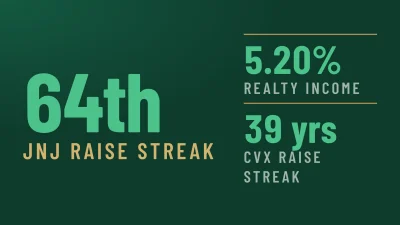
A quiet Sunday is a good time to look past the noise and study what actually lands in your account: cash dividends supported by real cash flow. The three companies below come from three different corners of the market (healthcare, net-lease real estate and integrated energy). Each one passes the same safety tests: a dividend covered by cash generation, a manageable balance sheet, and a payment record you can check line by line. The anchor of the group, Johnson & Johnson (NYSE:JNJ | JNJ Price Prediction), marked its 64th consecutive year of dividend increases with its latest raise. Pour a coffee and take your time with these.
Johnson & Johnson: A Healthcare Giant With a Raise Streak Few Can Match
Johnson & Johnson makes money in two ways. Its Innovative Medicine segment sells prescription drugs for cancer, immune diseases and brain disorders, and its MedTech segment sells heart devices, surgical tools, contact lenses and orthopaedic implants. In the third quarter, worldwide sales reached $25.4 billion, with Innovative Medicine contributing $16.8 billion and MedTech $8.6 billion. Management says the company is on track to top $100 billion in annual revenue for the first time in its 140-year history.
Yield: The quarterly dividend is $1.34, an annualized forward rate of $5.36. At a share price of $276.25, that works out to a yield of about 1.94%. The yield is modest partly because the stock has gained 51.06% over the past year.
Safety read: Updated guidance calls for adjusted EPS of $11.05 to $11.15, so the forward dividend uses roughly 48% of the midpoint. Free cash flow is guided to $21 billion for the year, and the third quarter alone produced more than $6 billion. The company held about $17 billion in cash against roughly $45 billion of debt, a net debt position near $28 billion for a company worth about $665B. The chief financial officer listed the ability to "increase our annual dividend" among the company’s core capital priorities.
Track record: The quarterly payout climbed from $1.19 in early 2024 to $1.24, then $1.30, and now $1.34, consistent with its Dividend King status.
Bull case: The drug pipeline is carrying the company past the loss of STELARA exclusivity. Oncology grew about 17% in the quarter, TREMFYA rose 68.2%, and the company now has 29 products and platforms making at least $1 billion a year. Chief Executive Joaquin Duato told analysts, "We have a clear path to double-digit growth by the end of the decade."
Risk: Talc litigation still hangs over the stock. The company agreed to a $5.5 billion ovarian talc resolution, but it requires participation from at least 95% of claimants. Related charges cut reported third-quarter EPS to $0.09, against adjusted EPS of $2.59.
Questions to research: Will the talc settlement reach its participation threshold? And what does the December 8, 2026 Enterprise Business Review say about the 2027 outlook and the plan to fix MedTech?
Realty Income: A Monthly Paycheck With 116 Straight Quarterly Raises
Realty Income (NYSE:O) is a landlord. It owns 15,536 properties rented to 1,842 clients across 96 industries, mostly on long-term net rented where tenants cover property-level expenses. The average remaining lease term is about 8.5 years, and occupancy is 98.8%. That combination of long contracts and full buildings is why the rent checks keep coming.
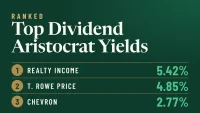
Yield: At $59.05 a share, Realty Income offers a high-yield 5.20%. The current monthly payment is $0.2715, an annualized $3.258, and the next one coming November 13.
Safety read: REITs are judged on adjusted funds from operations (AFFO), a cash-flow measure. Guidance calls for AFFO of $4.45 to $4.46 per share, so the annualized dividend uses about 73% of the low end. Chief Executive Sumit Roy said the "AFFO payout ratio, it’s amongst the lowest it has been in the history of Realty Income." The balance sheet carries a Fitch 'A' rating with a stable outlook, net debt of 5.4x EBITDA, and over 94% of its pro rata debt at fixed rates. Available liquidity stands at roughly $5.4 billion.
Track record: The company has declared 676 consecutive monthly dividends. It announced its 116th consecutive quarterly dividend increase in September, its 136th increase since its 1994 NYSE listing. It is part of to the S&P 500 Dividend Aristocrats index. The monthly payment has stepped up from $0.2695 a year ago to today’s $0.2715.
Bull case: Re-leased properties are renting at 103.5% of prior rent, and third-quarter investments earned a 6.8% initial cash yield at a spread of about 170 basis points over the cost of capital. Management also lowered its credit loss expectation to about 30 basis points.
Risk: Interest costs are climbing. Interest expense rose to $333.6M from $294.5M, and rising Treasury yields tend to weigh on REIT share prices.
Questions to research: Data centers made up 11.7% of new property investment in the quarter, and Europe drew $940.1 million. Are you comfortable with that shift away from a U.S. retail landlord? And how much of future AFFO growth depends on acquisitions versus built-in rent increases?
Chevron: Fortress Balance Sheet Behind 39 Years of Dividend Growth
Chevron (NYSE:CVX) pumps oil and natural gas, refines it into fuels and chemicals, and sells those products worldwide. Upstream operations produced about 3.98 million barrels of oil equivalent per day in the third quarter. U.S. refineries ran at a record 1.09 million barrels per day. Owning both the wells and the refineries helps smooth out cash flow when one side of the business weakens.
Yield: At $212.73, the stock yields 3.07%. The quarterly dividend is $1.78, or $7.12 annualized, payable December 10 to holders of record on November 18.
Safety read: Third-quarter adjusted EPS of $5.28 means the quarterly dividend took about 34% of that quarter’s adjusted earnings. Free cash flow reached $12.0B in the quarter. The balance sheet is conservative: debt-to-equity of 0.22, net debt of 0.94 times EBITDA, and interest coverage of 13.7x. Chevron cut debt by $3.5B and lowered net debt by $7.8B in the quarter.
Track record: Chief Financial Officer Eimear Bonner called dividend growth the company’s first priority: "We’ve done that for 39 consecutive years. We’ll continue to do that." The payment history backs her up: the quarterly payout rose from $1.42 in 2022 to $1.51, $1.63, $1.71 and now $1.78.
Bull case: Chevron hit its $3B structural cost reduction target six months early and is aiming for up to $4B by year end. The Hess integration delivered $1.5B in run-rate synergies, and U.S. production reached a record 2,077 MBOED. Lower costs raise the buffer under the dividend at any oil price.
Risk: Oil prices drive the cash. Brent averaged $97/bbl in the quarter against $69 a year earlier, and management noted prices swung between $68 and $132 a barrel within the quarter. Today’s free cash flow shows high prices that may not last.
Questions to research: Chevron releases a quarterly "Sensitivities and Forward Guidance" document. How much does earnings power shift with each move in Brent? And how much Venezuela exposure, where joint ventures plan to invest $7 billion over five years, fits your comfort level?
Three Paychecks, Three Engines, One Standard of Safety
Johnson & Johnson brings the longest raise run and a payout near half of adjusted earnings, while Realty Income delivers monthly income supported by an A-rated balance sheet and AFFO that covers its dividend. Chevron pairs a growing quarterly payout with the strongest free cash flow of the group. Each gets its cash from a different source, so together they give a retirement portfolio three dividend streams that hold up against one another’s weak spots.
Contact [email protected] for any questions or corrections.
Lee Jackson has covered Wall Street analysts' equity and debt research and equity strategy daily for 24/7 Wall St. since 2012. His broad, diverse career, including a stint as creative services director at an NBC affiliate in Austin, Texas, gives him unique insight into the financial industry.
Lee Jackson's journey in the financial industry spans more than 30 years, including nearly two decades as an institutional equity salesperson at Bear Stearns, Lehman Brothers, and Morgan Stanley. His career spanned pivotal sell-side Wall Street events, from the dot-com rise and bubble to the Long-Term Capital Management debacle, 9/11, and the Great Recession of 2008. This reflects his resilience and adaptability amid market volatility.
Lee Jackson’s practical financial industry experience, gained through a career at some of the biggest banks and brokerage firms, is complemented by a lifetime of writing across various platforms. This unique combination allows him to shed light on the intricacies of Wall Street in a way only someone with deep insider experience and knowledge can. Moreover, his extensive network across Wall Street continues to provide direct access for him and 24/7 Wall St., a privilege few firms enjoy.
Since 2012, Jackson’s work for 24/7 Wall St. has been featured in Barron’s, Yahoo Finance, MarketWatch, Business Insider, TradingView, Real Money, The Street, Seeking Alpha, Benzinga, and other media outlets. He attended the prestigious Cranbrook Schools in Bloomfield Hills, Michigan, and has a degree in broadcasting from the Specs Howard School of Media Arts.