A 68-Year-Old Swapped His Bond Funds for DIVO and GPIX in a $1.1 Million Portfolio. Here’s What Happened to His $6,700 Monthly Paycheck
A retiree dumps his safe bond funds to close a small income gap, and his paycheck climbs. But the swap quietly trades away the cushion that protects him when stocks fall, and a dividend cut is already on the way.

This post may contain links from our sponsors and affiliates, and Flywheel Publishing may receive compensation for actions taken through them.
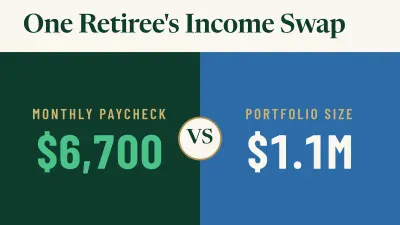
A 68-year-old retiree, an example case, reviews what his bond funds pay and decides it’s too little to generate the $6,700 a month he wants from his $1.1 million portfolio. He sells those broad, high-quality bond funds. Then he puts 20% into Amplify CWP Enhanced Dividend Income ETF (NYSEARCA:DIVO) and 20% into Goldman Sachs S&P 500 Premium Income ETF (NASDAQ:GPIX). His five other income holdings stay put. Every yield here shows current prices and payouts.
What the Swap Did to His Paycheck
We’ll use a broad U.S. investment-grade bond index fund to show what core bond funds pay. It yields about 4.3%. On the money he moved, that’s roughly $1,560 a month. Before the trade, his whole portfolio paid about $6,620 a month, so he was just short of his goal. It now pays about $7,560 a month, for a combined yield near 8.3%. DIVO and GPIX alone send him about $2,500. He nets $6,700.
Amplify CWP Enhanced Dividend Income ETF
DIVO has a short list of blue-chip dividend stocks like Caterpillar, Apple, and JPMorgan and sells covered calls on a few of them. With a covered call, the fund gets cash today for agreeing to sell a stock at an agreed-upon level if the stock rises past it. DIVO makes up 20% of his portfolio, yields about 4.9% and supplies 12% of his income. Last December’s oversized $0.95 payout makes its trailing yield look higher than what the monthly checks actually pay.
Goldman Sachs S&P 500 Premium Income ETF
GPIX holds S&P 500 stocks and sells index options for extra monthly income. It’s 20% of the portfolio, yields about 8.7% and delivers 21% of his income, the biggest share of any holding. Payments vary from month to month. Even so, it rises from $0.30 in late 2023 to about $0.39.
EPR Properties
EPR Properties (NYSE:EPR) is a real estate investment trust, or REIT. It has theaters, attractions, eat-and-play venues, and gyms, and it passes most of the rent to shareholders. It’s 15% of his portfolio. It yields about 6.3% on its $0.31 monthly dividend and supplies 11% of his income. EPR stopped paying from spring 2020 to summer 2021. When it resumed, it paid $0.25, down from $0.3825 before the pause. Some of those payments have included a return of capital, meaning part of the cash distributed may represent investors getting their own invested money back rather than income earned by the fund.
Blackstone Secured Lending
As a business development company, or BDC, Blackstone Secured Lending (NYSE:BXSL | BXSL Price Prediction) lends money to private companies. Its loans are 96% first-lien, which means it gets paid back first if a borrower fails. It’s 15% of its portfolio, yields about 10% on its new payout, and supplies 18% of its income. Earnings covered only 88% of the dividend, so it’s cutting the quarterly payout to $0.60 from $0.77 in 2027.
Energy Transfer
Energy Transfer (NYSE:ET) is a pipeline partnership running about 140,000 miles of pipe. It’s 15% of his portfolio, yields about 7.3% and covers 13% of his income. Its payout has gone up every quarter since early 2023. Back in late 2020, it was cut to $0.1525 from $0.305.
It sends a K-1 tax form, which is messier than a 1099. If he holds it in an IRA, his share of the partnership’s business income counts toward unrelated business taxable income (26 U.S.C. § 512(c)(1)). An IRA with $1,000 or more of that income must file Form 990-T, and the IRA custodian typically handles the filing.
Virtus Stone Harbor Emerging Markets Income Fund
Virtus Stone Harbor Emerging Markets Income Fund (NYSE:EDF) buys emerging-market debt. It’s a closed-end fund: it has a fixed number of shares that trade on an exchange, so the share price may trade above or below the value of the bonds it holds. Funds like this can also borrow to boost income, which makes losses bigger too.
It’s 10% of his portfolio, pays about 16% and supplies 20% of his income. Its monthly payout has shrunk from $0.18 before 2020 to $0.06.
Invesco Preferred ETF
Invesco Preferred ETF (NYSEARCA:PGX) holds preferred stock, mostly from financial companies. Preferred stock is a hybrid that pays a fixed dividend, and those dividends get paid ahead of common shareholders. It’s 5% of his portfolio, yields about 7.3%, and supplies 4% of his income. Preferreds trade like long-term bonds, so their prices drop when rates rise. PGX is down about 8% over the past year.
What He Traded for the Raise
Bond funds usually soften the blow when stocks fall. Over the past month, the S&P 500 dropped about 5% while the bond index fund gained about 3%. GPIX fell about 5% too. DIVO held up better and slipped less than 1%. He gave up that buffer in exchange for income that rises and falls with stocks. He also took on credit risk in BXSL and EDF, plus a dividend cut that’s already been announced.
Three Steps to Take Before Selling Bonds
The trade raised his paycheck from about $6,620 to about $7,560 a month. Anyone thinking about the same move should work through three steps first:
- Figure out how big a portfolio drop you could sit through without selling. This question matters more than any yield.
- Build the budget around BXSL’s lower $0.60 payout.
- Ask a tax preparer whether Energy Transfer belongs in an IRA or should be held outside one.
Contact [email protected] for any questions or corrections.
David Beren has been a Flywheel Publishing contributor since 2022. Writing for 24/7 Wall St. since 2023, David loves to write about topics of all shapes and sizes. As a technology expert, David focuses heavily on consumer electronics brands, automobiles, and general technology. He has previously written for LifeWire, formerly About.com. As a part-time freelance writer, David’s “day job” has been working on and leading social media for multiple Fortune 100 brands. David loves the flexibility of this field and its ability to reach customers exactly where they like to spend their time. Additionally, David previously published his own blog, TmoNews.com, which reached 3 million readers in its first year. In addition to freelance and social media work, David loves to spend time with his family and children and relive the glory days of video game consoles by playing any retro game console he can get his hands on.