The AI Chip Boom Has a Hidden Beneficiary. Here’s Where Its Stock Could Be by 2030
Credo's revenue more than doubled, yet its shares have lost a third of their value in a month. Customer concentration, a sky-high beta and a bold 2030 price target set up a stretch case that demands a closer look.

This post may contain links from our sponsors and affiliates, and Flywheel Publishing may receive compensation for actions taken through them.

Credo (NASDAQ:CRDO | CRDO Price Prediction) makes the connections that let AI chips talk to each other. Its active electrical cables, optical DSPs and silicon photonics sit inside hyperscaler clusters. Q1 fiscal 2027 revenue hit $479 million, up 114.7% YoY.
CEO Bill Brennan said: “Our portfolio now spans connectivity from millimeters to kilometers with solutions across optics and copper.” Even so, the stock is up just 0.8% year to date. Can Credo reach $500 by 2030?

What’s Holding Credo Back Right Now
The stock has been falling. Shares are down 13.37% over the past week and 33.66% over the past month. They closed at $150.90 on November 3, well below the 52-week high of $308.67.
Three pressure points stand out. The first is customer concentration.
The top four customers accounted for 33%, 28%, 13% and 10% of Q1 revenue. The second is an acquisition that lifted goodwill to $986.45 million from $92.8 million, and amortization of the acquired intangible assets is pressuring GAAP margins. The third is share-based compensation, which hit $87.98 million. With a beta of 3.25, any AI spending scare hits this stock harder than it hits the market.
Wall Street Sees $284. Our Model Is More Patient
The consensus target is $284.05, from 5 Strong Buys, 14 Buys, 1 Hold and 0 Sells. The base case is $206.69, or 36.97% upside, inside a one-year range of $168.03 to $332.89. Confidence in the model is high at 0.9.

Analysts are right about the direction but too aggressive on timing. With 95% of analysts bullish, sentiment has little room left to improve. Earnings growth adds only 0.03 to our factor. Over the longer term, our 2030 base case projects $348.03, and the bull case is $820.43.
Here’s What It Takes for Credo to Reach $500
A move to $500 from today’s price of $150.90 would need a gain of 231.3%. With forward EPS of $7.16, a price of $500 implies a forward P/E of 70x. The base case of $206.69 already implies 37x, so the bold target requires 33x of additional multiple expansion at today’s earnings.
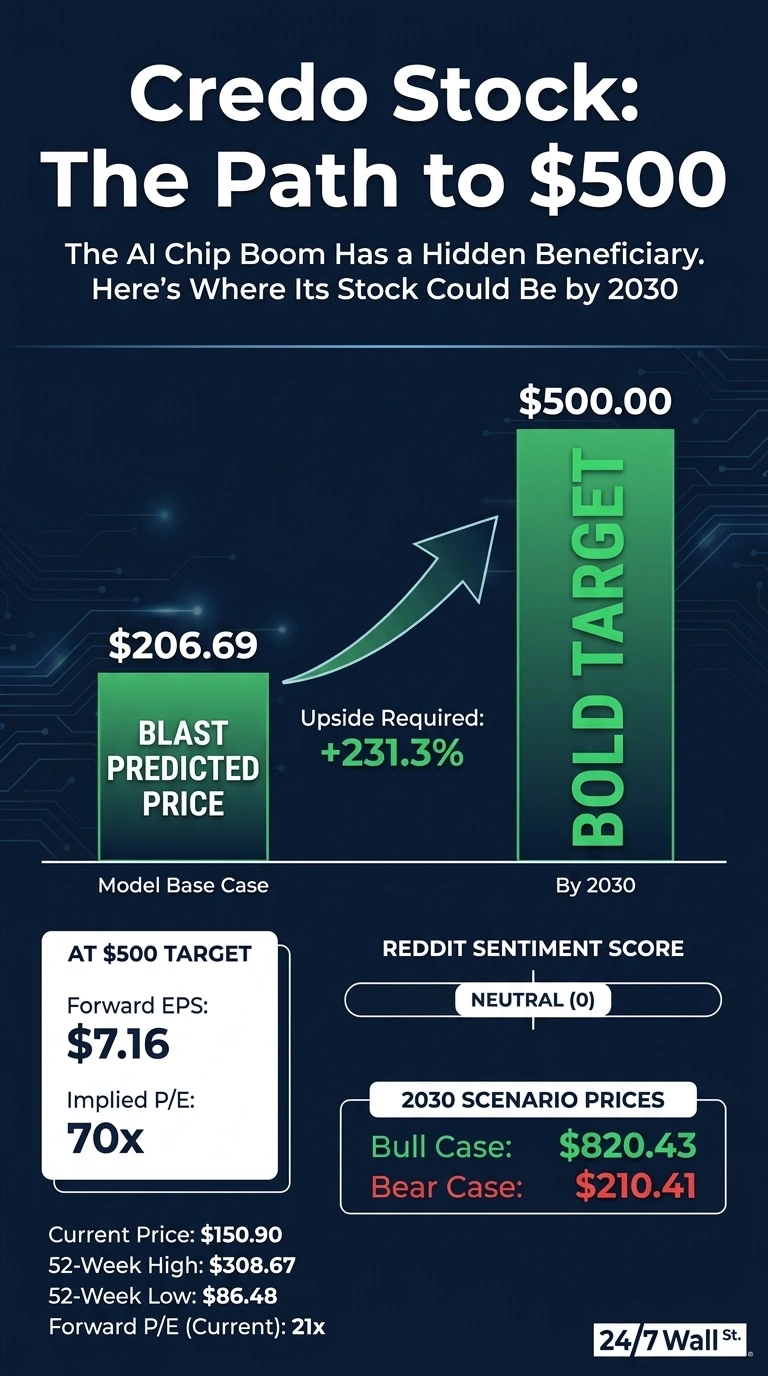
That multiple contracts as earnings grow. At 37x, $500 needs EPS of about $13.59. Fiscal 2026 EPS was $3.46, so the earnings path has been sharp.
Among the drivers, management expects more than $600 million in fiscal 2027 optical revenue, with ZeroFlap optics, silicon photonics PICs and optical DSPs each expected to top $100 million.
CFO Dan Fleming guided to “more than 85% year-over-year total revenue growth for the full year.” OmniConnect, which Brennan says could add “thousands of dollars of Credo content per GPU,” is expected to start generating revenue in fiscal 2028.
Concentration presents the biggest risk, because a pause from the customer behind 33% of revenue would hit results hard.
Credo Trades at 21x Forward Earnings After the Selloff
At $150.9, Credo trades at a forward P/E of 21x. The valuation seems cheap for a company guiding Q2 revenue to $525M-$535M.
Shares sit above the 52-week low of $86.48 and have gained 1144.98% since January 2022. Starting from a discounted multiple gives the bull case more room to work.
$500 Is a Stretch, but Here’s Why It’s Possible
Getting to $500 by 2030 requires a 231.3% gain. My verdict: it’s a stretch, sitting between our 2030 base and bull cases.
Three things need to happen. Optical revenue has to clear $600 million, OmniConnect and Active LED Cables have to start producing revenue in fiscal 2028, and the customer base has to broaden. A slowdown in hyperscaler AI spending would undermine the thesis. Returns at this level shouldn’t be expected every year, but we’ve outlined the plan for how Credo could reach $500 in 2030.
Contact [email protected] for any questions or corrections.
Vandita Jadeja is a financial publisher with over a decade of experience writing about financial topics, including investment, savings, retirement, insurance and banking. Vandita is a Chartered Accountant who loves to debunk financial concepts for readers.
Her work has appeared on sites that include The Motley Fool, InvestorPlace, and Benzinga. She covers investing and focuses on stock picks and price prediction for 24/7 Wall St.
When not looking for the next stock investment opportunity, she can be found traveling, reading, chasing sunsets and enjoying her iced latte.